Robert Reed - Marrow
Здесь есть возможность читать онлайн «Robert Reed - Marrow» весь текст электронной книги совершенно бесплатно (целиком полную версию без сокращений). В некоторых случаях можно слушать аудио, скачать через торрент в формате fb2 и присутствует краткое содержание. Год выпуска: 2000, ISBN: 2000, Издательство: Tor Books, Жанр: Фантастика и фэнтези, на английском языке. Описание произведения, (предисловие) а так же отзывы посетителей доступны на портале библиотеки ЛибКат.
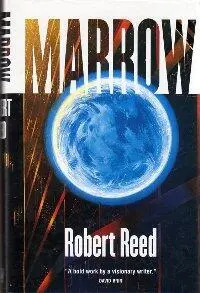
- Название:Marrow
- Автор:
- Издательство:Tor Books
- Жанр:
- Год:2000
- ISBN:0-312-86801-4
- Рейтинг книги:5 / 5. Голосов: 1
-
Избранное:Добавить в избранное
- Отзывы:
-
Ваша оценка:
Marrow: краткое содержание, описание и аннотация
Предлагаем к чтению аннотацию, описание, краткое содержание или предисловие (зависит от того, что написал сам автор книги «Marrow»). Если вы не нашли необходимую информацию о книге — напишите в комментариях, мы постараемся отыскать её.
Marrow — читать онлайн бесплатно полную книгу (весь текст) целиком
Ниже представлен текст книги, разбитый по страницам. Система сохранения места последней прочитанной страницы, позволяет с удобством читать онлайн бесплатно книгу «Marrow», без необходимости каждый раз заново искать на чём Вы остановились. Поставьте закладку, и сможете в любой момент перейти на страницу, на которой закончили чтение.
Интервал:
Закладка:
Her son made no comment.
“Twenty seconds,” she announced.
Till said, “Yes,” and politely looked up, those bright brown eyes squinting against the anticipated glare of the engines.
And with Till momentarily distracted, Miocene slipped away.
The room never changed.
Sitting along each wall, wearing the symbolic bodies and white togas of wizened old scribes, were dozens of sophisticated AIs. Each was a little different from its neighbor, in abilities and aesthetic sensibilities. In this realm, differences were a blessing. The reason for their existence was a single question—a question requiring utter concentration as well as a fondness for novelty. Every day or week or month, one of the scribes would propose some new solution, or a variation on an old solution, and with a boundless youth, the machines would discuss and debate, and occasionally shout at one another. Inevitably they would find some critical flaw in the elaborate mathematics, or the logical assumptions, and the proposal would be given a quick funeral, its corpse placed on an electronic shelf next to millions of failed hypotheses—proof of their zeal, if not their genius.
In the room’s center was a dense and extremely precise map of the ship. The map didn’t portray the ship as it was today, but the ship as it existed when the first captains arrived: Every vast chamber and long tunnel, tiny crevice and grand ocean, was displayed in all of its abandoned glory.
Yet a substantial, perhaps critical feature was missing.
Into that ignorance, the new Master appeared.
The AI scribes regarded her with a cold scorn. They were conservative souls, by nature. They didn’t approve of mutinies, even mutinies justified on legal grounds. With a machine’s humor, one scribe said, “Who are you? I don’t recognize you.”
The others laughed in low, disgusted voices.
Miocene said nothing for a long second. Then her image pretended to sigh, and in a passing fashion, she mentioned, “I can improve this map of yours. I know things that the old Master couldn’t have imagined.”
Doubt bled into interest.
Then, curiosity.
But one of the scribes shook its rubber face, warning her, “Your predecessor has to be put on trial. A fair and public trial, as mandated by the ship’s own laws. Otherwise we will not work with you.”
“Haven’t I promised trials?” she replied. “Examine my fife. Any profile you wish. When have I been anything but a champion of the ship’s laws?”
The scribes did as Miocene advised, and just as she expected, they grew bored. Her life wasn’t a puzzle. It held no interest for them. One after another, their gazes returned to their elaborate, mysterious map.
“If I give you this information,” she told them, “you cannot share it with anyone else. Is that understood?”
“We understand everything,” the first scribe warned.
“And if you find a possible solution, tell no one but me. Me.” She stared at each set of their glass eyes. “Can you embrace those terms?”
In a voice, they said, “Yes.”
Into the map, Miocene inserted the newest parameters: she drew the hyperfiber shell surrounding the core, then set Marrow inside the shell, and finally she showed what was inside Marrow. Then she caused Marrow to expand and contract, a flood of data explaining how energy cycled through the iron body, how the buttresses kept it firmly in place, and anything else of potential interest that she had absorbed over the horrible centuries.
In a fraction of a second, old faces grew enthralled.
Miocene felt the faint shudder as the ship’s engines began throwing plasma out into the cold, cold universe.
The physical portion of her sat beside her son, watching as he turned and showed her another good smile.
“It’s lovely, yes,” he admitted.
The plasma river was a wide column moving at near lightspeed, only a tiny portion of its energies given off as visible light, but still bright enough that the stunning glare caused the stars to vanish in their blinking, tearing eyes.
“May we leave now, madam?” he asked quietly, like a bored little boy.
The other part of her, the holoimage, was equally disappointed. She was surrounded by scribes who whispered at lightspeed, able to accomplish miracles inside an instant.
Then with a calm, knowing face, one of the scribes gave her a tentative and ridiculously simple solution to the great puzzle.
“That?” she cried out. “That’s your answer?”
The first scribe spoke for its peer, admitting, “That’s an artistic solution. Not a hard mathematical one. Madam.”
“Obviously.’Then as she vanished, she growled, “Tell no one, just the same. And keep working at it. Will you do that for me?”
“No,” the scribe replied, speaking to empty air.
“We do it for ourselves,” said its neighbors.
And they were whispering again, using those quick dessicated voices, their plaything-puzzle suddenly transformed, everything about their tiny universe made fascinating again, and inside this stuffy room, everything was enormous.
Forty
To watchful eyes, they were another anonymous repair crew: several dozen Remoras happily imprisoned inside their bulky lifesuits, sitting shoulder to shoulder inside one of their tough old skimmers, every face different from its neighbors’s faces, everyone telling good filthy Remoran jokes as they made their way toward the ship’s leading face.
“How many captains does it take to fuck?” one asked.
“Three,” the others shouted. “Two to do it, while the third captain hands out the appropriate awards and citations!”
“Where does the Master send her shit?” asked another.
Everyone pointed at the nearest of the rocket nozzles, then broke into a familiar, half-amused giggle.
Then Orleans leaned forward, asking, “What’s the difference between the new Master and the old one?”
There was an abrupt silence. Everyone knew the question, but nobody recognized the joke. Which wasn’t surprising, since the old man had just dreamed it up.
His newest mouth pulled into an enormous smile, short tusklike teeth tapping against the faceplate. “Any ideas? No?” Then he let off a big laugh, telling them, “Our new Master came back from the dead. While the old one was never alive.”
Polite, if somewhat nervous laughter gave way to silence.
Pivoting his helmet, Orleans showed his face to the crew. On a public channel, he told them, “It wasn’t very funny. You’re right.” But on a scrambled private channel, he said, “Don’t dwell on things.” He told them, “We’ll be dead soon enough. Relax.”
Nervousness mutated into a useful determination. No, they were thinking, they wouldn’t die. His crew’s outlook was betrayed by their straight-backed postures and defiant fists. These were mostly youngsters, and most still believed they could fool death by culturing a positive attitude along with their innate cleverness and deserved good fortune. “Not me,” each thought.’I won’t die today.” Then one after another, they turned their faces toward the rocket’s nozzle, looking at its vastness, and at the brilliant column of fight—the new Master’s farts—the light dwarfing everything else, splitting the universe neatly in two.
Only Orleans ignored the spectacle. He kept his amber eyes focused on the blisterlike buildings that flanked the wide roadway. In a rare mood, he found himself feeling sentimental, recalling that when he was a youngster, he thoroughly expected to be dead by now. Vaporized by an impact comet, probably. The idea that he could outlive everyone in his generation… well, it didn’t seem like a possibility then. Such an impossibly long life would prove a Remora’s cowardice, or at least a crippling sense of caution. Yet Orleans was neither a coward nor a worrier, and he had a sharp disrespect for luck, good and otherwise.
Читать дальшеИнтервал:
Закладка:
Похожие книги на «Marrow»
Представляем Вашему вниманию похожие книги на «Marrow» списком для выбора. Мы отобрали схожую по названию и смыслу литературу в надежде предоставить читателям больше вариантов отыскать новые, интересные, ещё непрочитанные произведения.







Обсуждение, отзывы о книге «Marrow» и просто собственные мнения читателей. Оставьте ваши комментарии, напишите, что Вы думаете о произведении, его смысле или главных героях. Укажите что конкретно понравилось, а что нет, и почему Вы так считаете.