Walter Tevis - Mockingbird
Здесь есть возможность читать онлайн «Walter Tevis - Mockingbird» весь текст электронной книги совершенно бесплатно (целиком полную версию без сокращений). В некоторых случаях можно слушать аудио, скачать через торрент в формате fb2 и присутствует краткое содержание. Город: London, Год выпуска: 2007, ISBN: 2007, Издательство: Gollancz, Жанр: Фантастика и фэнтези, на английском языке. Описание произведения, (предисловие) а так же отзывы посетителей доступны на портале библиотеки ЛибКат.
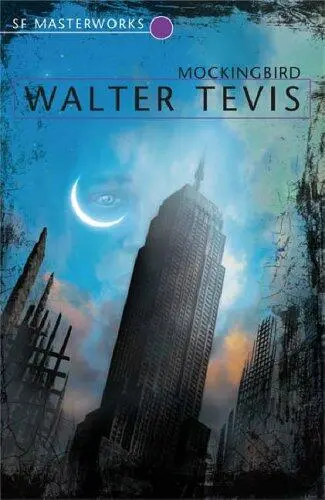
- Название:Mockingbird
- Автор:
- Издательство:Gollancz
- Жанр:
- Год:2007
- Город:London
- ISBN:978-0575079151
- Рейтинг книги:5 / 5. Голосов: 1
-
Избранное:Добавить в избранное
- Отзывы:
-
Ваша оценка:
Mockingbird: краткое содержание, описание и аннотация
Предлагаем к чтению аннотацию, описание, краткое содержание или предисловие (зависит от того, что написал сам автор книги «Mockingbird»). Если вы не нашли необходимую информацию о книге — напишите в комментариях, мы постараемся отыскать её.
Mockingbird
Review
From the Inside Flap “A moral tale that has elements of Aldous Huxley’s
,
, and
.”
—
“Set in a far future in which robots run a world with a small and declining human population, this novel could be considered an unofficial sequel to
, for its central event and symbol is the rediscovery of reading.”
—
“Because of its affirmation of such persistent human values as curiosity, courage, and compassion, along with its undeniable narrative power,
will become one of those books that coming generations will periodically rediscover with wonder and delight.”
—
“I’ve read other novels extrapolating the dangers of computerization but Mockingbird stings me, the writer, the hardest. The notion, the possibility, that people might indeed lose the ability, and worse, the desire to read, is made acutely probable.”
—
bestselling author ANNE MCCAFFREY “Walter Tevis is science fiction’s great neglected master, one of the definitive bridges between sf and literature. For those who know his work only through the movies, the lucid prose and literary vision of
and
will come as a revelation.”
—AL SARRANTONIO, Author of
saga
Mockingbird — читать онлайн бесплатно полную книгу (весь текст) целиком
Ниже представлен текст книги, разбитый по страницам. Система сохранения места последней прочитанной страницы, позволяет с удобством читать онлайн бесплатно книгу «Mockingbird», без необходимости каждый раз заново искать на чём Вы остановились. Поставьте закладку, и сможете в любой момент перейти на страницу, на которой закончили чтение.
Интервал:
Закладка:
I was too shocked to quarrel with him. I hadn’t really realized until then how far we had come.
And that leads me to this question: why am I writing this? And the answer is only that I have always wanted to. Back in school, learning to read, all of us thought we would someday write books and that somebody would read them. I know now that I waited too long to start this; but I’ll go on with it anyway.
That script, ironically, won the director an award. It told the story of a married woman who brings her husband, Claude, to a clinic because of impotence. While waiting for the doctors to assess Claude’s problem, she is hit in the face with an ashtray by a sex-starved young lesbian and goes into a coma, during which she has a religious awakening, with visions.
I remember getting drunk on mescaline and gin at the party where the award was given and trying to explain to a bare-breasted actress who sat on a sofa next to me that the only standards of the television industry were monetary, that there was no real motive in television beyond the making of money. She smiled at me all the time I talked, and occasionally ran her fingertips lightly across her nipples. And when I had finished she said, “But money is fulfillment too.”
I got her drunk and took her to a motel.
Writing a book, I feel as a Talmudic scholar or an Egyptologist might have felt at Disneyland in the twentieth century. Except, I suppose, I do not really have to wonder if there is anyone who wants to hear what I have to say; I know there is no bne. I can only wonder how many people are left alive who can read. Possibly a few thousand. A friend of mine who works part time as the head of a publishing house says the average book finds about eighty readers. I’ve asked him why they don’t stop publishing altogether. He says he frankly doesn’t know, but that his publishing company is such a tiny division of the recreation corporation that owns it that they have probably forgotten about its existence. He doesn’t know how to read himself; but he respects books because his mother had been a kind of recluse who read almost constantly, and he had loved her deeply. He is, by the way, one of the few people I know who were brought up in a family. Most of my friends have come out of the dormitories. I was reared in a kibbutz, out in Nebraska. But then I’m Jewish, and that, too, is a pretty rare thing these days: to be Jewish and to know it. I was one of the last members of the kibbutz; it was converted into a state-operated Thinker Dormitory when I was in my twenties.
I was born in 2137…
Reading that date I was immediately curious about how long ago Alfred Fain had lived, and I asked Bob. He said, “About two hundred years.”
Then I said, “Is there a date now? Does this year have a number?”
He looked at me coldly. “No,” he said. “There is no date.”
I would like to know the date. I would like for my child to have a birth date.
Bentley
DAY NINETY-FIVE
I am not so tired now. The work is getting easier to do, and I feel stronger.
I am sleeping better at nights, now that I have decided to take my sopors. And the food is passable now and I eat a great deal. More than I have ever eaten before in my life.
I do not exactly like the effect of sopors anymore; but they are necessary if I am to sleep properly. They stop some of the pain of my thoughts.
Today I tripped and fell between the rows of plants, and another prisoner who was nearby ran over and helped me up. He was a tall, gray-haired man whom I had noticed before because of the way he whistles at times.
He helped me brush myself off and then looked at me closely and said, “You all right, buddy?”
All of this was terribly intimate—almost obscene—but I did not mind, really. “Yes,” I said. “I’m all right.” And then one of the robots shouted, “No talking. Invasion of Privacy!” and the man looked at me, grinned broadly, and shrugged. We both went back to work. But as he walked away I heard him mutter, “Stupid goddamn robots!” and I was shocked at the strength of unashamed feeling in his voice.
I have seen other prisoners whispering together in the rows. It is often several minutes before a robot notices and stops them.
The robots walk between the rows with us; but they stop before going close to the low cliff at the end of the field. Perhaps they are programmed that way so they will not fall—or be pushed—over the cliff. Anyway they are far enough back by the time I arrive at the seaward end of the row so that there is a short time when they cannot see me, because of a dip in the ground before it comes to the edge of the cliff.
I have learned to speed up, doing two squirts of the gun to each beat of music, toward the end of each row. This gives me time to stand at the edge of the ocean for sixteen beats—and I am thankful I learned to determine this from Arithmetic jor Boys and Girls . I stand and look out over the ocean. It is wonderful to look at— broad and huge and serene. Something deep in my self seems to respond to it, with a feeling I cannot name. But I am learning again to welcome strange feelings. Sometimes there are birds over the ocean, their curved wings outspread, sailing in the air in smooth broad arcs, above my world of men and machines, inscrutable, and breathtaking to see. Looking at them I say sometimes to myself a word I learned from a film: “Splendid!”
I said I am learning to welcome strange feelings, and this is true. How different I now seem from what I was, far less than a yellow ago, when I first began to feel those feelings while watching silent films at my bed-and-desk. I know that I am being disobedient to all that I was taught about feelings toward things outside myself when I was a child, but I do not care. In fact, I enjoy doing what was forbidden once.
I have nothing to lose.
I think the ocean means most to me on rain days, when the water and sky are gray. There is a sandy beach below the cliff; its tan color looks beautiful against the gray water. And the white birds in the gray sky! My heart beats noticeably when I even imagine it, here in my cell. And it is sad, like the horse with the hat on its head in the old film, like King Kong falling—so slowly, so softly, so far—and like the words that I now say aloud: “Only the mockingbird sings at the edge of the woods.” Like remembering Mary Lou, cross-legged on the floor, her eyes on her book.
Sadness. Sadness. But I will embrace the sadness, and make it a part of this life that I am memorizing.
I have nothing to lose.
DAY NINETY-SEVEN
An astonishing thing happened today, out in the field.
I had been working for about two hours; it was nearly time for the second break. I heard a rustling sound behind me where the robot overseer normally stood and I looked around and there the robot was, staggering jerkily in the row. Just as I looked his heavy foot came down on a Protein 4 plant. The plant split open with a disgusting noise and covered his foot with purple juice.
The robot’s mouth was grimly set and his eyes stared upward. He staggered for a few more moments, stepped on another plant, and then stood completely still for a moment, as if dormant. Then he fell flat to the ground like a dead weight. The other robot walked over to him, looked down at his inert body, and said, “Rise.” But the other did not move. The standing robot bent down and picked up the fallen one and began to carry him back toward the prison buildings.
A minute, later I heard a loud voice in the field shout, “Malfunction, boys!” There were the sounds of running. I looked in astonishment and saw a group of blue-uniformed prisoners running between the rows and then, suddenly, there was an arm around my shoulder—a thing that had never happened before in my life: a stranger putting an arm around my shoulder!—and it was the man with gray hair and he was saying, “Come on, buddy! To the beach,” and I found myself running, following him. And I was feeling frightened. Frightened but good.
Читать дальшеИнтервал:
Закладка:
Похожие книги на «Mockingbird»
Представляем Вашему вниманию похожие книги на «Mockingbird» списком для выбора. Мы отобрали схожую по названию и смыслу литературу в надежде предоставить читателям больше вариантов отыскать новые, интересные, ещё непрочитанные произведения.







Обсуждение, отзывы о книге «Mockingbird» и просто собственные мнения читателей. Оставьте ваши комментарии, напишите, что Вы думаете о произведении, его смысле или главных героях. Укажите что конкретно понравилось, а что нет, и почему Вы так считаете.