Walter Tevis - Mockingbird
Здесь есть возможность читать онлайн «Walter Tevis - Mockingbird» весь текст электронной книги совершенно бесплатно (целиком полную версию без сокращений). В некоторых случаях можно слушать аудио, скачать через торрент в формате fb2 и присутствует краткое содержание. Город: London, Год выпуска: 2007, ISBN: 2007, Издательство: Gollancz, Жанр: Фантастика и фэнтези, на английском языке. Описание произведения, (предисловие) а так же отзывы посетителей доступны на портале библиотеки ЛибКат.
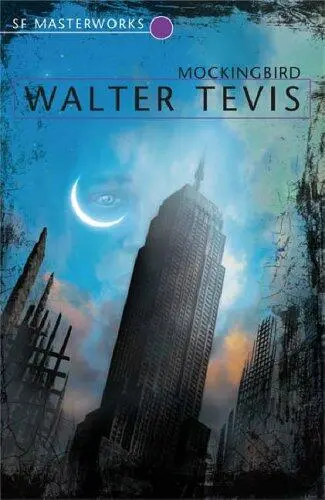
- Название:Mockingbird
- Автор:
- Издательство:Gollancz
- Жанр:
- Год:2007
- Город:London
- ISBN:978-0575079151
- Рейтинг книги:5 / 5. Голосов: 1
-
Избранное:Добавить в избранное
- Отзывы:
-
Ваша оценка:
Mockingbird: краткое содержание, описание и аннотация
Предлагаем к чтению аннотацию, описание, краткое содержание или предисловие (зависит от того, что написал сам автор книги «Mockingbird»). Если вы не нашли необходимую информацию о книге — напишите в комментариях, мы постараемся отыскать её.
Mockingbird
Review
From the Inside Flap “A moral tale that has elements of Aldous Huxley’s
,
, and
.”
—
“Set in a far future in which robots run a world with a small and declining human population, this novel could be considered an unofficial sequel to
, for its central event and symbol is the rediscovery of reading.”
—
“Because of its affirmation of such persistent human values as curiosity, courage, and compassion, along with its undeniable narrative power,
will become one of those books that coming generations will periodically rediscover with wonder and delight.”
—
“I’ve read other novels extrapolating the dangers of computerization but Mockingbird stings me, the writer, the hardest. The notion, the possibility, that people might indeed lose the ability, and worse, the desire to read, is made acutely probable.”
—
bestselling author ANNE MCCAFFREY “Walter Tevis is science fiction’s great neglected master, one of the definitive bridges between sf and literature. For those who know his work only through the movies, the lucid prose and literary vision of
and
will come as a revelation.”
—AL SARRANTONIO, Author of
saga
Mockingbird — читать онлайн бесплатно полную книгу (весь текст) целиком
Ниже представлен текст книги, разбитый по страницам. Система сохранения места последней прочитанной страницы, позволяет с удобством читать онлайн бесплатно книгу «Mockingbird», без необходимости каждый раз заново искать на чём Вы остановились. Поставьте закладку, и сможете в любой момент перейти на страницу, на которой закончили чтение.
Интервал:
Закладка:
There was a place where the cliff was low and there was a cleft in the rock where you could climb down worn old steps, themselves made of rock. As I was going down with the others, astonished at the back-slapping and friendly shouting among them— a thing I had never seen even as a child—I noticed a strange thing on one of the cliff rocks beside the stairs. There was writing, in faded white paint. It said: “John loves Julie. Class of ’94.”
Everything was so strange that I felt almost hypnotized by it. Men were saying things to one another and laughing, just as in pirate films. Or, for that matter, in some prison films. But seeing it in a film and then actually seeing it happen are two very different things.
And yet, thinking about it now in my cell, I can see that I was not as upset as I might have been, possibly because I had seen such intimacy in the films.
Some of the men gathered together pieces of driftwood and built a fire on the beach. I had never seen an open fire before and I liked it. Then some of the men actually took off their clothes, ran laughing down the beach and into the water. Some splashed and played in the shallow waters; others went out deeper and began to swim, just as though they were in a Health and Fitness pool. I noticed that they stayed in little groups, both those who were playing and those swimming, and they seemed to want it that way.
The rest of us sat in a circle around the fire. The gray-haired man pulled a joint from his shut pocket and took a twig from the fire and lit it. He seemed to be accustomed to fires—in fact, all of them seemed to have done this many times before.
One man, smiling, said to the man next to nun, “Charlie, how long since the last malfunction?” and Charlie said, “It’s been a while. We were overdue.” And the other laughed and said, “Yeah!”
The gray-haired man came over and sat by me. He offered me the joint but I shook my head, so he shrugged and gave it to the man on the other side of me. Then he said, “We’ve got at least an hour. Repair on robots is slow here.”
“Where are we?” I asked.
“I’m not sure,” he said. “Everybody gets knocked out in court and they don’t wake him up till he gets here. But one guy told me once he thought it was North Carolina.” He spoke to the man who had taken the joint. The man was passing it to the next man. “Is that right, Foreman? North Carolina?”
Foreman turned around. “I heard South,” he said, “South Carolina.”
“Well, somewhere in there,” the gray-haired man said.
For a while we were all silent around the fire, watching its flames in the afternoon air, listening to the sound of the surf against the beach and hearing the occasional cry of a gull overhead. Then one of the older men spoke to me. “What they put you in for? Kill somebody?”
I was embarrassed and didn’t know what to say. He would not have understood about reading. “I was living with someone,” I said finally. “A woman…”
The man’s face brightened for a moment and then almost immediately went sad. “I lived with a woman once. For over a blue.”
“Oh?” I said.
“Yeah. A blue and a yellow. At least. That isn’t what they put me here for, though. Shit, I’m a thief is why. But I sure do remember…” He was wrinkled and thin and bent; there were only a few hairs on his head, and his hands shook as he took the joint and inhaled from it and then passed it to the younger man next to him.
“Women,” the gray-haired man beside me said, breaking the silence.
Something about that one word seemed to open up the older man. “I used to fix coffee for her,” he said, “and we’d drink it in bed. Real coffee with real milk in it, and sometimes when I could find it a piece of fruit. An orange, maybe. She’d drink that coffee out of a gray mug and I’d just sit at the other end of the bed facing her and pretend to be thinking about my own coffee but what I was really doing was watching her. God, I could watch that woman.” He shook his head.
I could feel his sadness. There were goose bumps on my arms and legs from hearing him talk like that. I had never heard another person speak for me like that before. He had said what I felt and, sad as I was, there was relief for me in it.
Someone else said softly, “What become of her?”
For a while the old man didn’t answer. Then he said, “Don’t know. One day I come home from the mill and she wasn’t there. Never saw her again.”
There was silence for a moment and then one of the younger prisoners spoke up. He was trying, I suppose, to be helpful. “Well, quick sex is best,” he said philosophically.
The old man turned his head slowly and stared at the man who had just spoken. And then he said to him, strongly and evenly, “Fuck that. You can just fuck that.”
The younger man looked flustered, and turned his face away. “I didn’t mean…”
“Fuck it,” the old man said. “Fuck your quick sex. I know what my life’s been like.” Then he turned toward the ocean again and said softly, repeating himself, “I know what my life’s been like.”
Hearing this and seeing the way the old man looked toward the ocean with his thin shoulders squared under his faded blue prison shirt and the breeze blowing the few wisps of hair on his old, tight-skinned head, I felt such sadness that it was beyond tears. And I was thinking of Mary Lou and of the way she had looked, in the mornings sometimes, drinking tea. Or of her hand on the back of my neck and the way that, sometimes, she would stare at me and stare, and then smile…
I must have sat there thinking these things about Mary Lou and feeling my own grief for a long while, looking out toward the ocean, past the old man. And then I heard the gray-haired man next to me say softly, “You wanta swim?” I looked up at him, startled, and said, “No,” perhaps too quickly. But the thought of getting naked with all those strangers had brought me back to the present with a start.
Yet I love to swim.
In the Thinker Dormitories, each child has the pool to himself for ten minutes. Dormitories are very strict about Individualism.
I was thinking about this when the gray-haired man suddenly said, “My name’s Belasco.”
I looked down at the sand at my feet. “Hello,” I said.
And then, a moment later, he said, “What’s your name , buddy?”
“Oh,” I said, still looking at the sand. “Bentley.” And I felt his hand on my shoulder and looked up, startled, at his face. He was grinning at me. “Good to know you, Bentley,” he said.
After a while I got up and walked down to the water’s edge but away from the swimmers. I know that I have changed much since I left Ohio; but all that intimacy and feeling were more than I could stand at once. And I wanted to be alone with my thoughts of Mary Lou.
At the water’s edge I found a hermit crab, in a small, curled whelk shell. I knew it was a hermit crab from a picture in a book Mary Lou had found: Seashore Creatures of North America .
There was a strong, briny, clean smell along the edge of the water, and the waves, gently rolling in along the wet sands, made a sound like I had never heard before. I stood there in the sun watching, and smelling the smell, and listening to the water-sound, until Belasco’s voice called me back. “Time to go, Bentley. They’ll have him fixed before long.”
We all climbed silently up the stairs and went back to our positions in the field and waited.
After a while the robots came back. They did not notice that we had made no progress in their absence. Stupid robots.
I bent to work, in time to music.
When I got to the seaward end of the row, I looked down at the beach. Our fire was still burning.
Читать дальшеИнтервал:
Закладка:
Похожие книги на «Mockingbird»
Представляем Вашему вниманию похожие книги на «Mockingbird» списком для выбора. Мы отобрали схожую по названию и смыслу литературу в надежде предоставить читателям больше вариантов отыскать новые, интересные, ещё непрочитанные произведения.






Обсуждение, отзывы о книге «Mockingbird» и просто собственные мнения читателей. Оставьте ваши комментарии, напишите, что Вы думаете о произведении, его смысле или главных героях. Укажите что конкретно понравилось, а что нет, и почему Вы так считаете.