Walter Tevis - Mockingbird
Здесь есть возможность читать онлайн «Walter Tevis - Mockingbird» весь текст электронной книги совершенно бесплатно (целиком полную версию без сокращений). В некоторых случаях можно слушать аудио, скачать через торрент в формате fb2 и присутствует краткое содержание. Город: London, Год выпуска: 2007, ISBN: 2007, Издательство: Gollancz, Жанр: Фантастика и фэнтези, на английском языке. Описание произведения, (предисловие) а так же отзывы посетителей доступны на портале библиотеки ЛибКат.
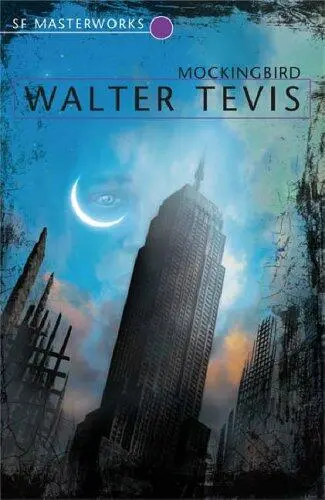
- Название:Mockingbird
- Автор:
- Издательство:Gollancz
- Жанр:
- Год:2007
- Город:London
- ISBN:978-0575079151
- Рейтинг книги:5 / 5. Голосов: 1
-
Избранное:Добавить в избранное
- Отзывы:
-
Ваша оценка:
Mockingbird: краткое содержание, описание и аннотация
Предлагаем к чтению аннотацию, описание, краткое содержание или предисловие (зависит от того, что написал сам автор книги «Mockingbird»). Если вы не нашли необходимую информацию о книге — напишите в комментариях, мы постараемся отыскать её.
Mockingbird
Review
From the Inside Flap “A moral tale that has elements of Aldous Huxley’s
,
, and
.”
—
“Set in a far future in which robots run a world with a small and declining human population, this novel could be considered an unofficial sequel to
, for its central event and symbol is the rediscovery of reading.”
—
“Because of its affirmation of such persistent human values as curiosity, courage, and compassion, along with its undeniable narrative power,
will become one of those books that coming generations will periodically rediscover with wonder and delight.”
—
“I’ve read other novels extrapolating the dangers of computerization but Mockingbird stings me, the writer, the hardest. The notion, the possibility, that people might indeed lose the ability, and worse, the desire to read, is made acutely probable.”
—
bestselling author ANNE MCCAFFREY “Walter Tevis is science fiction’s great neglected master, one of the definitive bridges between sf and literature. For those who know his work only through the movies, the lucid prose and literary vision of
and
will come as a revelation.”
—AL SARRANTONIO, Author of
saga
Mockingbird — читать онлайн бесплатно полную книгу (весь текст) целиком
Ниже представлен текст книги, разбитый по страницам. Система сохранения места последней прочитанной страницы, позволяет с удобством читать онлайн бесплатно книгу «Mockingbird», без необходимости каждый раз заново искать на чём Вы остановились. Поставьте закладку, и сможете в любой момент перейти на страницу, на которой закончили чтение.
Интервал:
Закладка:
My way of getting used to being with Bob, after he insisted that we live together, was to ask him questions about the way things worked. He seemed to enjoy answering them.
I asked him why it was that thought buses weren’t driven by robots.
“The real idea,” he said, “was to make the ultimate machine. It was the same kind of idea that had led to me—to my kind of robot.”
“What’s ultimate about a thought bus?” I said. They seemed to me such ordinary things, always around, with their comfortable seats and with never more than three or four passengers. Sturdy, gray, four-wheeled aluminum vehicles and one of the few mechanical things that always worked and that did not require a credit card to use.
Bob was sitting in a dusty Plexiglas armchair in the kitchen of our apartment; I was boiling synthetic eggs at the nuclear stove, on the one burner that worked. Over the stove a portion of the wall covering had fallen away years before to reveal copies of a green-jacketed book that had been nailed there by some long-gone former tenants, for insulation,
“Well, they always work , for one thing,” he said grimly. “They don’t need spare parts. The brain of a thought bus is so good at finding wear and stress points in the machinery, and making critical adjustments to distribute the wear and tear, that it just wasn’t necessary to make any.” He was looking out the window, at snow falling. “My body works the same way,” he said. “I don’t need spare parts either.” He became silent.
He seemed to have drifted off the point. I had noticed him doing it before and had called it to his attention. “Just getting senile,” he had said. “Robot brains wear out like anybody else’s.” But apparently, thought-bus brains did not wear out.
I think Bob is too obsessed by that dream of his, and by his attempt to “resurrect his lost self”—the attempt that led him to send Paul away and take me as his wife. Bob wants to find out whose brain he has and to recover its memories. I think it’s impossible. I think he knows it’s impossible. The brain he has is an erased copy of a very intelligent person’s brain. Erased completely, except for a few old dreams.
I’ve told him he should let it go. “When in doubt, forget it,” as Paul says. But he says it’s the only thing that keeps him sane—that interests him. In their first ten blues Make Nines had burned out their own circuits with household current and transformers, had smashed their brains in heavy plant equipment, or had merely freaked out and begun to drool like idiots, or had become erratic, screaming lunatics—had drowned themselves in rivers and buried themselves alive in agricultural fields. No more robots were made after the Make Nine series. Never.
Bob has a way, when he is thinking, of running his fingers through his black, kinky hair, over and over again. It is a very human gesture. I certainly have never seen another robot do it. And sometimes he whistles .
He told me once that he remembered part of a line of a poem from his brain’s erased memory. It went: “Whose ‘something’ these are I think I know…” But he could not remember what the “something” was. A word like “tools” or “dreams.” Sometimes he would say it that way:
“Whose dreams these are I think I know…” But it did not satisfy him.
I asked him once why he thought he was any different from the other Make Nines, when he told me that as far as he knew none of the others had shared these “memories.” What he said was: “I’m the only black one.” And that was all.
When he drifted off like that on that snowy afternoon in our kitchen, I brought him back by asking, “Is self-maintenance the only ‘ultimate’ thing about a thought bus?”
“No,” he said, and ran his fingers through his hair. “No.” But instead of going on right away he said, “Get me a marijuana cigarette, will you, Mary?” He always calls me “Mary” instead of Mary Lou.
“Okay,” I said. “But how can dope work on a robot?”
“Just get it,” he said.
I got a joint from a package in my bedroom. They were a mild brand, called Nevada Grass, that were delivered with the Pro-milk and synthetic eggs twice a week to the people in the apartment complex where we live. The people who have, as most of us do, the use of the yellow credit card. I say “people” because Bob is the only robot who lives here. He commutes to work by thought bus and is gone six hours a day. Most of that time I read books, or ancient magazines on microfilm. Bob brings me books from work almost every day. He gets them from some archives building that is even older than the one I lived in with Paul. He brought me a microfilm projector after I asked him once if there were other things to read besides books. Bob can be very helpful—although, come to think of it, I believe all robots were originally programmed that way: to help people.
I am certainly wandering in this account, in this continuation of my plan to memorize my life. Maybe I’m getting senile—like Bob.
No, I’m not senile. I’m just excited to be memorizing my life again. Before I started this I was merely bored—as bored as I had been after Simon died in New Mexico, as bored and freaky as I was getting at the Bronx Zoo before Paul first showed up, looking so childlike and simple, and appealing…
I’d better quit thinking about Paul.
I brought Bob his joint and he lit it and inhaled deeply. Then, trying to be friendly, he said, “Don’t you ever smoke? Or take pills?”
“No,” I said. “They make me sick, physically. And I don’t like the idea of them anyway. I like being wide awake.”
“Yes, you do,” he said. “I envy you.”
“Why envy me?” I said. “I’m human and subject to diseases, and aging, and broken bones…”
He ignored that. “I was programmed to be wide awake and fully aware twenty-three hours a day. It has only been in the last few years, since I’ve begun to allow myself to concentrate on thinking about my dreams, about my former personality and its erased feelings and memories, that I’ve learned to… to relax my mind and let it wander.” He took another puff from the joint. “I never liked being wide awake. I certainly don’t like it now.”
I thought about that for a minute. “I doubt if that marijuana could affect a metal brain. Why don’t you try programming yourself for a high? Can’t you alter some circuits somewhere and make yourself euphoric, or drunk?”
“I tried it. Back in Dearborn. And later, when I was first assigned by Government to this nonsense of being a university dean. The second time I tried harder than the first because I was furious at the pretense of learning that the university was committed to— the learning of nothing by students who come here to learn nothing except some kind of inwardness. But I didn’t get high. I got hung-over.”
He stood up from his chair and walked over to the window and watched the snow for a while. I took my eggs off the fire and began to peel them.
Then he spoke again. “Maybe it was the buried memory of a classical education in my brain that made me feel so furious. Or maybe it was just that I had been really trained to do my job. I know and understand engineering. Not one of my students knows any of the laws of thermodynamics or vector analysis or solid geometry or statistical analysis. I know all these disciplines and more. They are not on magnetic memories built into my brain, either. I learned them by playing library tapes over and over again, studying along with every other Make Nine robot, in Cleveland. And I learned to be a Detector…” He shook his head, and turned away from the window to face me. “But that doesn’t matter anymore, either. Your father was right. There aren’t many working Detectors anymore. There is no need for them. When the children stopped being born…”
Читать дальшеИнтервал:
Закладка:
Похожие книги на «Mockingbird»
Представляем Вашему вниманию похожие книги на «Mockingbird» списком для выбора. Мы отобрали схожую по названию и смыслу литературу в надежде предоставить читателям больше вариантов отыскать новые, интересные, ещё непрочитанные произведения.





Обсуждение, отзывы о книге «Mockingbird» и просто собственные мнения читателей. Оставьте ваши комментарии, напишите, что Вы думаете о произведении, его смысле или главных героях. Укажите что конкретно понравилось, а что нет, и почему Вы так считаете.