Walter Tevis - Mockingbird
Здесь есть возможность читать онлайн «Walter Tevis - Mockingbird» весь текст электронной книги совершенно бесплатно (целиком полную версию без сокращений). В некоторых случаях можно слушать аудио, скачать через торрент в формате fb2 и присутствует краткое содержание. Город: London, Год выпуска: 2007, ISBN: 2007, Издательство: Gollancz, Жанр: Фантастика и фэнтези, на английском языке. Описание произведения, (предисловие) а так же отзывы посетителей доступны на портале библиотеки ЛибКат.
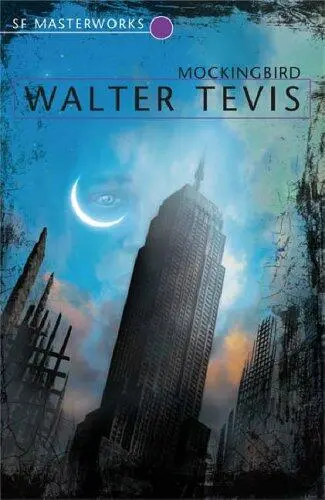
- Название:Mockingbird
- Автор:
- Издательство:Gollancz
- Жанр:
- Год:2007
- Город:London
- ISBN:978-0575079151
- Рейтинг книги:5 / 5. Голосов: 1
-
Избранное:Добавить в избранное
- Отзывы:
-
Ваша оценка:
Mockingbird: краткое содержание, описание и аннотация
Предлагаем к чтению аннотацию, описание, краткое содержание или предисловие (зависит от того, что написал сам автор книги «Mockingbird»). Если вы не нашли необходимую информацию о книге — напишите в комментариях, мы постараемся отыскать её.
Mockingbird
Review
From the Inside Flap “A moral tale that has elements of Aldous Huxley’s
,
, and
.”
—
“Set in a far future in which robots run a world with a small and declining human population, this novel could be considered an unofficial sequel to
, for its central event and symbol is the rediscovery of reading.”
—
“Because of its affirmation of such persistent human values as curiosity, courage, and compassion, along with its undeniable narrative power,
will become one of those books that coming generations will periodically rediscover with wonder and delight.”
—
“I’ve read other novels extrapolating the dangers of computerization but Mockingbird stings me, the writer, the hardest. The notion, the possibility, that people might indeed lose the ability, and worse, the desire to read, is made acutely probable.”
—
bestselling author ANNE MCCAFFREY “Walter Tevis is science fiction’s great neglected master, one of the definitive bridges between sf and literature. For those who know his work only through the movies, the lucid prose and literary vision of
and
will come as a revelation.”
—AL SARRANTONIO, Author of
saga
Mockingbird — читать онлайн бесплатно полную книгу (весь текст) целиком
Ниже представлен текст книги, разбитый по страницам. Система сохранения места последней прочитанной страницы, позволяет с удобством читать онлайн бесплатно книгу «Mockingbird», без необходимости каждый раз заново искать на чём Вы остановились. Поставьте закладку, и сможете в любой момент перейти на страницу, на которой закончили чтение.
Интервал:
Закладка:
Since I am trained at Mental Arts it is easy for me to spend much of the shoe-inspection time in gentle hallucinating, but I am dismayed at times to find that there is one aspect of my hallucinations over which I have no control; images of Mary Lou will come, with shocking vividness, into my mind. I will be trying to amuse myself with hallucinated abstractions—colors and free-form shapes—when, without warning, I will see Mary Lou’s face, with that intense and puzzled stare. Or Mary Lou sitting cross-legged on the floor of my office with a book in her lap, reading.
When I was teaching, I used to make a little joke during my hallucinating-to-orgasm lecture. I would say to my classes, “This would be a good technique to learn in case you are ever sent to prison.” It never got much of a laugh, since I suppose you have to be well-educated in Classics—James Cagney films, for instance—to understand the prison reference. Anyway, that was a joke I used to make. But I do not now hallucinate to orgasm—even though I am expert at the technique. At night in my cell I masturbate—as I suppose the other prisoners do. I want to save my most intimate thoughts of Mary Lou for when I am alone at night.
We are given two joints and two sopors with our evening meal but I have been saving mine. After supper I can smell the sweet smell of marijuana in the big prison dormitory and hear the music of erotic TV coming from the other cells, and imagine the synthetic bliss on the faces of the other prisoners. Somehow the thought of that, writing it now, makes me shudder. I want Mary Lou here with me. I want to hear her voice. I want to laugh with her. I want her to comfort me.
A year ago I would not have known what I was feeling. But after all those films I know what it is: I am in love with Mary Lou.
It feels terrible. Being in love feels terrible.
I don’t know where this prison is. Somewhere by the ocean. I was brought here unconscious and woke to find myself being given a blue uniform by a robot. I could not sleep the first night, wanting her with me.
I want her. Nothing else is real.
DAY NINETY-ONE
In the afternoons I work in a field at the edge of the ocean. The field is vast, with about two miles of shoreline; it is full of a coarse synthetic plant called Protein 4. The plants are big ugly things, about the size and shape of a man’s head, purple-green in color and with a rancid smell. Even out in the sunny fields, the smell is sometimes almost overpowering. My job is feeding them individually with chemicals that are prescribed by a computer each day. I have a little squirt gun that is loaded with pellets by a computer terminal at the end of each long row, and I hold it to a little plastic mouth that is imbedded in the yellow soil at the base of each plant and squeeze a pellet in.
It is backbreaking to do, under the hot sun, keeping up the fast tempo that is created by the constant music in the field. Forty of us work there, with a five-minute break each hour. We all perspire constantly.
Ten moron robots could do this work. But we are being rehabilitated.
Or that is what the television we must watch during our after-lunch social time tells us. We are not allowed to talk during social time, so I do not know if the others feel as angry as I do, and as weary.
Two robots in brown uniforms watch over us while we work. They are short, heavy, and ugly, and whenever I look toward the one who has beaten me he seems to be staring at me, unblinking, with his android’s mouth hanging slightly open, as if he is about to drool.
My hand is still so tired and sore from squeezing the trigger on that pistol that I cannot write any more.
Mary Lou. I only hope that you are not as unhappy as I. And I hope that you think of me, from time to time.
Mary Lou
ONE
Reading gets to be a bore sometimes, but every now and then I find out something that I enjoy knowing about. I’m sitting in an armchair by the window as I write this, holding a board in my lap to write on, and for a long time before starting I just sat and stared at the snow coming down. Big, heavy, clumped-together flakes falling straight down from the sky. Bob has told me to take it easy so I won’t get a backache from carrying around this stuck-out belly. So I watched the snow for a long time. And I began to think of something I’d read a few days ago about the water cycle, about how the whole elaborate business of evaporation and condensation and winds and air really works. I watched the snow coming down and thought about how those white clumps had recently been the surface water of the Atlantic Ocean, turned to vapor by the heat of the sun. I could visualize clouds moving together far above the water, and the water in them crystallizing into snowflakes, and those flakes falling and clumping and falling further until I could see them, outside this window in New York.
Something makes me feel very good about just knowing things like that.
When I was a little girl Simon talked to me about things like the water cycle and the precession of the equinoxes. He had an old piece of blackboard and chalk; I remember him drawing me a picture of the planet Saturn with its rings. When I asked him how he knew about such things he told me he had learned them from his father. His grandfather had, as a boy, looked at the night sky through a celestial telescope, way back in the days not long after what Simon called “the death of intellectual curiosity.”
Although he couldn’t read or write and had never been to school, Simon had some knowledge of the past. Not just of Chicago whorehouses but of the Roman Empire and of China and Greece and Persia. I can remember him in our little wooden shack, a marijuana cigarette hanging from his toothless mouth while he stood at the wood stove stirring rabbit stew or bean soup, and saying, “There used to be big men in the world, men of mind and power and imagination. There was St. Paul and Einstein and Shakespeare…” He had several lists of names from the past that he would rattle off grandly at such times, and they always gave me a sense of wonder to hear. “There was Julius Caesar and Tolstoy and Immanuel Kant. But now it’s all robots. Robots and the pleasure principle. Everybody’s head is a cheap movie show.”
Jesus. I miss Simon, almost as much as I miss Paul. I wish he were here in New York with me, during the hours in the morning when Bob is at work at the university. While I was writing the first part of this journal, this memorizing of my life, when Paul and I were living together, I wanted Simon to be able to answer questions for me about the days when I first showed up at his place in the desert. About how I looked as a girl, and whether I was pretty and smart and whether I really learned things as fast as he said I did. Now I wish I had him for his sense of humor, and his wildness. He was an old, old man; but he was far wilder and far funnier than either of the two I have lived with since.
Paul was pathetically serious. It’s comical just to remember how his face looked when I threw the rock at the glass on the python cage, or how gravely he went about teaching me how to read. And he used to read over the first parts of this journal, when we were living at the library, and purse his lips, and frown—even at the parts I thought were funny.
Bob is hardly better. It would be silly to expect a robot to have a sense of humor, but it is still hard to take his gravity and his sensitivity. Especially when he tells me about that dream he keeps having and that he has had all of his long life. At first I was interested, but I eventually became bored with it.
I suppose that dream has much to do with my living here in this three-room apartment with him. It was almost certainly the beginning of his desire to live and act like an ordinary human being of a long time ago, to try to live a life like the life of the dream’s original dreamer.
Читать дальшеИнтервал:
Закладка:
Похожие книги на «Mockingbird»
Представляем Вашему вниманию похожие книги на «Mockingbird» списком для выбора. Мы отобрали схожую по названию и смыслу литературу в надежде предоставить читателям больше вариантов отыскать новые, интересные, ещё непрочитанные произведения.






Обсуждение, отзывы о книге «Mockingbird» и просто собственные мнения читателей. Оставьте ваши комментарии, напишите, что Вы думаете о произведении, его смысле или главных героях. Укажите что конкретно понравилось, а что нет, и почему Вы так считаете.