Greg Bear - Darwin's Children
Здесь есть возможность читать онлайн «Greg Bear - Darwin's Children» — ознакомительный отрывок электронной книги совершенно бесплатно, а после прочтения отрывка купить полную версию. В некоторых случаях можно слушать аудио, скачать через торрент в формате fb2 и присутствует краткое содержание. Город: New York, Год выпуска: 2010, ISBN: 2010, Издательство: Del Rey Books, Жанр: Фантастика и фэнтези, на английском языке. Описание произведения, (предисловие) а так же отзывы посетителей доступны на портале библиотеки ЛибКат.
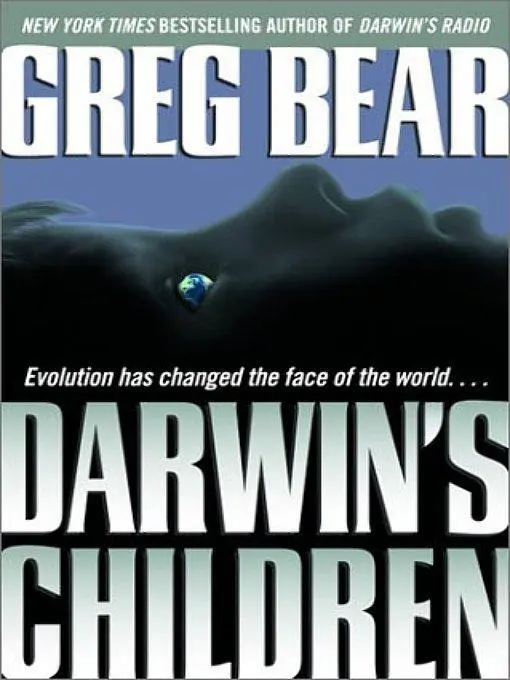
- Название:Darwin's Children
- Автор:
- Издательство:Del Rey Books
- Жанр:
- Год:2010
- Город:New York
- ISBN:9780345448361
- Рейтинг книги:3 / 5. Голосов: 1
-
Избранное:Добавить в избранное
- Отзывы:
-
Ваша оценка:
Darwin's Children: краткое содержание, описание и аннотация
Предлагаем к чтению аннотацию, описание, краткое содержание или предисловие (зависит от того, что написал сам автор книги «Darwin's Children»). Если вы не нашли необходимую информацию о книге — напишите в комментариях, мы постараемся отыскать её.
, painted a chilling portrait of humankind on the threshold of a radical leap in evolution—one that would alter our species forever. Now Bear continues his provocative tale of the human race confronted by an uncertain future, where “survival of the fittest” takes on astonishing and controversial new dimensions.
Eleven years have passed since SHEVA, an ancient retrovirus, was discovered in human DNA—a retrovirus that caused mutations in the human genome and heralded the arrival of a new wave of genetically enhanced humans. Now these changed children have reached adolescence… and face a world that is outraged about their very existence. For these special youths, possessed of remarkable, advanced traits that mark a major turning point in human development, are also ticking time bombs harboring hosts of viruses that could exterminate the “old” human race.
Fear and hatred of the virus children have made them a persecuted underclass, quarantined by the government in special “schools,” targeted by federally sanctioned bounty hunters, and demonized by hysterical segments of the population. But pockets of resistance have sprung up among those opposed to treating the children like dangerous diseases—and who fear the worst if the government’s draconian measures are carried to their extreme.
Scientists Kaye Lang and Mitch Rafelson are part of this small but determined minority. Once at the forefront of the discovery and study of the SHEVA outbreak, they now live as virtual exiles in the Virginia suburbs with their daughter, Stella—a bright, inquisitive virus child who is quickly maturing, straining to break free of the protective world her parents have built around her, and eager to seek out others of her kind.
But for all their precautions, Kaye, Mitch, and Stella have not slipped below the government’s radar. The agencies fanatically devoted to segregating and controlling the new-breed children monitor their every move—watching and waiting for the opportunity to strike the next blow in their escalating war to preserve “humankind” at any cost. DARWIN’S CHILDREN
Darwin's Children — читать онлайн ознакомительный отрывок
Ниже представлен текст книги, разбитый по страницам. Система сохранения места последней прочитанной страницы, позволяет с удобством читать онлайн бесплатно книгу «Darwin's Children», без необходимости каждый раз заново искать на чём Вы остановились. Поставьте закладку, и сможете в любой момент перейти на страницу, на которой закончили чтение.
Интервал:
Закладка:
Miss Kinney nodded, going along for the moment.
“We’d switch out a runner and a channel each time. In a couple of hours, I bet most of us could sink baskets really well, and if we added up the points, the teams would have more points than if they, you know, fought with each other.” Stella thought this over very earnestly for an instant and her face lit up. “Maybe a thousand points in a game.”
“Nobody would want to watch,” Miss Kinney said. She was showing her exhaustion now, but also making a funny little grin that Stella could not interpret. Stella looked at the blinking red light on the nosey on Miss Kinney’s belt. Miss Kinney had turned off the nosey before practice, perhaps because the girls often triggered its tiny little wheeping alarm when they exercised, no matter how much self-control they displayed.
“I would watch!” Celia said, leaning into the words. “I could learn how to train people in motion with, you know, signs.” Celia glanced at Stella conspiratorially, and undered, / Signs and smells and spit, eyes that twirl and brows that knit. It was a little song they sometimes sang in the dorm before sleep; softly. “That would really be fun.”
The other girls agreed that they understood that sort of game.
Miss Kinney lifted her hand and twisted it back and forth like a little flag. “What is it? You don’t like competition?”
“We like push-pull,” Stella said. “We do it all the time. On the playground, in the walking square.”
“Is that when you do those little dances?” Miss Kinney asked.
“That’s mosey or maybe push-pull,” said Harriet Pincher, the stockiest girl in the group. “Palms get sweaty with mosey. They stay dry with push-pull.”
Stella did not know how to begin to explain the difference. Sweaty palms in a group touch could make all sorts of changes. Individuals could become stronger, more willing to lead, or less aggressive in their push to lead, or simply sit out a deme debate, if one happened. Dry palms indicated a push-pull, and that was less serious, more like play. A deme needed to adjust all the time, and there were many ways to do that, some fun, some more like hard work.
Rarely, a deme adjustment involved stronger measures. The few attempts she had seen had resulted in some pretty nasty reactions. She didn’t want to bring that up now, though Miss Kinney seemed genuinely interested.
Adjusting to humans was a puzzle. The new children were supposed to do all the adjusting, and that made it hard.
“Come on,” said Miss Kinney, getting up. “Try again. Humor me.”
4
Pathogenics Centers
Viral Threat Assessment Division
Sandia Labs
NEW MEXICO
“We trade a lot of aptronyms to let off steam,” Jonathan Turner said as he spun the golf cart up to the concrete guard box.
“Aptronyms?” Christopher Dicken asked.
The sun had set in typical New Mexico fashion—suddenly and with some drama. Halogen lamps were switching on all over the facility, casting the plain and often downright ugly architecture into stark artificial day.
“Names that suit the job. I’ll give you an example,” Turner said. “We have a doctor here at Sandia named Polk. Asa Polk.”
“Ah,” Dicken said. The guard box stood empty. Something small and white moved back and forth behind smoked glass windows. A long steel tube jutted from the side. He used a handkerchief to wipe sweat from his cheeks and forehead. The sweat was not just from the heat. He did not like this new role. He did not like secrets.
In particular, he did not like stepping into the belly of the beast.
Turner followed his gaze. “Nobody home,” he said. “We still use people at the main gates, but here it’s an automated sentry.” Dicken caught a glimpse of a grid of purple beams scooting over Turner’s face, then his own.
A green light glowed beside the gate.
“You are who we say you are, Dr. Dicken,” Turner said. He reached into a small box under the dash and took out a plastic bag marked BIOHAZARD. “The rag, please, Kleenex in your pockets, anything used to sop. Nothing like that is allowed in or out. Clothing is bad enough.”
Dicken dropped the handkerchief into the bag, and Turner sealed it and slipped it into a small metal drop box. The concrete and iron barriers sank and drew back.
“In accounting, we have Mr. Ledger,” Turner said as he drove through. “And in statistics, Dr. Damlye.”
“I once worked with a pathologist named Boddy,” Dicken said.
Turner nodded provisional approval. “One of our arbovirus geniuses is named Bugg.”
The cart hummed past a dark gray water tower and five pressurized gas cylinders painted lime green, then crossed a median to a fenced enclosure containing a large white satellite dish. With a flourish, Turner did a 360 around the dish, then drove up to a row of squat bungalows. Behind the bungalows, and beyond several electrified fences topped with razor wire, lay five concrete warehouses, all of them together code-named Madhouse. The fences were patrolled by squat gray robots and soldiers toting automatic weapons.
“I once knew a plastic surgeon named Scarry,” Dicken said.
Turner smiled approval. “An auto mechanic named Torker.”
“A nuclear chemist named Mason.”
Turner grimaced. “You can do better. It may be essential to your sanity, working here.”
“I’m fresh out,” Dicken admitted.
“I could go on for days. Hundreds and hundreds, all on file and verified. None of this urban legend crap.”
“I thought you said just personal acquaintances.”
“I may have been handicapping you,” Turner admitted, and pulled the cart into a parking space marked in cargo letters on a white placard: #3 madhouse honcho. “A gynecologist named Box.”
“An anthropologist named Mann,” Dicken said, peering right at the sunning cages for the more hirsute residents of the Madhouse, now empty. “Mustn’t let down the team.”
“A dog trainer named Doggett.”
“A traffic cop named Rush.” Dicken felt himself warming to the game.
“A cabby named Parker,” Turner countered.
“A compulsive gambler named Chip.”
“A proctologist named Poker,” Turner said.
“You used that one.”
“Scout’s honor, it’s another,” Turner said. “And I was a scout, believe it or not.”
“Merit badge in hemorrhagic fevers?”
“Lucky guess.”
They walked toward the plain double doors and the white-lit corridor beyond. Dicken’s brow furrowed. “A pathologist named Thomas Shew,” he said, and smiled sheepishly.
“So?”
“T. Shew.”
Turner groaned and opened the door for Dicken. “Welcome to the Madhouse, Dr. Dicken. Initiation begins in half an hour. Need to make a pit stop first? Restrooms to your right. The cleanest loos in Christendom.”
“Not necessary,” Dicken said.
“You should, really. Initiation begins with drinking three bottles of Bud Light, and ends with drinking three bottles of Becks or Heinekens. This symbolizes the transition from the halls of typical piss-poor science to the exalted ranks of Sandia Pathogenics.”
“I’m fine.” Dicken tapped his forehead. “A libertarian named State,” he offered.
“Ah, that’s a different game entirely,” Turner said.
He rapped on the closed door to an office and stood back, folding his hands. Dicken looked along the cinder block hallway, then down to the concrete gutters on each side, then up at sprinkler heads mounted every six feet. Long red or green tags hung from the sprinkler heads, twisting in a slow current of air flowing north to south. The red tags read: caution: acid solution and detergent. A second pipe and sprinkler system on the left side of the corridor carried green tags that read: Extreme caution: chlorine dioxide.
Читать дальшеИнтервал:
Закладка:
Похожие книги на «Darwin's Children»
Представляем Вашему вниманию похожие книги на «Darwin's Children» списком для выбора. Мы отобрали схожую по названию и смыслу литературу в надежде предоставить читателям больше вариантов отыскать новые, интересные, ещё непрочитанные произведения.






Обсуждение, отзывы о книге «Darwin's Children» и просто собственные мнения читателей. Оставьте ваши комментарии, напишите, что Вы думаете о произведении, его смысле или главных героях. Укажите что конкретно понравилось, а что нет, и почему Вы так считаете.