Greg Bear - Darwin's Children
Здесь есть возможность читать онлайн «Greg Bear - Darwin's Children» — ознакомительный отрывок электронной книги совершенно бесплатно, а после прочтения отрывка купить полную версию. В некоторых случаях можно слушать аудио, скачать через торрент в формате fb2 и присутствует краткое содержание. Город: New York, Год выпуска: 2010, ISBN: 2010, Издательство: Del Rey Books, Жанр: Фантастика и фэнтези, на английском языке. Описание произведения, (предисловие) а так же отзывы посетителей доступны на портале библиотеки ЛибКат.
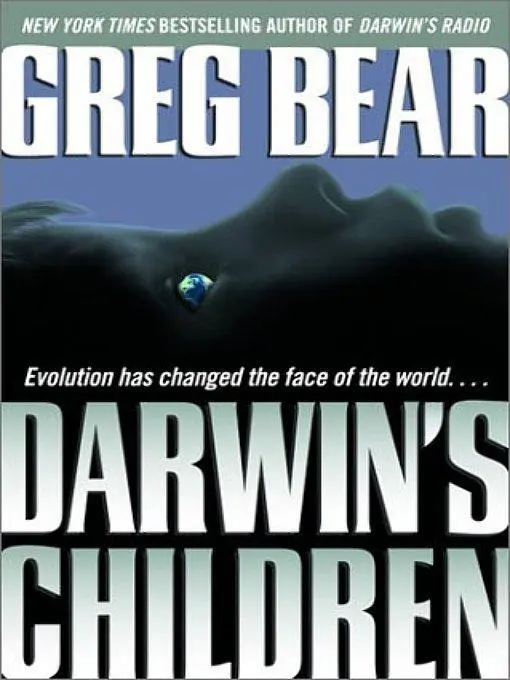
- Название:Darwin's Children
- Автор:
- Издательство:Del Rey Books
- Жанр:
- Год:2010
- Город:New York
- ISBN:9780345448361
- Рейтинг книги:3 / 5. Голосов: 1
-
Избранное:Добавить в избранное
- Отзывы:
-
Ваша оценка:
Darwin's Children: краткое содержание, описание и аннотация
Предлагаем к чтению аннотацию, описание, краткое содержание или предисловие (зависит от того, что написал сам автор книги «Darwin's Children»). Если вы не нашли необходимую информацию о книге — напишите в комментариях, мы постараемся отыскать её.
, painted a chilling portrait of humankind on the threshold of a radical leap in evolution—one that would alter our species forever. Now Bear continues his provocative tale of the human race confronted by an uncertain future, where “survival of the fittest” takes on astonishing and controversial new dimensions.
Eleven years have passed since SHEVA, an ancient retrovirus, was discovered in human DNA—a retrovirus that caused mutations in the human genome and heralded the arrival of a new wave of genetically enhanced humans. Now these changed children have reached adolescence… and face a world that is outraged about their very existence. For these special youths, possessed of remarkable, advanced traits that mark a major turning point in human development, are also ticking time bombs harboring hosts of viruses that could exterminate the “old” human race.
Fear and hatred of the virus children have made them a persecuted underclass, quarantined by the government in special “schools,” targeted by federally sanctioned bounty hunters, and demonized by hysterical segments of the population. But pockets of resistance have sprung up among those opposed to treating the children like dangerous diseases—and who fear the worst if the government’s draconian measures are carried to their extreme.
Scientists Kaye Lang and Mitch Rafelson are part of this small but determined minority. Once at the forefront of the discovery and study of the SHEVA outbreak, they now live as virtual exiles in the Virginia suburbs with their daughter, Stella—a bright, inquisitive virus child who is quickly maturing, straining to break free of the protective world her parents have built around her, and eager to seek out others of her kind.
But for all their precautions, Kaye, Mitch, and Stella have not slipped below the government’s radar. The agencies fanatically devoted to segregating and controlling the new-breed children monitor their every move—watching and waiting for the opportunity to strike the next blow in their escalating war to preserve “humankind” at any cost. DARWIN’S CHILDREN
Darwin's Children — читать онлайн ознакомительный отрывок
Ниже представлен текст книги, разбитый по страницам. Система сохранения места последней прочитанной страницы, позволяет с удобством читать онлайн бесплатно книгу «Darwin's Children», без необходимости каждый раз заново искать на чём Вы остановились. Поставьте закладку, и сможете в любой момент перейти на страницу, на которой закончили чтение.
Интервал:
Закладка:
Kaye’s eyes crinkled. She suddenly felt angry and perversely in control, even predatory, as if she were the hawk and they were the pigeons. The woman noticed the change. The man did not. “Terence,” the woman said and touched the man’s elbow. He looked down from the ceiling, meeting Kaye’s steady glare and reeling in his spiel with a surprised galumph and a bobble of his Adam’s apple.
“I’m alone,” Kaye said. She offered this like bait, hoping they would bite and she would have them. “My husband just got out of prison. My daughter is in a school.”
“I’m so sorry. Are you all right?” the woman asked Kaye with an equal mix of suspicion and solicitude.
“What kind of daughter?” the man asked. “A daughter of sin and disease?” The woman tugged hard on his sleeve. His Adam’s apple bobbled again, and their eyes darted over her clothes as if looking for suspicious bulges.
Kaye squared her shoulders and shoved out her hand to get through.
“I know you,” the man continued, despite his wife’s tugging. “I recognize you now. You’re the scientist. You discovered the sick children.”
Confined by the aisle, Kaye’s throat closed in. She coughed. “I have to go.”
The man made one last attempt, brave enough, to get through to her. “Even a scientist in self-centered love with her own mind, suffocating in the fame of television exposure, can learn to know God.”
“You’ve spoken to Him?” Kaye demanded. “You’ve talked to God?” She grabbed his arm and dug into the fabric and the flesh beneath with her fingernails.
“I pray all the time,” the man said, drawing back. “God is my Father in Heaven. He is always listening.”
Kaye tightened her grip. “Has God ever answered you?” she asked.
“His answers are many.”
“Do you ever feel God in your head?”
“Please,” the man said, wincing.
“Let him go ,” the woman insisted, trying to push her arm between them.
“God doesn’t talk to you? How weird .” Kaye advanced, pushing both back. “Why wouldn’t God talk to you ?”
“We fear God, we pray, and He answers in many ways.”
“God doesn’t stick around when things get ugly. What kind of God is that? He’s like a recorded message, some sort of God service that puts you on hold when you’re screaming. Explain it to me. God says he loves me but dumps me into a world of pain. You, so full of hate, so ignorant, he leaves alone. Self-righteous bigots he doesn’t even touch. Explain that to me! ”
She let go of the man’s arm.
The couple turned with stricken looks and fled.
Kaye stood with the murmuring books lapsing into silence behind her. Her chest heaved and her cheeks were flushed and moist.
“All right,” she said to the empty aisle.
After a decent interval, to avoid meeting the couple outside, she left the store. She ignored the guard’s irritated glower.
She stood under the eaves breathing in the heat and the humidity and listening to real thunder, far off over Virginia. The government car came around the corner and stopped at the black-striped yellow curb in front of the store. “Sorry,” the driver said. Kaye looked through the limo’s window and saw for the first time how young the driver was, and how worried. “Store security ignored my license. No place to park. Goddamned guard fingered his holster at me. Jesus Christ, Mrs. Rafelson, I’m sorry. Is everything okay?”
2
Hart Senate Office Building
Plenary Session of the Senate Emergency Action Oversight Committee,
Closed Hearing
WASHINGTON, D.C.
Mark Augustine waited patiently in the antechambers until called to take his seat. It was duly noted that he was the former director of Emergency Action. The nine senators assembled for this unusual evening session—five Republicans and four Democrats—exchanged edgy pleasantries for a few minutes. Two of the Democrats observed, for the record, that the current director was late. As well, Senator Gianelli was not present.
The chair, Senator Julia Thomasen of Maryland, expressed her aggravation and wondered who had called the meeting. No one was clear on that.
The meeting began without the director and Gianelli, and lacking any obvious point or focus, soon devolved into a testy debate about the events that had led to Mark Augustine’s dismissal three years earlier.
Augustine sat back in his chair, folded his hands in his lap, and let the senators argue. He had come to the Hill to testify fifty-three times in his career. Power did not impress him. Lack of power impressed him. Everyone in this room, as far as he was concerned, was almost completely powerless.
And—if the rumors were true—what they did not know was about to bite them right on the ass.
The minority Democrats held sway for a few minutes, deftly entering their comments into the record. Senator Charles Chase of Arizona began the questioning of Augustine as a matter of senatorial courtesy. His questions soon led to the role of the state of Ohio in the death of SHEVA children.
“Madam Chair,” bellowed Senator Percy from Ohio, “I resent the implication that the state of Ohio was in any way responsible for this debacle.”
“Senator Percy, Senator Chase has the floor,” Senator Thomasen reminded him.
“I resent the entire subject area,” Percy bellowed.
“Noted. Please continue, Senator Chase.”
“Madam Chair, I am only following the line of questioning begun last week by Senator Gianelli, who is not, I hope, indisposed today, not with a virus, at least.”
No laughter in the Senate chamber. Chase continued without missing a beat. “I mean no disrespect to the honorable senator from Ohio.”
Senator Percy flipped his hand out over the chamber as if he would have gladly tossed them all through a window. “Personal corruption should not reflect ill on such a fine state.”
“Nor am I impugning the reputation of Ohio, which is where I was born, Madam Chair. May I continue my questions?”
“What in hell made you move, Charlie?” Percy asked. “We could use your eagle eye.” He grinned to the nearly empty room. Only a grandstanding senator—or an aging vaudevillian—could imagine an audience where there was none, Augustine mused. He unfolded his hands to tap his finger lightly on the table.
“Chair asks for a minimum of unchecked camaraderie.”
“I’m done, Madam Chair,” Percy announced, sitting back and wrapping his hands behind his neck.
Augustine sipped slowly from a glass of water.
“Perhaps our questions should be more pointed, dealing more with responsibility and less with geography,” Thomasen suggested.
“Hear, hear,” Percy said.
“When you were in charge of the school system for Emergency Action, did you supply all schools—even state-controlled schools—with the federally mandated allotments for medical supplies?” Chase continued.
“We did, Senator,” Augustine said.
“These supplies included the very antivirals that might have saved these unfortunate children?”
“They did.”
“In how many states was there sufficient supply of these antivirals to treat sick children?”
“Five; six, if we include the territory of Puerto Rico.”
“My state, doctor, was one of those five?”
“It was, Senator,” Augustine said.
The senator paused to let that sink in. “The supply of antivirals was sufficient to take care of the children in our custody—our care. Arizona did not lose nearly as many children as most. And that supply was insured because Arizona did not seek to control and divert the federal allotments and allocations for Emergency Action schools, a hijacking sponsored by the Republican majority, if I remember correctly?”
Читать дальшеИнтервал:
Закладка:
Похожие книги на «Darwin's Children»
Представляем Вашему вниманию похожие книги на «Darwin's Children» списком для выбора. Мы отобрали схожую по названию и смыслу литературу в надежде предоставить читателям больше вариантов отыскать новые, интересные, ещё непрочитанные произведения.







Обсуждение, отзывы о книге «Darwin's Children» и просто собственные мнения читателей. Оставьте ваши комментарии, напишите, что Вы думаете о произведении, его смысле или главных героях. Укажите что конкретно понравилось, а что нет, и почему Вы так считаете.