Greg Bear - Darwin's Children
Здесь есть возможность читать онлайн «Greg Bear - Darwin's Children» — ознакомительный отрывок электронной книги совершенно бесплатно, а после прочтения отрывка купить полную версию. В некоторых случаях можно слушать аудио, скачать через торрент в формате fb2 и присутствует краткое содержание. Город: New York, Год выпуска: 2010, ISBN: 2010, Издательство: Del Rey Books, Жанр: Фантастика и фэнтези, на английском языке. Описание произведения, (предисловие) а так же отзывы посетителей доступны на портале библиотеки ЛибКат.
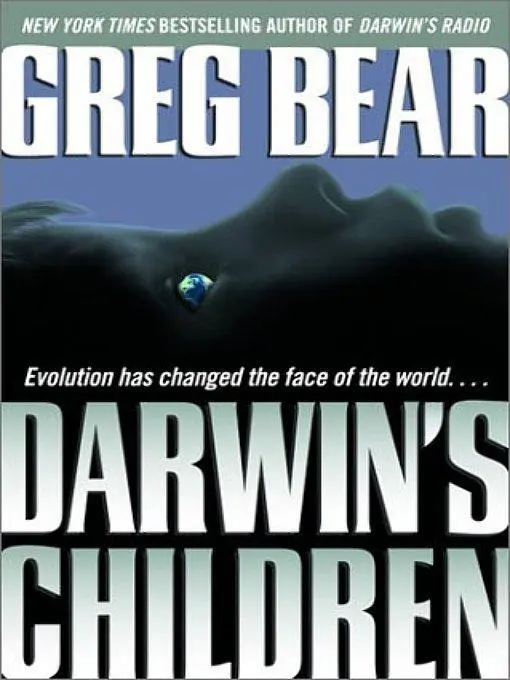
- Название:Darwin's Children
- Автор:
- Издательство:Del Rey Books
- Жанр:
- Год:2010
- Город:New York
- ISBN:9780345448361
- Рейтинг книги:3 / 5. Голосов: 1
-
Избранное:Добавить в избранное
- Отзывы:
-
Ваша оценка:
Darwin's Children: краткое содержание, описание и аннотация
Предлагаем к чтению аннотацию, описание, краткое содержание или предисловие (зависит от того, что написал сам автор книги «Darwin's Children»). Если вы не нашли необходимую информацию о книге — напишите в комментариях, мы постараемся отыскать её.
, painted a chilling portrait of humankind on the threshold of a radical leap in evolution—one that would alter our species forever. Now Bear continues his provocative tale of the human race confronted by an uncertain future, where “survival of the fittest” takes on astonishing and controversial new dimensions.
Eleven years have passed since SHEVA, an ancient retrovirus, was discovered in human DNA—a retrovirus that caused mutations in the human genome and heralded the arrival of a new wave of genetically enhanced humans. Now these changed children have reached adolescence… and face a world that is outraged about their very existence. For these special youths, possessed of remarkable, advanced traits that mark a major turning point in human development, are also ticking time bombs harboring hosts of viruses that could exterminate the “old” human race.
Fear and hatred of the virus children have made them a persecuted underclass, quarantined by the government in special “schools,” targeted by federally sanctioned bounty hunters, and demonized by hysterical segments of the population. But pockets of resistance have sprung up among those opposed to treating the children like dangerous diseases—and who fear the worst if the government’s draconian measures are carried to their extreme.
Scientists Kaye Lang and Mitch Rafelson are part of this small but determined minority. Once at the forefront of the discovery and study of the SHEVA outbreak, they now live as virtual exiles in the Virginia suburbs with their daughter, Stella—a bright, inquisitive virus child who is quickly maturing, straining to break free of the protective world her parents have built around her, and eager to seek out others of her kind.
But for all their precautions, Kaye, Mitch, and Stella have not slipped below the government’s radar. The agencies fanatically devoted to segregating and controlling the new-breed children monitor their every move—watching and waiting for the opportunity to strike the next blow in their escalating war to preserve “humankind” at any cost. DARWIN’S CHILDREN
Darwin's Children — читать онлайн ознакомительный отрывок
Ниже представлен текст книги, разбитый по страницам. Система сохранения места последней прочитанной страницы, позволяет с удобством читать онлайн бесплатно книгу «Darwin's Children», без необходимости каждый раз заново искать на чём Вы остановились. Поставьте закладку, и сможете в любой момент перейти на страницу, на которой закончили чтение.
Интервал:
Закладка:
“Fifteen years and the strain is killing us. It cannot go on.
“When we suspend habeas corpus and nobody blinks, when our neighbors and relatives and even our children are hauled away in unmarked trucks and we huddle in fearful relief, the end of an entire way of life, of the American philosophy and psychology, is near, too near, perhaps upon us already.
“A government based on fear attracts the worst elements, who corrupt it from within. A shaky edifice, a government against its people, any of its people, must soon collapse.”
—Jeremy Willis, The New Republic1
WASHINGTON, D.C.
The clouds over the capital were swollen and green with rain. The air felt close and sticky. Kaye took a government car from Dulles. She wore a trim gray suit with a pale yellow blouse, ruffled collar and sleeves, sensible walking shoes, dress pumps in her bag. She had carefully made up her face late in the morning and touched up in a restroom at Dulles. She knew how she looked: pale, thin, face a deeper shade of powdery beige than her wrists. Middle-aged and frail. Too much time spent in laboratories, not enough looking at the sun or seeing the sky.
She could have been any one of ten thousand professional workers leaving the long blocky tan-and-gray buildings around Washington, waiting for traffic to clear, stopping off for a drink or a coffee, meeting coworkers for dinner. She preferred the anonymity.
Last night, Kaye had carefully studied the briefing folio from Senator Gianelli’s office. What she had read in that folio she could clearly see on the drive from Dulles. The capital was losing the last of its self-respect. On some streets, garbage pickups had been delayed for weeks without explanation. National guard and regular army troops walked around the streets in trios, firearms slung and clips loaded. Military and security vehicles—Humvees, bomb-squad trucks, armored personnel carriers—sat on key streets, humped up on sidewalks or blocking intersections. Concrete barriers that shifted every day and multiple checkpoints with armored ID kiosks made travel to government buildings tortuous.
The capital even smelled sick. Washington had become a city of long, sad lines, drawn faces, rumpled clothing. Everyone feared people in long coats, delivery trucks, boxes left on streets, and posters taped to walls demanding obscure justice and hiding thin, nasty bombs beneath to blow up those who would try to take them down.
Only the clowns and the monsters looked healthy and happy. Only clowns and monsters found their careers advancing in Washington, D.C., in the fifteenth year of SHEVA.
The driver told her the hearing had been delayed and they had some time to kill. Kaye asked him to stop in front of a Stefano’s bookstore on K Street. She thought about eating but she could not rouse an appetite. She just wanted to be alone for a few minutes to think.
Kaye pulled up the strap on her shoulder bag and entered the retail-grade checkpoint outside the bookstore. A large, heavy guard in an ill-fitting uniform with all the buttons straining looked her over with a blank expression and motioned for her to apply thumb to scanner, then waved her through the metal detector. Sniffers whuffed, checking for traces of explosives or suspicious volatiles.
Perfume had become a no-no in the city.
“Clear,” the guard said, his voice like soft thunder. “Y’all have a good evening.”
Outside, the rain began to fall. Kaye looked back through a display window and saw trash floating down the gutters, paper bags and cups bobbing along. The gutters were clogging and water would soon back up.
She knew she needed some food. She should not attend the hearing on an empty stomach, and she had not eaten since ten that morning. It was five now. Soup and sandwiches were available at a small café inside the store. But Kaye walked past the menu board without stopping, on some sort of autopilot. Her walking shoes made damp sucking sounds on the linoleum as she passed several deep aisles of bookshelves. Fluorescent lights flickered and buzzed overhead. A young man with long felted hair sat on a patched chair, half-empty knapsack crumpled in his lap, asleep. A paperback Bible lay open facedown on the arm of the chair.
God sleeping.
Without thinking, Kaye turned right and found herself in the religion section. Most of the shelves were filled with brightly colored apocalypse novels. E-paper holograms leaped from lurid covers as she passed: end time, rapture, revelation, demons and dark angels. Most of the books had speaker chips that could read out the entire story. The same chips replaced jacket copy with vocal come-ons. The shelves murmured softly in a wave, like ghosts triggered by Kaye’s brief passage.
Serious theology texts had been crowded out. She found a single shelf concealed high in the back, near the brick wall. It was cold in that corner and the books were worn and dusty.
Eyes wide, ill at ease, Kaye touched the spines and read one title, then another. None seemed right. Most were contemporary Christian commentaries, not what she was looking for. Some lashed out angrily at Darwinism and modern science.
She turned slowly and looked down the aisle, listening to the books, their competing voices sibilant like falling leaves. Then she frowned and returned to the lone shelf. She was determined to find something useful. She tugged out a book called Talking With the Only God . Skimming through five pages, she found big print, wide margins, self-righteous but simple instructions on how to live a Christian life in troubled times. Not good. Not what I need.
She replaced the book with a grimace and turned to leave. An older man and woman blocked the aisle, smiling at her. Kaye held her breath, eyes shifting. She was sure her driver had come into the store but could not remember seeing him.
“Are you seeking?” the man asked. He was tall and skeletally thin with a short cap of braided white hair. He wore a black suit. The way his coat sleeves rode up his wrists reminded Kaye of Mitch, but the man himself did not. He looked determined and a little fake, like a mannequin or a bad actor. The woman was equally tall, thin through the waist but with fleshy arms. She wore a long dress that clung to her thighs.
“I beg your pardon?” Kaye asked.
“There are better places to seek, and better texts to find,” the man said.
“Thanks, I’m fine,” Kaye said. She looked away and reached for another book, hoping they would leave her alone.
“What are you seeking?” the woman asked.
“I was just browsing. Nothing specific,” Kaye said, avoiding their eyes.
“You won’t find answers here,” the man said.
The driver was not in sight. Kaye was on her own, and this probably wasn’t serious anyway. She tried to appear friendly and unconcerned.
“There’s only one valid translation of the Lord’s words,” the man said. “We find them in the King James Bible. God watched over King James like a holy flame.”
“I’ve heard that,” Kaye said.
“Which church do you attend?”
“No church,” she said. She had come to the end of the aisle and the pair had not moved. “Excuse me. I have an appointment.” Kaye clutched her purse to her side.
“Have you made peace with God?” the woman asked.
The man lifted his hand as if in benediction. “We lose our families, the families of God. In our sin, in homosexuality and promiscuity and following the ways of the Arab and the Jew, the pagan gods of the Web and TV, we stray from the path of God and God’s punishment is swift.” He swept his hand with a scowl at the whispering books on the shelves. “It is useless to seek His truth in the voices of the devil’s machines.”
Читать дальшеИнтервал:
Закладка:
Похожие книги на «Darwin's Children»
Представляем Вашему вниманию похожие книги на «Darwin's Children» списком для выбора. Мы отобрали схожую по названию и смыслу литературу в надежде предоставить читателям больше вариантов отыскать новые, интересные, ещё непрочитанные произведения.





Обсуждение, отзывы о книге «Darwin's Children» и просто собственные мнения читателей. Оставьте ваши комментарии, напишите, что Вы думаете о произведении, его смысле или главных героях. Укажите что конкретно понравилось, а что нет, и почему Вы так считаете.