Greg Bear - Darwin's Children
Здесь есть возможность читать онлайн «Greg Bear - Darwin's Children» — ознакомительный отрывок электронной книги совершенно бесплатно, а после прочтения отрывка купить полную версию. В некоторых случаях можно слушать аудио, скачать через торрент в формате fb2 и присутствует краткое содержание. Город: New York, Год выпуска: 2010, ISBN: 2010, Издательство: Del Rey Books, Жанр: Фантастика и фэнтези, на английском языке. Описание произведения, (предисловие) а так же отзывы посетителей доступны на портале библиотеки ЛибКат.
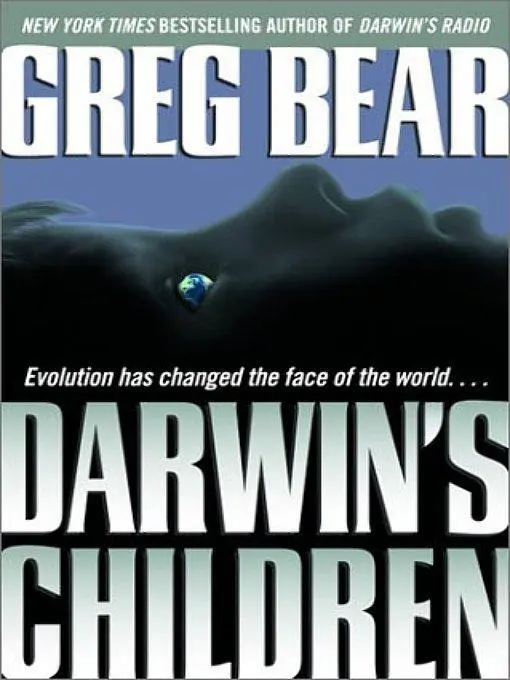
- Название:Darwin's Children
- Автор:
- Издательство:Del Rey Books
- Жанр:
- Год:2010
- Город:New York
- ISBN:9780345448361
- Рейтинг книги:3 / 5. Голосов: 1
-
Избранное:Добавить в избранное
- Отзывы:
-
Ваша оценка:
Darwin's Children: краткое содержание, описание и аннотация
Предлагаем к чтению аннотацию, описание, краткое содержание или предисловие (зависит от того, что написал сам автор книги «Darwin's Children»). Если вы не нашли необходимую информацию о книге — напишите в комментариях, мы постараемся отыскать её.
, painted a chilling portrait of humankind on the threshold of a radical leap in evolution—one that would alter our species forever. Now Bear continues his provocative tale of the human race confronted by an uncertain future, where “survival of the fittest” takes on astonishing and controversial new dimensions.
Eleven years have passed since SHEVA, an ancient retrovirus, was discovered in human DNA—a retrovirus that caused mutations in the human genome and heralded the arrival of a new wave of genetically enhanced humans. Now these changed children have reached adolescence… and face a world that is outraged about their very existence. For these special youths, possessed of remarkable, advanced traits that mark a major turning point in human development, are also ticking time bombs harboring hosts of viruses that could exterminate the “old” human race.
Fear and hatred of the virus children have made them a persecuted underclass, quarantined by the government in special “schools,” targeted by federally sanctioned bounty hunters, and demonized by hysterical segments of the population. But pockets of resistance have sprung up among those opposed to treating the children like dangerous diseases—and who fear the worst if the government’s draconian measures are carried to their extreme.
Scientists Kaye Lang and Mitch Rafelson are part of this small but determined minority. Once at the forefront of the discovery and study of the SHEVA outbreak, they now live as virtual exiles in the Virginia suburbs with their daughter, Stella—a bright, inquisitive virus child who is quickly maturing, straining to break free of the protective world her parents have built around her, and eager to seek out others of her kind.
But for all their precautions, Kaye, Mitch, and Stella have not slipped below the government’s radar. The agencies fanatically devoted to segregating and controlling the new-breed children monitor their every move—watching and waiting for the opportunity to strike the next blow in their escalating war to preserve “humankind” at any cost. DARWIN’S CHILDREN
Darwin's Children — читать онлайн ознакомительный отрывок
Ниже представлен текст книги, разбитый по страницам. Система сохранения места последней прочитанной страницы, позволяет с удобством читать онлайн бесплатно книгу «Darwin's Children», без необходимости каждый раз заново искать на чём Вы остановились. Поставьте закладку, и сможете в любой момент перейти на страницу, на которой закончили чтение.
Интервал:
Закладка:
“Yes, Senator.” Augustine tapped his finger again on the table. Now was not the time to bring up Arizona’s current record. There were rumors that the children of dissidents were being warehoused in schools there. He no longer had access to the lists, of course.
“Is it fair to say that you lost your job because of this fiasco?” Chase asked.
“It was part of the larger picture,” Augustine said.
“A large part, I presume.”
Augustine gave the merest nod.
“Do you continue to consult for the Emergency Action Authority?”
“I serve as adviser on viral affairs to the director of the National Institutes of Health. I still have an office in Bethesda.”
Chase searched his papers for more material, then added, “Your star is not completely out of the firmament in this matter?”
“I suppose not, Senator.”
“And what is the authority’s budget this year?” Chase looked up innocently.
“You of all people should know that, Charlie,” Senator Percy grumbled.
“Emergency Action’s budget is not subject to yearly congressional review, nor is it available for direct public scrutiny,” Augustine said. “I don’t have exact figures myself, but I would estimate the present budget at over eighty billion dollars—double what it was when I served as director. That includes research and development in the private and public sector.”
Thomasen looked around the room with a frown. “The director is tardy.”
“She is not here to defend herself,” Percy observed with amusement. Thomasen nodded for Chase to continue, and then conferred with an intern.
Chase closed in on his favorite topic. “Emergency Action has become one of the biggest government programs in this nation, successfully fighting off all attempts to limit its scope and investigate its constitutionality in a time of drastic fiscal cutbacks, has it not?”
“All true,” Augustine said.
“And with this budget, approved by both Republican and Democratic administrations year after year, EMAC has spent tens of millions of dollars on lawyers to defend its questionable legality, has it not?”
“The very best, Senator.”
“And does it pay any attention to the wishes of Congress, or of this oversight committee? Even to the extent that the director arrives on time when summoned?”
Senator Percy from Ohio exhaled over his microphone, creating the sensation of a great wind in the chamber. “Where are we going, Madam Chair? Haven’t we enough black eyes to go around?”
“We lost seventy-five thousand children, Senator Percy!” Chase roared.
Percy riposted immediately. “They were killed by a disease , Senator Chase, not by my constituents, nor indeed by any of the normal citizens—the true citizens—of my great state, or this fine country.” Percy avoided the hawklike gaze of the senator from Arizona.
“Dr. Augustine, is it not the scientific conclusion that this new variety of virus—hand, foot, and mouth disease—arose within the so-called normal adult population, in part through recombination of ancient viral genes not found within SHEVA children?” Chase asked.
“It is,” Augustine said.
“Many prominent scientists disagree,” Percy said, and lifted his hand as if to fend off the sudden rap of the gavel.
“And did you predict that just the reverse would happen, fourteen years ago, a statement that practically led to the creation of Emergency Action?”
“The reverse being…” Augustine said, lifting his brows.
“That the children would create new viruses that would kill us , Doctor.”
Augustine nodded. “I did.”
“And is that not still a scientific possibility, Dr. Augustine?” Percy demanded.
“It hasn’t happened, Senator,” Augustine said mildly.
Percy moved in. “Come on, Dr. Augustine. It’s your theory. Is it not likely that this deadly viral outbreak will happen soon, given the possibility that these children might perceive that they are under threat, and that many of these old viruses respond to the chemicals, steroids, or whatever, that we make when we are unhappy or stressed?”
Augustine subdued a twitch of his lips. The senator was showing some education. “I suggest that perhaps the children have already turned the other cheek, and it is time now for us to show some charity. We could relieve some of their stress. And we should recognize them for what they are, not what we fear they might become.”
“They are the mutated products of a deadly viral disease,” Percy said, straightening his microphone with a scraping noise.
“They are our children,” Augustine said.
“Never!” Percy shouted.
3
Sable Mountain Emergency Action School
ARIZONA
Without explanation, Stella’s evening study hour had been canceled and she had been told to go to the gym. The building was empty and the basketball made a clapping echo with each resonant bounce.
Stella ran toward the end of the court, worn sneakers squeaking on the rubbery paint that covered the hard concrete. She spun around for a layup and watched the ball circle the hoop, hiccup, then drop through. There was no net to slow its fall. She deftly grabbed the ball as it fell and ran around the court to do it again. Mitch had taught her how to shoot hoops when she was eight. She remembered a little about the rules, though not much.
Stella’s bunkmate, black-haired Celia Northcott, wandered into the gym fifteen minutes later. Celia was a year younger but seemed more mature. She had been born as a twin but her sister had died while only a few months old. This was common among SHEVA twins; usually, only one survived. Celia made up for a tendency toward sadness with a brittle cheer that sometimes irritated Stella. Celia was full of schemes, and was probably the most avid constructor of demes—social groupings of SHEVA children—and plans about how to live when they grew up.
She was nursing her arm—a bandage covered her wrist—and grimaced as Stella held the ball and queried her with a freckle flash and stare.
“Blood,” Celia said, and sat cross-legged on the side of the court. “About a gallon.”
“Why?” Stella asked.
“How should I know? KUK/ I had a nightmare last night.” Celia’s tongue caught and she made her signature glottal click, which almost obscured her underspeech. Celia was not very good at double speaking. Someone, she never said who, had tried to mutilate her tongue when she was eight years old. This she had revealed to Stella late at night, when Stella had found her huddled in a corner of the barracks, crying and smelling of electric onions. The facile ridge found in most of the children was a white scar on Celia’s tongue, and she sometimes slurred her words, or inserted a hard clucking sound.
Stella squatted beside Celia and lightly bounced her palm off the ball, held in the nest of her legs. Nobody knew why the counselors took so much blood, but visits to the hospital usually followed upsets or unusual behavior; that much Stella had deduced. “How long did they keep you?”
“Until morning.”
“Anything new in the hospital?” That was what they called the administration building, adjacent to the counselor and teacher dormitories, all beyond a razor-wire topped fence that surrounded the boys’ and girls’ compounds.
Celia shook her head. “They gave me oatmeal and eggs for breakfast,” she said. “And a big glass of orange juice.”
“Did they do a biopsy?”
Celia bit her lip and let her eyes grow large. “No. Who’s had-KUK a biopsy?”
“Beth Fremont says one of the boys told her. Right out of his… you know.” She pointed down and tapped the basketball.
Читать дальшеИнтервал:
Закладка:
Похожие книги на «Darwin's Children»
Представляем Вашему вниманию похожие книги на «Darwin's Children» списком для выбора. Мы отобрали схожую по названию и смыслу литературу в надежде предоставить читателям больше вариантов отыскать новые, интересные, ещё непрочитанные произведения.





Обсуждение, отзывы о книге «Darwin's Children» и просто собственные мнения читателей. Оставьте ваши комментарии, напишите, что Вы думаете о произведении, его смысле или главных героях. Укажите что конкретно понравилось, а что нет, и почему Вы так считаете.