Greg Bear - Darwin's Children
Здесь есть возможность читать онлайн «Greg Bear - Darwin's Children» — ознакомительный отрывок электронной книги совершенно бесплатно, а после прочтения отрывка купить полную версию. В некоторых случаях можно слушать аудио, скачать через торрент в формате fb2 и присутствует краткое содержание. Город: New York, Год выпуска: 2010, ISBN: 2010, Издательство: Del Rey Books, Жанр: Фантастика и фэнтези, на английском языке. Описание произведения, (предисловие) а так же отзывы посетителей доступны на портале библиотеки ЛибКат.
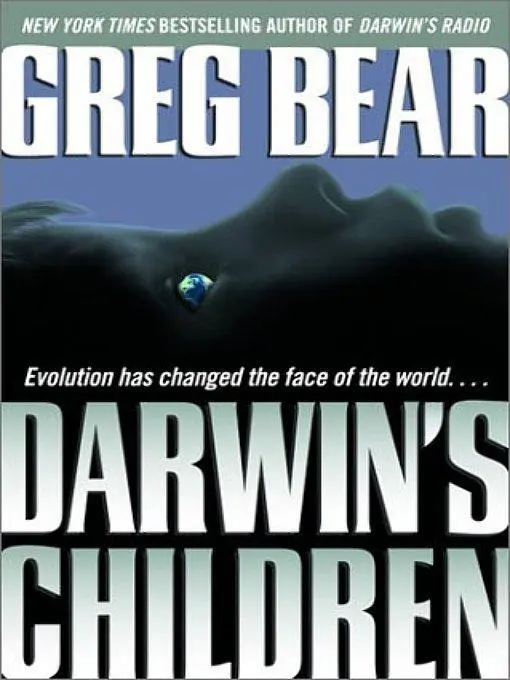
- Название:Darwin's Children
- Автор:
- Издательство:Del Rey Books
- Жанр:
- Год:2010
- Город:New York
- ISBN:9780345448361
- Рейтинг книги:3 / 5. Голосов: 1
-
Избранное:Добавить в избранное
- Отзывы:
-
Ваша оценка:
Darwin's Children: краткое содержание, описание и аннотация
Предлагаем к чтению аннотацию, описание, краткое содержание или предисловие (зависит от того, что написал сам автор книги «Darwin's Children»). Если вы не нашли необходимую информацию о книге — напишите в комментариях, мы постараемся отыскать её.
, painted a chilling portrait of humankind on the threshold of a radical leap in evolution—one that would alter our species forever. Now Bear continues his provocative tale of the human race confronted by an uncertain future, where “survival of the fittest” takes on astonishing and controversial new dimensions.
Eleven years have passed since SHEVA, an ancient retrovirus, was discovered in human DNA—a retrovirus that caused mutations in the human genome and heralded the arrival of a new wave of genetically enhanced humans. Now these changed children have reached adolescence… and face a world that is outraged about their very existence. For these special youths, possessed of remarkable, advanced traits that mark a major turning point in human development, are also ticking time bombs harboring hosts of viruses that could exterminate the “old” human race.
Fear and hatred of the virus children have made them a persecuted underclass, quarantined by the government in special “schools,” targeted by federally sanctioned bounty hunters, and demonized by hysterical segments of the population. But pockets of resistance have sprung up among those opposed to treating the children like dangerous diseases—and who fear the worst if the government’s draconian measures are carried to their extreme.
Scientists Kaye Lang and Mitch Rafelson are part of this small but determined minority. Once at the forefront of the discovery and study of the SHEVA outbreak, they now live as virtual exiles in the Virginia suburbs with their daughter, Stella—a bright, inquisitive virus child who is quickly maturing, straining to break free of the protective world her parents have built around her, and eager to seek out others of her kind.
But for all their precautions, Kaye, Mitch, and Stella have not slipped below the government’s radar. The agencies fanatically devoted to segregating and controlling the new-breed children monitor their every move—watching and waiting for the opportunity to strike the next blow in their escalating war to preserve “humankind” at any cost. DARWIN’S CHILDREN
Darwin's Children — читать онлайн ознакомительный отрывок
Ниже представлен текст книги, разбитый по страницам. Система сохранения места последней прочитанной страницы, позволяет с удобством читать онлайн бесплатно книгу «Darwin's Children», без необходимости каждый раз заново искать на чём Вы остановились. Поставьте закладку, и сможете в любой момент перейти на страницу, на которой закончили чтение.
Интервал:
Закладка:
“Kweeee,” Celia whistle-tongued.
“What did you dream?” Stella asked.
“I don’t remember. I just woke up with a screech.”
Stella licked her palms, tasting the paint on the court and the old rubber of the ball and a little of the dust and dirt of other shoes, other players. Then she held out her palms for Celia to clasp. Celia’s palms were damp. Celia squeezed and rubbed their hands together, sighed, and let go after a moment. “Thanks,” she said, eyes downcast. Her cheeks turned a steady mottled copper and stayed that way for a while.
Stella had learned the spit trick from another girl a few weeks after her arrival.
The door to the gym opened and Miss Kinney came in with ten other girls. Stella knew LaShawna Hamilton and Torry Butler from her dorm; she knew most of the others by name, but had never shared a deme with any of them. And she knew Miss Kinney, the girl’s school coach. Miss Kinney led the other girls onto the court. Slung over her shoulder was a duffel bag filled with more balls.
“How about a little practice?” she asked Celia and Stella.
“Her arm hurts,” Stella said.
“Can you bounce and throw?” Miss Kinney asked Celia. Miss Kinney stood about five feet nine inches tall, a little shorter than Stella. The gym teacher was thin and strong, with a long, well-shaped nose and large green eyes, like a cat’s.
Celia got to her feet. She never turned down a challenge from a counselor or a teacher. She thought she was tough.
“Good,” Miss Kinney said. “I brought some jerseys and shorts. They’re ragged, but they’ll pass. Let’s go put them on. Time to see what you can do.”
Stella adjusted the baggy shorts with a grimace and tried to focus on the ball. Miss Kinney shouted encouragement from the sidelines to Celia. “Don’t just sniff the breeze. Take a shot!”
All the girls on the court had come to a halt in the middle of hoop practice. Stella looked to Celia, the best at sinking baskets in her group of five .
Miss Kinney strode forward, exasperated, and put on her best I’m being patient face. Stella would not meet her steady gaze.
“What is so hard about this?” Miss Kinney asked. “Tell me. I want to know.”
Stella lowered her eyes farther. “We don’t understand the point.”
“We’re going to try something different. You’ll compete ,” Miss Kinney said. “You’ll play against each other and get exercise and learn physical coordination. It’s fun.”
“We could all make more baskets if we formed our own teams,” Stella said. “One team could have three slowing others down, if they were coming in too fast. Seven could play opposite and make baskets.” Stella wondered if she sounded obtuse, but she truly wasn’t understanding what Miss Kinney expected of them.
“That isn’t the way it’s done,” Miss Kinney said, growing dangerously patient. Miss Kinney never got really angry, but it bothered Stella that she could hold in so much irritation and not express it. It made the teacher smell unpleasant.
“So, tell us how it’s-KUK done,” Celia said. She and LaShawna approached. Celia stood an inch taller than Stella, almost five eleven, and LaShawna was shorter than Miss Kinney, about five seven. Celia had the usual olive-to-brown skin and flyaway reddish hair that never seemed to know what to do or how to hold together on her head. LaShawna was darker, but not much, with finely kinked black hair that formed a slumped nimbus around her ears and down to her shoulders.
“It’s called a game. Come on, girls, you know what a game is.”
“We play,” Stella said defensively.
“Of course you play. All of us monkeys play ,” the teacher said.
Stella and LaShawna smiled. Sometimes Miss Kinney was more open and direct than the other teachers. They liked her, which made frustrating her even more distressing.
“This is organized play. You guys are good at organizing, aren’t you? What’s not to understand?”
“Teams,” LaShawna said. “Teams are like demes. But demes choose themselves.” She lifted her hands and spread them beside her temples, making little elephant ears. It was a sign; many of the new children did such things without really understanding why. Sometimes the teachers thought they were acting smart; but not Miss Kinney.
She glanced at LaShawna’s “ears,” blinked, and said for the tenth time, “Teams are not demes. Work with me here. A team is temporary and fun. I choose sides for you.”
Stella wrinkled her nose.
“I pick players with complementary abilities. I can help sculpt a team. You understand how that works, I’m sure.”
“Sure,” Stella said.
“Then you play against another team, and that makes all of you better players. Plus, you get exercise.”
“Right,” Stella said. So far, so good. She bounced the ball experimentally.
“Let’s try it again. Just the practice part. Celia, cover Stella. Stella, go for the basket.”
Celia stood back and dropped into a crouch and spread her arms, as Miss Kinney had told her to do. Stella bounced the ball, made a step forward, remembered the rules, then dribbled toward the basket. The floor of the court was marked with lines and half circles. Stella could smell Celia and knew what she was going to do. Stella moved toward her, and Celia stepped aside with a graceful sweep of her arms, but without any signs or suggestions for adjustment, and Stella, in some confusion, threw the ball. It bounced off the backboard without touching the basket.
Stella made a face at Celia.
“You are supposed to try to stop her,” Miss Kinney told Celia.
“I didn’t help her.” Celia glanced apologetically at Stella.
“No, I mean, actively try to stop her. ”
“But that would be a foul,” Celia said.
“Only if you chop her arms or push her or run into her.”
Celia said, “We all want to make baskets and be happy, right? If I stop her from getting a basket, won’t that reduce the number of baskets?”
Miss Kinney raised her eyes to the roof. Her face pinked. “You want to get the most baskets for your team, and keep the other team from getting any baskets.”
Celia was getting tired of thinking this through. Tears started in her eyes. “I thought we were trying to get the most baskets.”
“For your team ,” Miss Kinney said. “Why isn’t that clear?”
“It hurts to make others fail,” Stella said, looking around the court as if to find a door and escape.
“Oh, puh- leeze , Stella, it’s only a game! You play against one another. It’s called sport. Everyone can be friendly afterward. There’s no harm.”
“I saw soccer riots on TV once,” LaShawna said. Miss Kinney lifted her eyes to the ceiling. “People got hurt,” LaShawna added doubtfully.
“There’s a lot of passion in sport,” Miss Kinney admitted. “People care, but usually the players don’t hurt each other.”
“They run into each other and lay down for a long time. Someone should have warned them they were about to collide,” said Crystal Newman, who had silver-white hair and smelled like some new kind of citrus tree.
Miss Kinney motioned the twelve girls to go over to the metal chairs lined up outside the lines. They pulled the chairs into a circle and sat.
Miss Kinney took a deep breath. “I think maybe I’m missing something,” she said. “Stella, how would you like to play?”
Stella thought about this. “For exercise, we could push-pull and swing, mosey, you know, like a dance. If we wanted to learn how to run better, or make baskets better, we could set up running academies. Girls could form wavy channels and ovals and others could run the channels. The girls in the wavy channels could tell them how they aren’t doing it right.” She pointedly did not tell Miss Kinney about spit-calming, all the players slapping palms, which she had seen athletes do in human games. “Then the runners could shoot baskets from inside the channels and at different distances, until they could sink them from all the way across the court. That’s more points, right?”
Читать дальшеИнтервал:
Закладка:
Похожие книги на «Darwin's Children»
Представляем Вашему вниманию похожие книги на «Darwin's Children» списком для выбора. Мы отобрали схожую по названию и смыслу литературу в надежде предоставить читателям больше вариантов отыскать новые, интересные, ещё непрочитанные произведения.








Обсуждение, отзывы о книге «Darwin's Children» и просто собственные мнения читателей. Оставьте ваши комментарии, напишите, что Вы думаете о произведении, его смысле или главных героях. Укажите что конкретно понравилось, а что нет, и почему Вы так считаете.