Greg Bear - Darwin's Children
Здесь есть возможность читать онлайн «Greg Bear - Darwin's Children» — ознакомительный отрывок электронной книги совершенно бесплатно, а после прочтения отрывка купить полную версию. В некоторых случаях можно слушать аудио, скачать через торрент в формате fb2 и присутствует краткое содержание. Город: New York, Год выпуска: 2010, ISBN: 2010, Издательство: Del Rey Books, Жанр: Фантастика и фэнтези, на английском языке. Описание произведения, (предисловие) а так же отзывы посетителей доступны на портале библиотеки ЛибКат.
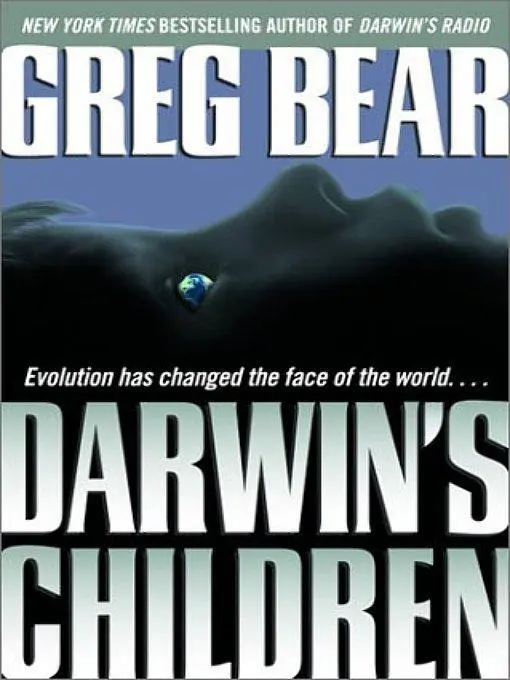
- Название:Darwin's Children
- Автор:
- Издательство:Del Rey Books
- Жанр:
- Год:2010
- Город:New York
- ISBN:9780345448361
- Рейтинг книги:3 / 5. Голосов: 1
-
Избранное:Добавить в избранное
- Отзывы:
-
Ваша оценка:
Darwin's Children: краткое содержание, описание и аннотация
Предлагаем к чтению аннотацию, описание, краткое содержание или предисловие (зависит от того, что написал сам автор книги «Darwin's Children»). Если вы не нашли необходимую информацию о книге — напишите в комментариях, мы постараемся отыскать её.
, painted a chilling portrait of humankind on the threshold of a radical leap in evolution—one that would alter our species forever. Now Bear continues his provocative tale of the human race confronted by an uncertain future, where “survival of the fittest” takes on astonishing and controversial new dimensions.
Eleven years have passed since SHEVA, an ancient retrovirus, was discovered in human DNA—a retrovirus that caused mutations in the human genome and heralded the arrival of a new wave of genetically enhanced humans. Now these changed children have reached adolescence… and face a world that is outraged about their very existence. For these special youths, possessed of remarkable, advanced traits that mark a major turning point in human development, are also ticking time bombs harboring hosts of viruses that could exterminate the “old” human race.
Fear and hatred of the virus children have made them a persecuted underclass, quarantined by the government in special “schools,” targeted by federally sanctioned bounty hunters, and demonized by hysterical segments of the population. But pockets of resistance have sprung up among those opposed to treating the children like dangerous diseases—and who fear the worst if the government’s draconian measures are carried to their extreme.
Scientists Kaye Lang and Mitch Rafelson are part of this small but determined minority. Once at the forefront of the discovery and study of the SHEVA outbreak, they now live as virtual exiles in the Virginia suburbs with their daughter, Stella—a bright, inquisitive virus child who is quickly maturing, straining to break free of the protective world her parents have built around her, and eager to seek out others of her kind.
But for all their precautions, Kaye, Mitch, and Stella have not slipped below the government’s radar. The agencies fanatically devoted to segregating and controlling the new-breed children monitor their every move—watching and waiting for the opportunity to strike the next blow in their escalating war to preserve “humankind” at any cost. DARWIN’S CHILDREN
Darwin's Children — читать онлайн ознакомительный отрывок
Ниже представлен текст книги, разбитый по страницам. Система сохранения места последней прочитанной страницы, позволяет с удобством читать онлайн бесплатно книгу «Darwin's Children», без необходимости каждый раз заново искать на чём Вы остановились. Поставьте закладку, и сможете в любой момент перейти на страницу, на которой закончили чтение.
Интервал:
Закладка:
“Ah,” Jurie said. “Dee Dee. Dr. Blakemore. Always prompt.”
“To a fault,” the woman said. In her late thirties, comfortably rotund, with long mousy hair and a self-assured expression, she pushed through the door and sat with some difficulty on a stool. In the next few minutes, four others joined them in the room, but remained standing.
“Thank you all for coming,” Jurie started the meeting. “We are all here to greet Dr. Dicken.”
Two of the men had entered holding cans of beer, apparently cadged from the party. Dicken noted that one—Dr. Orlin Miller, formerly of Western Washington University—still favored Bud Light over Heineken.
“We’re a relaxed group,” Jurie said. “Somewhat informal.” He never smiled, and as he spoke, he made small, unexpected hesitations between words. “What we’re essentially interested in, here at Pathogenics, is how diseases use us as genetic libraries and reservoirs. Also, how we’ve adapted to these inroads and learned to use the diseases. It doesn’t really matter whether viruses are rogue genes from inside us, or outside invaders—the result is the same, a constant battle for advantage and control. Sometimes we win, sometimes we lose, right?”
Dicken could not disagree.
“I’ve listened to all the media babble about virus children, and frankly I don’t give a damn whether they’re the products of disease or evolution. Evolution is a disease, for all I know. What I want to learn is how viruses can recombine and kill us.
“Not coincidentally, if we learn how that works, we have a pretty important weapon for both national defense and offense. This is the age of gene and germ, and whatever subtle little perversions we can think of, our enemies can also think of. Which is a pretty good reason to keep Sandia Pathogenics funded and running at fool steam, which we all will benefit from.”
“Amen,” said Turner.
I heard “fool steam,” Dicken thought, and looked around the room. Did anybody else? Fool steam ahead.
“Dr. Presky, shall we show Dr. Dicken our zoo?” Jurie asked.
7
NEAR LUBBOCK, TEXAS
Mitch had lost everything important, but once again he had dirt and bone chips and pottery. He was back in the field, carrying a small spade and a kit full of brushes. Starting from scratch was an archaeologist’s definition of workaday life, and he was definitely starting from scratch, all over again.
Around him, a neat square hole in the earth had been sculpted into many terraces on which sat fragments of flint, the crushed remains of what might have once been a wicker basket, a rough oval of shards from a small pot, and the thing that had absorbed his attention all day: an engraved shell.
The sun had set several hours ago and he was working by the light of a Coleman lantern. Down in the hole, all colors had long since turned to gray and brown. Brown was the color he knew best. Beige, gray, black, brown. The brown dust in his nose made everything smell like dry earth. A brown, neutral smell.
The shell lay in three pieces and was crudely engraved with what looked like a crosshatched bird’s wing. Mitch had a hunch it might be similar to the shells found at the Craig mound in Spiro, Oklahoma. If it was, that might generate enough publicity that they could persuade the contractors to pause for a few weeks.
The generator in the back of the truck had broken down the night before. Now, the lantern’s gas was running out.
With a sigh, he turned the lantern off, laid his spade and kit on the side of the hole and climbed out carefully, feeling his way in the dark, putting a strain on his good arm.
As with most university-sponsored digs, the budget was minimal and equipment was precious, usually secondhand, and seldom reliable. Time was important, of course. In two more weeks bulldozers would move in and cover hundreds of acres with fill and concrete slabs for a housing tract.
The twelve students working the site had gathered under a tent and were sipping beer in the cooling twilight. Some things never changed. He accepted a freshly popped can from a twenty-year-old brunette named Kylan, then sat with a groan in a camp chair reserved for him in part because he was the most experienced and in part because he was the oldest and the kids thought he might require the bare minimum of comfort to keep functioning.
The gimpy arm drew sympathy, too. Mitch could only dig effectively with one hand, propping the handle of the shovel under his armpit.
The others squatted on the dirt or on the two rugged wooden benches pulled from the back of the single battered pickup, the same one that held the useless generator.
“Any luck?” Kylan asked. They were not very talkative this evening, perhaps because they saw the imminent dashing of their hopes and dreams. This dig had become their lives in the past few weeks. Two couples were already lovers.
Mitch held up his hand, made a grasping motion. “Flashlight,” he said.
Tom Pritchard, twenty-four, skinny, with a head of dusty and tousled blond hair, tossed him a black aluminum flashlight.
The students looked at each other, blank-faced in the way kids have of hiding what might be an inappropriate emotion: hope.
“What is it?” asked tall, stout Caitlin Bishop, far from her native New York.
Mitch lifted his head and sighed. “Probably nothing,” he said.
They crowded around, all pretense and weariness gone. They needed hope as much as they needed rehydrating fluids. “What?” “What is it?” “What did you find?”
Mitch said it was probably nothing; probably not what he thought it was. And even if it was, how did that figure into his plans? There were hundreds of shells from Spiro scattered in private and university collections. So what if he had just found one more?
What sort of prize was that to replace his family?
He waved them off with the flashlight, then aimed the beam up at the first star to appear in the sky. The air was dry and the beam was only visible because the dust they had been raising all day lingered in the still air.
“Anyone know about Spiro, Oklahoma? The Craig mound?” he asked.
“Mississippian civilization,” said Kylan, the best student in the group but hardly the best digger. “Opened during the nineteen thirties by the Pocola Mining Company. A disaster. Burials, pottery, artifacts, all gone, all sold to tourists.”
“A famous source for engraved conch shells,” Mitch added. “Decorated with birds and snakes and such, vaguely Mesoamerican designs. Probably part of an extensive bartering community spread through a number of cultures in the East and South and Midwest. Anybody know about these shells?”
They all shook their heads.
“Show us,” said Bernard Rowland and stepped forward, as tall as Mitch and broader across the shoulders. He was a Mormon and did not drink beer; Iced Sweat, a wickedly green drink in a large plastic bottle, was his liquid of choice.
Mitch led them back through the ranks of holes in the ground. Flies were starting to zizz and hum after hiding out during the heat of the day. The cattle feed lots near Lubbock were less than ten miles away. When the wind was right, the smell was impressive. Mitch wondered why anyone would want to build homes here, so close to that smell and the flies.
They came to his hole and the students stood a foot back from the dry edges. He climbed into the hole and pointed the flashlight at the terrace that held the shell, painstakingly revealed by his brush and dental pick work of the last six hours.
“Wow,” Bernard said. “How did it get out here?”
“Good question,” Mitch said. “Anybody have a camera?”
Kylan handed him her digital, Dyno-labeled “Potshooter.” Mitch drew out the marker strings with length measurements in small squares of tape, handed them to the students, who set them at right angles and weighted them with rocks, and then snapped a series of flash pictures.
Читать дальшеИнтервал:
Закладка:
Похожие книги на «Darwin's Children»
Представляем Вашему вниманию похожие книги на «Darwin's Children» списком для выбора. Мы отобрали схожую по названию и смыслу литературу в надежде предоставить читателям больше вариантов отыскать новые, интересные, ещё непрочитанные произведения.




Обсуждение, отзывы о книге «Darwin's Children» и просто собственные мнения читателей. Оставьте ваши комментарии, напишите, что Вы думаете о произведении, его смысле или главных героях. Укажите что конкретно понравилось, а что нет, и почему Вы так считаете.