Rachel Maddow - Drift
Здесь есть возможность читать онлайн «Rachel Maddow - Drift» весь текст электронной книги совершенно бесплатно (целиком полную версию без сокращений). В некоторых случаях можно слушать аудио, скачать через торрент в формате fb2 и присутствует краткое содержание. Город: New York, Год выпуска: 2012, ISBN: 2012, Издательство: Crown Publishers, Жанр: Публицистика, на английском языке. Описание произведения, (предисловие) а так же отзывы посетителей доступны на портале библиотеки ЛибКат.
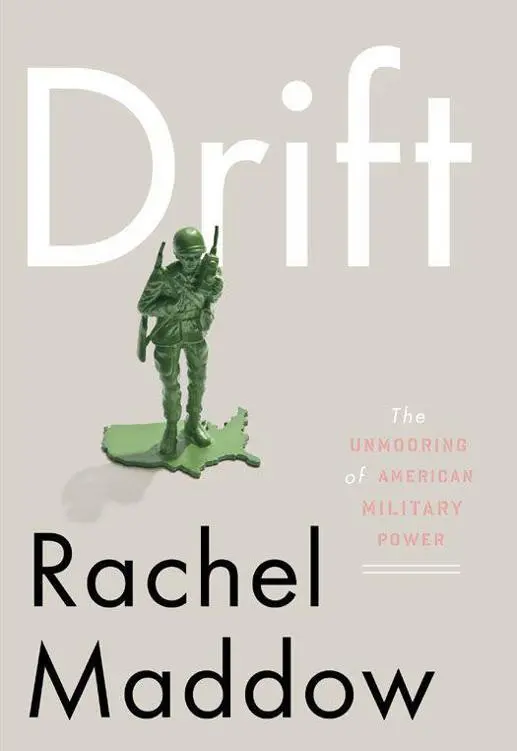
- Название:Drift
- Автор:
- Издательство:Crown Publishers
- Жанр:
- Год:2012
- Город:New York
- ISBN:978-0-307-46100-1
- Рейтинг книги:4 / 5. Голосов: 1
-
Избранное:Добавить в избранное
- Отзывы:
-
Ваша оценка:
Drift: краткое содержание, описание и аннотация
Предлагаем к чтению аннотацию, описание, краткое содержание или предисловие (зависит от того, что написал сам автор книги «Drift»). Если вы не нашли необходимую информацию о книге — напишите в комментариях, мы постараемся отыскать её.
Written with bracing wit and intelligence, Rachel Maddow’s
argues that we’ve drifted away from America’s original ideals and become a nation weirdly at peace with perpetual war, with all the financial and human costs that entails. To understand how we’ve arrived at such a dangerous place, Maddow takes us from the Vietnam War to today’s war in Afghanistan, along the way exploring the disturbing rise of executive authority, the gradual outsourcing of our war-making capabilities to private companies, the plummeting percentage of American families whose children fight our constant wars for us, and even the changing fortunes of G.I. Joe. She offers up a fresh, unsparing appraisal of Reagan’s radical presidency. Ultimately, she shows us just how much we stand to lose by allowing the priorities of the national security state to overpower our political discourse.
Sensible yet provocative, dead serious yet seriously funny,
will reinvigorate a “loud and jangly” political debate about how, when, and where to apply America’s strength and power—and who gets to make those decisions.
http://www.youtube.com/watch?v=Y9xoM7TMiTA
Drift — читать онлайн бесплатно полную книгу (весь текст) целиком
Ниже представлен текст книги, разбитый по страницам. Система сохранения места последней прочитанной страницы, позволяет с удобством читать онлайн бесплатно книгу «Drift», без необходимости каждый раз заново искать на чём Вы остановились. Поставьте закладку, и сможете в любой момент перейти на страницу, на которой закончили чтение.
Интервал:
Закладка:
Counterinsurgency Petraeus-style turns out to be a very intellectually satisfying theory. The study is full of examples of insurgencies and counterinsurgencies from modern history. Perhaps if Napoleon had had the principles of Field Manual 3–24 at hand in Spain in 1808, the study implies, all of Europe and much of the rest of the world would be speaking French and enjoying rich food and fine wine without gaining weight. Counterinsurgency doctrine is elegant and fulfilling as an academic exercise, particularly for liberals: the story of how a public entity (that is, the military) does everything the right way, anticipating and meeting a population’s every need, and thereby wins. The idea is that the Iraqis will love us in the end, and want to be like us, as long as our military applies the correct principles. Americans had already absorbed the belief that our military was our most able institution, the one we could depend on, the one that could do anything we asked; counterinsurgency doctrine went further, arguing that the military not only could do anything, it should do everything . If there was a big national mission outside our borders, the military owned it.
For this new doctrine to work, however, our soldiers were going to be asked to do a lot more than fire their weapons at bad guys, or clear a city block in Baghdad. The new field manual quotes a classic counterinsurgency expert: “To confine soldiers to purely military functions while urgent and vital tasks have to be done, and nobody else is available to undertake them, would be senseless. The soldier must then be prepared to become… a social worker, a civil engineer, a schoolteacher, a nurse, a boy scout.” Deposing a corrupt dictator, finding the proper local leadership, establishing public utilities or judicial systems, running prisons, directing traffic, hooking up sewage pipes, providing medical care was now all the work of the 82nd Airborne. “Arguably,” says Field Manual 3–24 , “the decisive battle is for the people’s minds.”
It’s hard not to be sympathetic to the entire enterprise. There are no Americans more impressive or more capable than the post-9/11 generation of Iraq and Afghanistan soldiers and veterans. But they are not superhuman. They cannot do the impossible. The general problem with the entire benighted theory of counterinsurgency is that there are no examples in modern history in which a counterinsurgency in a foreign country has been successful. None! The nearest example we have is in Indochina, where we pretty decisively lost the battle for the South Vietnamese “hearts and minds.” And it seems highly unlikely that Napoleon could have overcome Spanish resistance in 1808 by understanding that the population there was “accustomed to hardship, suspicious of foreigners and constantly involved in skirmishes with security forces.” In fact, you’d have to go back to the Roman Empire to find an army that ran successful counterinsurgency operations. The Romans applied rather different methods from those suggested in Field Manual 3–24 . They generally involved the Old Testament tactics of killing the able-bodied males and enslaving the women and children. There wasn’t much social work involved.
But in a can-do institution like the US military, if Washington asks for a way to “win” something like the years-long occupation of Iraq, then win we shall. With infinite resources anything is possible: open checkbook, swivel wrist. “I have always felt that success in Iraq was achievable,” Army chief of staff George Casey assured a gathering of the national press in the summer of 2007. “It will take patience and it will take will. And the terrorists are out to undermine our will, our national will to prosecute this. But as complex and as difficult and as confusing as you may find Iraq—it is—we can succeed there. And we will succeed there if we demonstrate patience and will…. [The Iraqis] have an educated population. They have oil wealth. They have water. They have some of the most fertile land that I’ve ever seen. In a decade or so this will be a remarkable country—if we stick with it. It’s imminently doable.” A decade or so… if we stick with it? At that point we were already four years in. This should be a fourteen-year war?
“It would be fine with me,” Sen. John McCain said while campaigning for president not long after the counterinsurgency doctrine–inspired surge began, if the US military stayed in Iraq a hundred years. Or maybe a thousand, he said, or even a million, as long as the Iraqi government wanted us there, and as long as there were no casualties, which would prove the Iraqis really liked us. The million-year-war proposal didn’t persuade the American public to back Senator McCain. He lost badly to Illinois senator Barack Obama in the 2008 presidential election. But even for President Obama, a man who made a name for himself as an avowed opponent of the Iraq War, getting out was not easy. In year nine of the war, Obama finally got the Iraqi government to provide the fig leaf of insisting upon our departure.
A few days after we agreed to leave, the Pentagon announced it would be stationing as-yet-undetermined thousands of troops in Kuwait, just across the border, where we could jump into Iraq in case the security situation deteriorated in our absence. Don’t forget to make room for the Predator and Reaper drones in there too. And don’t forget the thousands of private American contractors who could stick around inside Iraq and help out with US foreign policy by proxy, without fear of congressional interference.
The Guard and Reserves were ready at a moment’s notice too. “We’re in a situation now where the soldiers we have recruited… want to serve, and if we don’t continue to challenge them and maintain that combat edge, we think we’re going to see soldiers leave us because what we recruited them for and what we promised them, we weren’t able to deliver on,” the acting director of the National Guard said in 2011. “This country made a huge investment [in the reserve component] to this point, and we think they’ll get short-changed if we don’t take advantage of this operational reserve.”
The military commissioned a study in 2011 of the Guard and Reserve in the post-Iraq and post-Afghanistan era. The lead author told the Army Times: “Why would you want to take that progress and put it on the shelf and let it atrophy? You want to use it….”
With the World’s Greatest Privately Augmented Standing Army in place, we are, as Jefferson feared, constantly scanning the horizon for “a speck of war.” When Gen. George Casey returned from his job as the honcho of the Iraq War in 2007 to take over as Army chief of staff, one of the first things he did was send his transition team out to take a wide-angle view of the world his Army faced. Then he shared the findings with the national press. “I said, ‘Go talk to people who think about the future. Ask them what they think the world is going to look like in 2020.’ And they did. They went to universities. They went to think tanks. They went around to the intelligence agencies. They went around the government. And they came back and they said, ‘You know, we’re surprised at the almost unanimity that the next decades that we face here will be ones of what they call persistent conflict.’ ” The Army was going to have to grow, he said.
In his farewell-to-the-Army speech in 2011, when he was moving over to the CIA, David Petraeus implored the nation to keep hold of the can-do-everything counterinsurgency doctrine. “We will need to maintain the full-spectrum capability that we have developed over this last decade of conflict in Iraq, Afghanistan, and elsewhere,” the general said. “But again I know that that fact is widely recognized.”
Читать дальшеИнтервал:
Закладка:
Похожие книги на «Drift»
Представляем Вашему вниманию похожие книги на «Drift» списком для выбора. Мы отобрали схожую по названию и смыслу литературу в надежде предоставить читателям больше вариантов отыскать новые, интересные, ещё непрочитанные произведения.









Обсуждение, отзывы о книге «Drift» и просто собственные мнения читателей. Оставьте ваши комментарии, напишите, что Вы думаете о произведении, его смысле или главных героях. Укажите что конкретно понравилось, а что нет, и почему Вы так считаете.