Rachel Maddow - Drift
Здесь есть возможность читать онлайн «Rachel Maddow - Drift» весь текст электронной книги совершенно бесплатно (целиком полную версию без сокращений). В некоторых случаях можно слушать аудио, скачать через торрент в формате fb2 и присутствует краткое содержание. Город: New York, Год выпуска: 2012, ISBN: 2012, Издательство: Crown Publishers, Жанр: Публицистика, на английском языке. Описание произведения, (предисловие) а так же отзывы посетителей доступны на портале библиотеки ЛибКат.
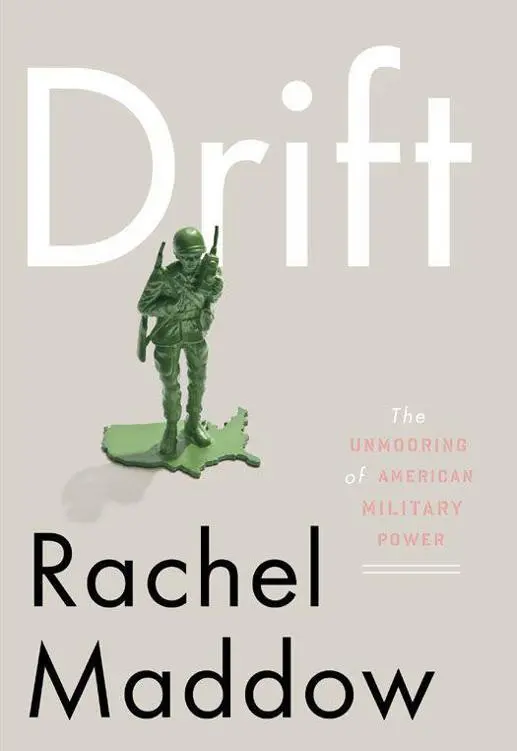
- Название:Drift
- Автор:
- Издательство:Crown Publishers
- Жанр:
- Год:2012
- Город:New York
- ISBN:978-0-307-46100-1
- Рейтинг книги:4 / 5. Голосов: 1
-
Избранное:Добавить в избранное
- Отзывы:
-
Ваша оценка:
Drift: краткое содержание, описание и аннотация
Предлагаем к чтению аннотацию, описание, краткое содержание или предисловие (зависит от того, что написал сам автор книги «Drift»). Если вы не нашли необходимую информацию о книге — напишите в комментариях, мы постараемся отыскать её.
Written with bracing wit and intelligence, Rachel Maddow’s
argues that we’ve drifted away from America’s original ideals and become a nation weirdly at peace with perpetual war, with all the financial and human costs that entails. To understand how we’ve arrived at such a dangerous place, Maddow takes us from the Vietnam War to today’s war in Afghanistan, along the way exploring the disturbing rise of executive authority, the gradual outsourcing of our war-making capabilities to private companies, the plummeting percentage of American families whose children fight our constant wars for us, and even the changing fortunes of G.I. Joe. She offers up a fresh, unsparing appraisal of Reagan’s radical presidency. Ultimately, she shows us just how much we stand to lose by allowing the priorities of the national security state to overpower our political discourse.
Sensible yet provocative, dead serious yet seriously funny,
will reinvigorate a “loud and jangly” political debate about how, when, and where to apply America’s strength and power—and who gets to make those decisions.
http://www.youtube.com/watch?v=Y9xoM7TMiTA
Drift — читать онлайн бесплатно полную книгу (весь текст) целиком
Ниже представлен текст книги, разбитый по страницам. Система сохранения места последней прочитанной страницы, позволяет с удобством читать онлайн бесплатно книгу «Drift», без необходимости каждый раз заново искать на чём Вы остановились. Поставьте закладку, и сможете в любой момент перейти на страницу, на которой закончили чтение.
Интервал:
Закладка:
The CIA has always used force. The agency was only about kindergarten age when they arranged the overthrow of the government of Iran, for crying out loud. And then on to mining the harbors in Nicaragua! But the covert action mission of the CIA has become something different now: the CIA is now a de facto branch of the military, with its own troops and its own robotic air force. President Obama chose for his second CIA director a man with no background whatsoever in civilian intelligence. No matter. Retired general David Petraeus had spent the previous four years running the US military in Iraq and Afghanistan, which apparently made him the perfect candidate for the job. Post-9/11, the CIA is a military force that wages war on America’s behalf. And it has the handy feature of being able to do so in places where we are not supposed to be at war. Having a secret military force with no visible chain of command, or recognizable rules of behavior or engagement, has become a most useful thing.
The secrecy extends to the CIA’s budget. In the ten years after the 9/11 attacks, the civilian spy budget doubled, but we taxpayers aren’t allowed to know what the various spy agencies are doing with our ever-more-generous contributions. We are told, after the fact, that the federal government spends around $55 billion a year on civilian intelligence (that’s not counting $27 billion for military intelligence), but what do we spend that on? Dunno. We’ve only been allowed to know the total dollar figure for the US intelligence so-called black budget since 2007. The idea that they’ll ever let us know its line items seems laughable; the 2007 press release noting with some resentment that the overall budget number would now be public also made clear that this was all we were getting: “Beyond the disclosure of the top-line figure, there will be no other disclosures.”
That attitude works for specific operations as well as it works for the overall enterprise. When pressed in 2009 by Pakistani reporters about “relentless” drone strikes in the Waziristans killing civilian bystanders, Secretary of State Hillary Clinton demonstrated the political benefit of using the CIA as trigger pullers. She just stonewalled. “I’m not going to comment on any particular tactic or technology.”
The CIA is obligated to brief the handful of souls on the House and Senate Intelligence Committees about their actions, but the briefees are legally required to keep their traps shut about anything they hear inside the closed-door sessions in ultrasecure rooms S-407 and HVC-304. They can’t even share it with fellow senators or House members. This can sometimes lead to an almost comic pantomime of what oversight is supposed to be. In 2010, two senators on the Intelligence Committee decided they were so upset by something they’d been briefed on that they had to alert the public. Senators Ron Wyden and Mark Udall did send up the alarm that they’d been briefed on something very disturbing; they just couldn’t say what it was. The press tried to report on their concerns, but it was difficult. The New York Times gamely described the senators’ worries about “some other kind of activity” and “some kind of unspecified domestic surveillance,” but they couldn’t explain further. “Unspecified” and “other” aren’t exactly the kinds of details that get the public’s heart pounding. Those senators may have been trying to ring alarm bells by going to the press, but those bells were pretty muffled. Our intel agencies are now well and truly integrated into how we wage war, but intel agencies don’t kowtow to lowly congressmen. You can know it, Mr. Wyden, but you can’t say a word. Sleep tight.
Of course, even that meager level of pseudo-sharing makes many a senior spook uncomfortable. So thank goodness for private contractors. Outfits like the She formerly known as Blackwater are not legally required to show up at HVC-304 and S-407 and tell how many Hellfire missiles they loaded on drones today, or where they did it. In 2011, the New York Times reported that private contractors accounted for about a quarter of the US
intelligence jobs. And if you don’t trust the Times , here’s what the director of national intelligence had to say in October of that year. The director wasn’t against lowering the number of contractors, but he insisted that private contractors would remain an integral and crucial part of our national spy game. “If all the contractors failed to come to work tomorrow,” he said, “the intelligence community would stop.”
Oh, and hey, if private contracts don’t provide sufficient insulation from public oversight, if the White House is queasy about turning over to Congress the civilian-to-bad-guy casualty-ratio algorithms used by the CIA and its for-profit civilian augmentees, not a problem ! The executive branch has a work-around for that, too. For operations the White House deems too sensitive or too politically combustible for congressional ears, there is always Joint Special Operations Command.
JSOC was created out of the embarrassments of post-Vietnam military operations: the botched attempt to rescue the Iran hostages, the bombing of the Marine barracks in Lebanon, and the unholy operational mess of the invasion of Grenada. We needed some elite badass soldiers in every branch, it was decided, whose various talents could be brought to bear, in concert, on difficult problems. JSOC has the use of elite, secretive units from all branches of the military, including the celebrated Navy SEAL Team 6, the Army’s Delta Force, and the Air Force’s Special Tactics Squadron. JSOC squads are sort of like Hasbro’s old Vietnam-era G.I. Joe Adventure Team come to life. (“Five rugged men with lifelike hair, outfitted for action, they’ll dare anything, and risk everything!”) Remember, the Adventure Team had the “flocked” hair, the beards, the Kung Fu Grip, the too-racy-for-regulation uniforms, the “Devil of the Deep” fantail watercraft, the “secret mission to Spy Island.” These were no regular Joes. They were clearly not bound by convention. They made their own rules.
By 2001, JSOC had run occasional and secret and daring operations at real-life Spy Islands in the Persian Gulf, Panama, Kuwait, El Salvador, Somalia, Haiti, and the Balkans. But the George W. Bush White House was the first to realize the full potential of Special Ops. Defense Secretary Rumsfeld and Vice President Cheney made them the equivalent of Reagan’s private-war-on-Nicaragua NSC—a thousand Ollie Norths (only more skilled and much more governable) at the ready. As Jeremy Scahill reported in The Nation at the end of 2009, “Special Forces turned into a virtual stand-alone operation that acted outside the military chain of command and in direct coordination with the White House.”
Unlike the Reagan White House, Team Bush didn’t wait around until after the fact to provide a justification for this move. The Bush lawyers (lots of them had worked for Meese) wrote up all the legal findings before the White House started sending Special Ops off with secret orders in their pockets. Essentially, the Bush administration claimed the Special Ops guys could do most anything they wanted in the War on Terror, anywhere the president chose to send them, and without telling anyone.
This is the sort of executive prerogative presidents in general appreciate, and President Obama has not been the exception to that rule. JSOC reportedly runs its own terrorist-targeting and drone-flying operations, with the help of contractors. “Contractors and especially JSOC personnel working under a classified mandate are not [overseen by Congress], so they just don’t care,” an intelligence source told Scahill. “If there’s one person they’re going after and there’s thirty-four people in the building, thirty-five people are going to die. That’s the mentality…. They’re not accountable to anybody and they know that.”
Читать дальшеИнтервал:
Закладка:
Похожие книги на «Drift»
Представляем Вашему вниманию похожие книги на «Drift» списком для выбора. Мы отобрали схожую по названию и смыслу литературу в надежде предоставить читателям больше вариантов отыскать новые, интересные, ещё непрочитанные произведения.










Обсуждение, отзывы о книге «Drift» и просто собственные мнения читателей. Оставьте ваши комментарии, напишите, что Вы думаете о произведении, его смысле или главных героях. Укажите что конкретно понравилось, а что нет, и почему Вы так считаете.