Rachel Maddow - Drift
Здесь есть возможность читать онлайн «Rachel Maddow - Drift» весь текст электронной книги совершенно бесплатно (целиком полную версию без сокращений). В некоторых случаях можно слушать аудио, скачать через торрент в формате fb2 и присутствует краткое содержание. Город: New York, Год выпуска: 2012, ISBN: 2012, Издательство: Crown Publishers, Жанр: Публицистика, на английском языке. Описание произведения, (предисловие) а так же отзывы посетителей доступны на портале библиотеки ЛибКат.
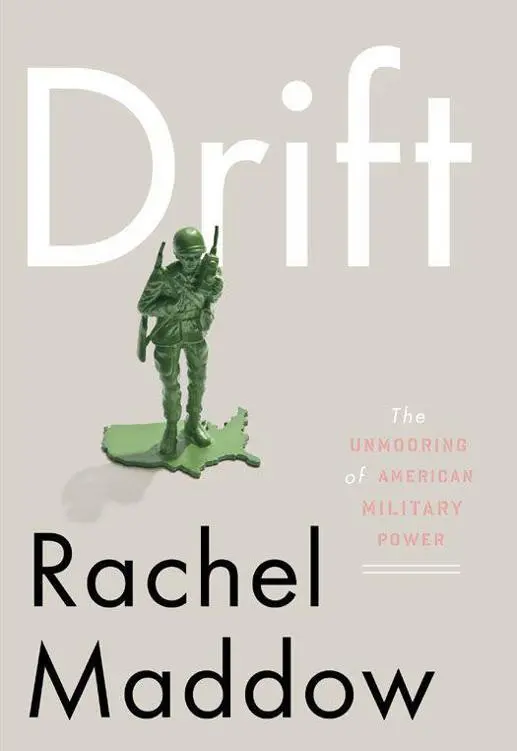
- Название:Drift
- Автор:
- Издательство:Crown Publishers
- Жанр:
- Год:2012
- Город:New York
- ISBN:978-0-307-46100-1
- Рейтинг книги:4 / 5. Голосов: 1
-
Избранное:Добавить в избранное
- Отзывы:
-
Ваша оценка:
Drift: краткое содержание, описание и аннотация
Предлагаем к чтению аннотацию, описание, краткое содержание или предисловие (зависит от того, что написал сам автор книги «Drift»). Если вы не нашли необходимую информацию о книге — напишите в комментариях, мы постараемся отыскать её.
Written with bracing wit and intelligence, Rachel Maddow’s
argues that we’ve drifted away from America’s original ideals and become a nation weirdly at peace with perpetual war, with all the financial and human costs that entails. To understand how we’ve arrived at such a dangerous place, Maddow takes us from the Vietnam War to today’s war in Afghanistan, along the way exploring the disturbing rise of executive authority, the gradual outsourcing of our war-making capabilities to private companies, the plummeting percentage of American families whose children fight our constant wars for us, and even the changing fortunes of G.I. Joe. She offers up a fresh, unsparing appraisal of Reagan’s radical presidency. Ultimately, she shows us just how much we stand to lose by allowing the priorities of the national security state to overpower our political discourse.
Sensible yet provocative, dead serious yet seriously funny,
will reinvigorate a “loud and jangly” political debate about how, when, and where to apply America’s strength and power—and who gets to make those decisions.
http://www.youtube.com/watch?v=Y9xoM7TMiTA
Drift — читать онлайн бесплатно полную книгу (весь текст) целиком
Ниже представлен текст книги, разбитый по страницам. Система сохранения места последней прочитанной страницы, позволяет с удобством читать онлайн бесплатно книгу «Drift», без необходимости каждый раз заново искать на чём Вы остановились. Поставьте закладку, и сможете в любой момент перейти на страницу, на которой закончили чтение.
Интервал:
Закладка:
After four years of assuming Western impotence, if not outright approval, Miloševic finally felt the noose tightening. Within weeks of the Croat victory at Krajina, in the face of ever more energetic NATO air strikes, and with the prospect of facing a newly armed (American-trained and -supported) coalition of Bosnians and Croatians, the Serb leader knuckled under. He came to the negotiating table to sign a deal that ended his genocidal four-year rampage.
So it was soon after the peace accords were signed that those twenty thousand American peacekeepers—who would be joined by twenty thousand private citizens under contract to provide support services—arrived in Bosnia and Croatia as part of an international force to keep Miloševic and his Serbian military under heel. And did Clinton have a hard time selling that manpower commitment to the American people? He did not. He was helped greatly by—what else? Outsourcing. Clinton had only had to make a minimal call-up of Guard members and Reserves. “An Army planner told us they could have asked the national command authority to increase the force ceiling and reserve call-up authority,” according to a US government audit of the Bosnian operation. “However, because they had LOGCAP as an option, it was not necessary to seek these increases to meet support needs.”
It was also not necessary for a skittish and unsure president to put himself on the line seeking a real show of public support for our mission. And Congress didn’t take a stand one way or the other. The president simply shipped American troops off to a possible war zone and both houses of Congress offered a mealy vote of almost-approval, expressing reservations about the president’s policy but agreeing to support “the men and women of the United States Armed Forces who are carrying out their missions in support of peace in Bosnia and Herzegovina with professional excellence, dedicated patriotism and exemplary bravery.” The Clinton administration got this not-quite-approval approval largely because it assured Congress that the mission would be short and limited.
More than three years later, there were still thousands of American troops in Bosnia. And when Miloševic’s Serbian Army started menacing a new target in former Yugoslavia, Kosovo, Clinton had a game plan at the ready. NATO started up another bombing campaign and the president prepared to deploy an entirely new contingent of US soldiers to keep the peace in yet another former Yugoslavian state. “How could the U.S. military find a way to provide the logistics for its forces, without calling up reserves or the National Guard, while at the same time helping to deal with the humanitarian crisis that the war had provoked?” asked Peter W. Singer in his book Corporate Warriors . “Simple: the U.S. military would pass the work on to someone else…. Instead of having to call up roughly 9,000 reservists, Brown & Root Services was hired.”
Cheney’s little “augmentation” program had proved a godsend to the Clinton administration. “It is often necessary to use LOGCAP in these missions,” noted the Government Accounting Office report on Bosnia in 1997, “because of the political sensitivity of activating guard and reserve forces.”
That political sensitivity is there for a reason. Mounting an overseas military operation should force a national gut-check about wars that presidents might otherwise rush us into. It lessens the possibility of stranding our military in conflicts the country doesn’t support or, worse, doesn’t care about. Having a work-around for that political sensitivity must have felt like genius to those who wanted war without the hassle, but even in the short run, that work-around had clear unintended consequences. Not only was there little public debate about the merits of a major American deployment, there was also less pressure to bring the mission to a quick conclusion. American peacekeeping troops were in the Balkans for more than eight years, without the general public much noticing. Even at the time of the initial deployment, little more than a third of the country was closely following the story; only a fifth understood the details of the US contribution to the international peacekeeping force. The American public, according to a Pew Research Center poll, was much more interested in a recent blizzard and a weekend-long federal government shutdown. Eight years into the Balkan mission, the American public was even less engaged.
“Deploying LOGCAP or other contractors instead of military personnel can alleviate the political and social pressures that have come to be a fact of life in the U.S. whenever military forces are deployed,” wrote Lt. Col. Steven Woods in his Army War College study about the effects of LOGCAP. “While there has been little to no public reaction to the deaths of five DynCorp employees killed in Latin America or the two American support contractors from Tapestry Solutions attacked (and one killed) in Kuwait… U.S. forces had to be withdrawn from Somalia after public outcry following the deaths of U.S. soldiers in Mogadishu….
“Additionally, military force structure often has a force cap, usually for political reasons. Force caps impose a ceiling on the number of soldiers that can be deployed into a defined area. Contractors expand this limit.” To infinity and beyond, in other words, with a pay-to-play pop-up army.
By the time Bill Clinton left office in 2001, an Operation Other Than War, as Pentagon forces called them, could go on indefinitely, sort of on autopilot—without real political costs or consequences, or much civilian notice. We’d gotten used to it.
By 2001, the ability of a president to start and wage military operations without (or even in spite of) Congress was established precedent.
By 2001, even the peacetime US military budget was well over half the size of all other military budgets in the world combined.
By 2001, the spirit of the Abrams Doctrine—that the disruption of civilian life is the price of admission for war—was pretty much kaput.
By 2001, we’d freed ourselves of all those hassles, all those restraints tying us down.
CHAPTER 8
“One Hell of a Killing Machine”
THE HOUBARA BUSTARD IS NOT A PARTICULARLY LARGE OR regal bird. It looks a little like what you might get if you bred a common pheasant with an ostrich—like a miniature ostrich with a shorter neck and legs, or maybe a pheasant on steroids, with a stretched neck, sprinter’s legs, and a much more impressive wingspan. But the little fella has recently provided crucial assistance in making America’s war in Afghanistan (and its spillover in Pakistan) the longest-running military hot show in our nation’s history.
In May 2011, Pakistan got its nose out of joint when US Special Forces sprung a surprise mission on a compound in Abbottabad and offed the most infamous terrorist on the planet, without giving a heads-up to the host government. The Pakistani military and intelligence service found itself having to explain how the target, Osama bin Laden, could have been living in tranquility just a few miles down the road from Pakistan’s most important military academy, in a neighborhood crawling with current and retired military officers. Was Pakistani intelligence that incompetent, or were they protecting bin Laden? And then they had to explain how a US strike force and its very big helicopters could fly into Abbottabad, spend nearly an hour on the ground, and then leave the country with bin Laden’s carcass in tow without being detected, let alone stopped.
While President Obama and the rest of America took a celebratory victory lap, the Pakistanis found the entire episode hugely shaming—but not so much on the bin-Laden-in-our-backyard count. They really fixated on the lack of respect accorded their nation by the United States. “American troops coming across the border and taking action in one of our towns… is not acceptable to the people of Pakistan,” former president Pervez Musharraf said the day after the raid. “It is a violation of our sovereignty.” Worse, word quickly leaked out that President Obama had not only ordered that the Pakistani military and its intelligence service be kept in the dark while the mission was being planned and executed, he had his team ready to do battle with any Pakistani military forces that tried to stop the operation once in progress.
Читать дальшеИнтервал:
Закладка:
Похожие книги на «Drift»
Представляем Вашему вниманию похожие книги на «Drift» списком для выбора. Мы отобрали схожую по названию и смыслу литературу в надежде предоставить читателям больше вариантов отыскать новые, интересные, ещё непрочитанные произведения.









Обсуждение, отзывы о книге «Drift» и просто собственные мнения читателей. Оставьте ваши комментарии, напишите, что Вы думаете о произведении, его смысле или главных героях. Укажите что конкретно понравилось, а что нет, и почему Вы так считаете.