Rachel Maddow - Drift
Здесь есть возможность читать онлайн «Rachel Maddow - Drift» весь текст электронной книги совершенно бесплатно (целиком полную версию без сокращений). В некоторых случаях можно слушать аудио, скачать через торрент в формате fb2 и присутствует краткое содержание. Город: New York, Год выпуска: 2012, ISBN: 2012, Издательство: Crown Publishers, Жанр: Публицистика, на английском языке. Описание произведения, (предисловие) а так же отзывы посетителей доступны на портале библиотеки ЛибКат.
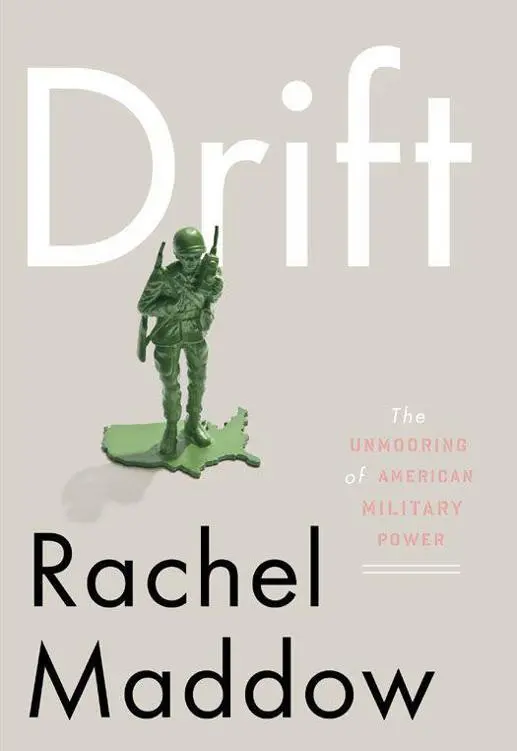
- Название:Drift
- Автор:
- Издательство:Crown Publishers
- Жанр:
- Год:2012
- Город:New York
- ISBN:978-0-307-46100-1
- Рейтинг книги:4 / 5. Голосов: 1
-
Избранное:Добавить в избранное
- Отзывы:
-
Ваша оценка:
Drift: краткое содержание, описание и аннотация
Предлагаем к чтению аннотацию, описание, краткое содержание или предисловие (зависит от того, что написал сам автор книги «Drift»). Если вы не нашли необходимую информацию о книге — напишите в комментариях, мы постараемся отыскать её.
Written with bracing wit and intelligence, Rachel Maddow’s
argues that we’ve drifted away from America’s original ideals and become a nation weirdly at peace with perpetual war, with all the financial and human costs that entails. To understand how we’ve arrived at such a dangerous place, Maddow takes us from the Vietnam War to today’s war in Afghanistan, along the way exploring the disturbing rise of executive authority, the gradual outsourcing of our war-making capabilities to private companies, the plummeting percentage of American families whose children fight our constant wars for us, and even the changing fortunes of G.I. Joe. She offers up a fresh, unsparing appraisal of Reagan’s radical presidency. Ultimately, she shows us just how much we stand to lose by allowing the priorities of the national security state to overpower our political discourse.
Sensible yet provocative, dead serious yet seriously funny,
will reinvigorate a “loud and jangly” political debate about how, when, and where to apply America’s strength and power—and who gets to make those decisions.
http://www.youtube.com/watch?v=Y9xoM7TMiTA
Drift — читать онлайн бесплатно полную книгу (весь текст) целиком
Ниже представлен текст книги, разбитый по страницам. Система сохранения места последней прочитанной страницы, позволяет с удобством читать онлайн бесплатно книгу «Drift», без необходимости каждый раз заново искать на чём Вы остановились. Поставьте закладку, и сможете в любой момент перейти на страницу, на которой закончили чтение.
Интервал:
Закладка:
That sort of tough talk certainly put the bounce back in Dick Cheney’s step. He’d had to give up on having the Soviets as a real enemy, but he and deputies like Paul Wolfowitz and Scooter Libby went to work constructing a rationale for refitting the US military for this new New World Peril. “If we choose wisely today, we can do well something America has always done badly before,” Cheney would say, “we can draw down our military force at a responsible rate that will not end up endangering our security.”
The basic idea was that in this dangerous world, where threats to our national security could rear up in the Middle East, or the Korean Peninsula, or even in the Americas, we had to be ready to move quickly, and maybe into more than one place at a time. Think of it as a two-fisted game of intercontinental Whac-A-Mole. “Highly ready and rapidly deployable power projection forces,” Cheney wrote, “including forcible entry forces, remain key means of precluding challengers.”
If, in 1990, the new mission for the US military was stopping the emergence of any challenger anywhere in the world, the mission sure wasn’t shrinking, but budget pressures meant the active-duty force would have to. Cheney and company hit on what seemed like a simple and rational way to squeeze dollars without squeezing military capability: do more with less. Take the Gulf War, for example. So many of the soldiers shipped to the Persian Gulf were simply there to handle the care and feeding of the fighting troops. Did the cooks at the base in Saudi Arabia need to be US Army? The maintenance workers? The electricians? The plumbers? Did it require a US-trained soldier to wash sheets and towels and skivvies? Couldn’t someone else do that? Not a bad idea, on the face of it.
Cheney started by reordering the architectural bureaucracy of the US military. He changed the so-called four pillars of military capability (readiness, sustainability, modernization, and force structure) to— voilà! —six pillars. Modernization became two pillars now—one for science and technology and one for systems acquisition (in other words, the pillar that was buying stuff from defense contractors became, instead: buying stuff from defense contractors A , and buying stuff from defense contractors B ). Cheney also invented a sixth pillar—and this was genius—called infrastructure and overhead. As if there was no infrastructure and overhead already in weapons acquisition or force readiness or any other part of the military. Cheney pretended that infrastructure and overhead could be sequestered in one part of the budget and cut, alone, without affecting anything else. “The Department must vigorously pursue reductions and management efficiencies in defense infrastructure and overhead,” Cheney, Wolfowitz, and Libby et al. wrote as they were on their way out of office. And how would this vigorous pursuit of reductions be executed? What they left in place for the business school wannabes of the next administration was a little something called the Logistics Civilian Augmentation Program (a defense program name that for once made sense: civilians augmenting the military).
The first private contractor under this program was signed on in 1992, during the last months of Dick Cheney’s tenure as secretary of defense. It was a company called Brown & Root Services Corporation. Four years later, while the contract was still in place, Cheney was making a very comfortable living as CEO of Brown & Root’s parent corporation, Halliburton. And after Vice President Cheney helped push us into wars in Afghanistan and Iraq, the value of those contracts kept Halliburton stock bouncing happily along. You can read all the conspiracy you want to into that, but focusing on Cheney’s bank accounts misses the forest for the trees. In utterly nonconspiratorial point of fact, the merits of that big Halliburton contract—known by its acronym, LOGCAP—seemed so obvious to all concerned that the military’s congressional overseers never seriously discussed the possible downsides of handing over pieces of military budget line items to private contractors.
LOGCAP soon became the darling of technocrats on both sides of the political aisle. The program that began under the first President Bush grew enormously under President Bill Clinton. Tiny cohorts of civilian augmenters had been deployed alongside US troops before, “but it wasn’t until the U.S. led NATO forces into Bosnia in 1995,” wrote BusinessWeek , “that the entire private military industry came of age.”
The Clinton administration leaned hard on LOGCAP. Vice President Al Gore, who was vigorously reinventing government to be more responsive and empowering federal employees to find cost savings and generally imposing the kind of management efficiencies that get the profs at Harvard Business School all hot and bothered, held up the Pentagon’s LOGCAP program as a poster child for good governance. “Outsourcing or privatization of key support functions, with the strong prospect of lowering costs and improving performance, is under way under the leadership of the Deputy Secretary of Defense,” trumpeted Gore’s 1996 report on the streamlining of the Defense Department.
Some sections read like brochure copy for Cheney’s Halliburton: “LOGCAP has provided the Army with a highly flexible contractual means of providing quality of life services to troops deployed in some of the harshest environments in the world, without impacting its combat capability.”
It’s like they thought it was magic; you half expected the pages of that Al Gore report to shake loose a little glitter, a smiley face sticker or two.
In Clinton’s eight years in office—massive cost overruns and sex-slave scandals notwithstanding—the military’s program of privatization exploded. In 1992, the US Department of Defense did a few hundred million dollars’ worth of business with private contractors. By the time Clinton left office, the Department of Defense had executed more than three thousand contracts valued at about $300 billion . In fact, Defense had been contracting private vendors with such eager rapidity that nobody at the Pentagon could actually tot up the number of private workers who were on the military’s payroll (once removed). Maybe it was 125,000 people. Maybe closer to 600,000. Not quite sure.
They were unable to tell Congress or anybody else exactly how much was being doled out for training, security, or food services. But the Pentagon did have some other numbers to share that sounded good. Consider the savings, they told congressional committees: skilled local laborers hired to do plumbing or electrical work on overseas bases, for instance, were paid at least ten dollars an hour less than a soldier might be. And a company like KBR (Brown & Root had merged with another company to become Kellogg, Brown & Root, or KBR) could pay $1.12 an hour to an unskilled Croatian laborer, where an American soldier might cost $16 an hour, and leave the government on the hook for all those “quality of life” benefits like medical care and dental care and day care. Didn’t take a degree in finance to see the value in that.
The Clinton years saw some spectacular mission creep in outsourcing, too. By the time Clinton left office, Department of Defense privatization was a damn sight more than the effort to get twenty-four-hour Oscar Mayer products and cornflakes and Gatorade into PXs on forward military bases in Bosnia. The military had also outsourced pieces of information technology, data processing, payroll, mapping, aerial surveillance—even intelligence gathering.
Private American companies were providing military expertise and weapons training to countries like Saudi Arabia and Kuwait. One particular beneficiary was a private company founded by a gaggle of recently retired US Army generals, Military Professional Resources Incorporated (MPRI), “with a recognition that there is a great national resource in the retired military community,” as one of the principals said. “And if that talent could be brought together we could provide various military expertise in a variety of ways to our government.” Less modestly, MPRI described itself as “the greatest corporate assemblage of military expertise in the world.”
Читать дальшеИнтервал:
Закладка:
Похожие книги на «Drift»
Представляем Вашему вниманию похожие книги на «Drift» списком для выбора. Мы отобрали схожую по названию и смыслу литературу в надежде предоставить читателям больше вариантов отыскать новые, интересные, ещё непрочитанные произведения.










Обсуждение, отзывы о книге «Drift» и просто собственные мнения читателей. Оставьте ваши комментарии, напишите, что Вы думаете о произведении, его смысле или главных героях. Укажите что конкретно понравилось, а что нет, и почему Вы так считаете.