Rachel Maddow - Drift
Здесь есть возможность читать онлайн «Rachel Maddow - Drift» весь текст электронной книги совершенно бесплатно (целиком полную версию без сокращений). В некоторых случаях можно слушать аудио, скачать через торрент в формате fb2 и присутствует краткое содержание. Город: New York, Год выпуска: 2012, ISBN: 2012, Издательство: Crown Publishers, Жанр: Публицистика, на английском языке. Описание произведения, (предисловие) а так же отзывы посетителей доступны на портале библиотеки ЛибКат.
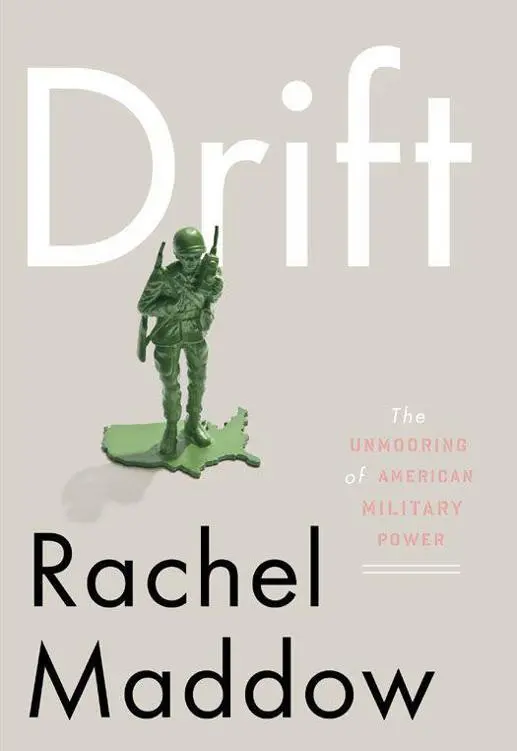
- Название:Drift
- Автор:
- Издательство:Crown Publishers
- Жанр:
- Год:2012
- Город:New York
- ISBN:978-0-307-46100-1
- Рейтинг книги:4 / 5. Голосов: 1
-
Избранное:Добавить в избранное
- Отзывы:
-
Ваша оценка:
Drift: краткое содержание, описание и аннотация
Предлагаем к чтению аннотацию, описание, краткое содержание или предисловие (зависит от того, что написал сам автор книги «Drift»). Если вы не нашли необходимую информацию о книге — напишите в комментариях, мы постараемся отыскать её.
Written with bracing wit and intelligence, Rachel Maddow’s
argues that we’ve drifted away from America’s original ideals and become a nation weirdly at peace with perpetual war, with all the financial and human costs that entails. To understand how we’ve arrived at such a dangerous place, Maddow takes us from the Vietnam War to today’s war in Afghanistan, along the way exploring the disturbing rise of executive authority, the gradual outsourcing of our war-making capabilities to private companies, the plummeting percentage of American families whose children fight our constant wars for us, and even the changing fortunes of G.I. Joe. She offers up a fresh, unsparing appraisal of Reagan’s radical presidency. Ultimately, she shows us just how much we stand to lose by allowing the priorities of the national security state to overpower our political discourse.
Sensible yet provocative, dead serious yet seriously funny,
will reinvigorate a “loud and jangly” political debate about how, when, and where to apply America’s strength and power—and who gets to make those decisions.
http://www.youtube.com/watch?v=Y9xoM7TMiTA
Drift — читать онлайн бесплатно полную книгу (весь текст) целиком
Ниже представлен текст книги, разбитый по страницам. Система сохранения места последней прочитанной страницы, позволяет с удобством читать онлайн бесплатно книгу «Drift», без необходимости каждый раз заново искать на чём Вы остановились. Поставьте закладку, и сможете в любой момент перейти на страницу, на которой закончили чтение.
Интервал:
Закладка:
The Pakistani parliament called the country’s military and intelligence chieftains into a rare (and marathon) closed-door session, where the generals had a spot of trouble in covering their respective lapses, but they did deftly deflect much of the civilian ire: the United States, they reminded everyone, was the bad guy here. The generals had little trouble encouraging parliament to formally demand that, henceforth, the United States would ensure that “Pakistan’s national interests were fully respected.” Ally schmally —the Pakistani people deserved some respect. To add some bite to this declaration of sovereignty, the generals suggested a good first step would be forcing the United States to shut down the secret program the CIA had been running out of an airbase in a remote corner of Pakistan called Balochistan. Unfortunately, in publicizing their demand that the CIA leave that airbase, the generals also revealed to surprised Pakistani legislators… that the CIA had been using that airbase . This was cause for an uproar in parliament, but the fact that the CIA had been flying armed drones out of the airfield known as Shamsi came as much less of a surprise to the citizens of the areas those drones were targeting—the tribal regions.
The CIA’s rather dumpy-looking high-tech unmanned aircraft had been used mainly for surveillance in the early stages of the war in Afghanistan. But they could also be armed with Hellfire missiles. Very occasionally from 2004 to 2007, and more frequently in 2008, the Bush administration used drones to launch airborne attacks on suspected terrorists in Pakistan. When the Obama administration took over in 2009, the number of drone attacks spiked; the next year the 2009 numbers more than doubled. The Obama administration refused as a matter of policy to officially acknowledge the CIA’s drone attacks, but in the days following a big get, they announced that some key Al-Qaeda or Haqqani Network leader “was killed,” as if the event were an act of providence or, like a rainbow, a remarkable atmospheric happening.
Meanwhile, in North and South Waziristan, the presence of the drones has become a hated fact of life—the locals reportedly call them “wasps.” So this was a very popular move in Pakistan, telling the CIA to get the hell out of Shamsi, that there would be no more lethal American drones launched from Pakistani soil… or else. Or else what? Well, Pakistan’s air marshal reminded the Obama administration, the F-16 jets the United States had sold the Pakistani Air Force could knock the drones out of the sky. Team Obama did not flinch. These drone attacks had become the centerpiece of Obama’s recalibration of America’s Global War on Terror, even if we didn’t call it that anymore. The strikes had proved Democrats could be as serious about killing bad guys as Republicans were. In fact, the successes had been among the few bright spots on a fairly bleak political landscape for a young, inexperienced, first-term president. The Obama administration had no intention of pulling up stakes in Shamsi. “That base is neither vacated nor being vacated” was the anonymous but official word from Washington. It was a Mexican standoff in Balochistan.
Here’s where the Houbara bustard provided a little wiggle room in what otherwise looked like a very knotty situation. This tiny forgotten strip of land that held the airbase in Shamsi, it turned out, did not actually belong to Pakistan; it had been quietly signed over to the United Arab Emirates twenty years earlier, in a show of friendship. You see, Balochistan, aside from being full of spectacular Garden of Eden natural wonders, is among the few wintering grounds of the Houbara bustard, a bird held in high esteem among hunters from the UAE and Saudi Arabia and Qatar. Falconry is the sport of Arab kings, and the poor bustard had long been the preferred prey for falconers. So Emirati royalty were really pleased to have this special foothold in Balochistan, and right away built themselves a sizeable landing strip for easy access to this surprisingly sought-after corner of the world.
“The sheiks tell me it is the ultimate challenge for the falcon,” a chieftain in Balochistan told New Yorker writer Mary Anne Weaver back around the time the Emiratis built the Shamsi airstrip. “The falcon is the fastest bird on earth, and the houbara is also fast, both on the ground and in the air. It is also a clever, wary bird, with a number of tricks.” Among these tricks, the chieftain continued, is an ability to ink-jet “a dark-green slime violently from its vent. Its force is so strong that it can spread for three feet, and it can temporarily blind the falcon, or glue its feathers together, making it unable to fly.” The belief also persisted that the meat of the bustard was an aphrodisiac. Not hard to see why the bustard had been sought and consumed with such sustained effort that the bird was nearly extinct on the Arabian Peninsula.
Cold War politics had added degrees of difficulty for the sportsmen as well. The fall of the shah in 1979 made bustard hunting problematic for Sunni Arabs in Shiite Iran, as had the near-constant state of war in Afghanistan. So Balochistan emerged as the destination spot for latter-day Arab Nimrods. For the last twenty years or so, Emirati sheiks and Saudi princes and the more general run of ambitious Arab dignitaries had jockeyed for the best allotments in the last good place on earth to hunt the bustard. (When Pakistan’s foreign office bestowed upon the Emirati poobahs an allotment once held by the Saudis, the Saudis withheld oil supplies from Pakistan and money for flood relief.) Arab royalty of various stripes show up every year with, according to Weaver’s description, pop-up tent cities, hundreds of servants, satellite dishes for better communication, and hunting vehicles tricked out with sophisticated laptops, infrared spotlights, and bustard-seeking radar. Maybe not sporting, but certainly effective.
Officials at Pakistan’s Ministry of Environment warned over and over about their ever-dwindling bustard population, but they were powerless to keep the Arab potentates to their bag limit of one hundred birds a year. “They never respect code of conduct,” said one ministry man. “What can the Wildlife Department do if the crown prince of Saudi Arabia, the president of the UAE or emir of Qatar go into a region that is prohibited for hunting and cross their bag limit?” Not much, apparently, if Pakistan still wanted cheap oil and dirhams and riyals for flood relief, or jet fighters and tanks.
The Emiratis had made one concession that slightly crimped their style in the bustard-hunting department. In the weeks after the 9/11 attacks in 2001—when everybody wanted to pitch in—they had agreed, with the consent of Pakistani president Musharraf, to let the Americans use Shamsi as a base to supply US troops fighting the Taliban just across the border in Afghanistan… and maybe for a few special and classified operations. In the ten years that followed, as the CIA (and its many private contractors) began operating lethal attack drones out of Shamsi, the remote top secret base remained off-limits to Pakistan’s own Air Force. So when the shit hit the fan (when the slime hit the falcon) in the aftermath of the bin Laden raid, thanks to the Houbara bustard, everybody had an out: the United States could make it plain that the CIA was not vacating Shamsi, and Pakistan could still save face. Pakistani government officials could say—and did!—Hey, we just checked our land records and it turns out this little strip of Balochistan is not, legally speaking, Pakistan-controlled territory after all. We gave it to the Emiratis for bustard hunting! So, sorry, but there’s nothing we can do to stop the part of America’s secret drone war operating out of Shamsi. But we do condemn it in the strongest possible language.
Читать дальшеИнтервал:
Закладка:
Похожие книги на «Drift»
Представляем Вашему вниманию похожие книги на «Drift» списком для выбора. Мы отобрали схожую по названию и смыслу литературу в надежде предоставить читателям больше вариантов отыскать новые, интересные, ещё непрочитанные произведения.








Обсуждение, отзывы о книге «Drift» и просто собственные мнения читателей. Оставьте ваши комментарии, напишите, что Вы думаете о произведении, его смысле или главных героях. Укажите что конкретно понравилось, а что нет, и почему Вы так считаете.