Rachel Maddow - Drift
Здесь есть возможность читать онлайн «Rachel Maddow - Drift» весь текст электронной книги совершенно бесплатно (целиком полную версию без сокращений). В некоторых случаях можно слушать аудио, скачать через торрент в формате fb2 и присутствует краткое содержание. Город: New York, Год выпуска: 2012, ISBN: 2012, Издательство: Crown Publishers, Жанр: Публицистика, на английском языке. Описание произведения, (предисловие) а так же отзывы посетителей доступны на портале библиотеки ЛибКат.
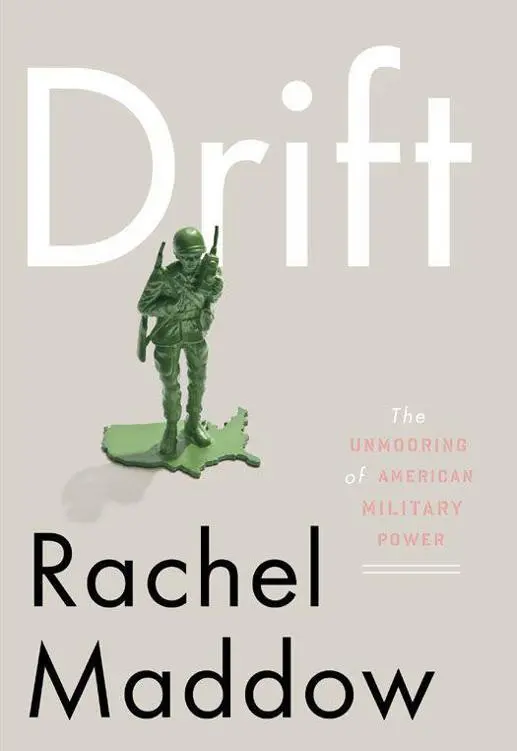
- Название:Drift
- Автор:
- Издательство:Crown Publishers
- Жанр:
- Год:2012
- Город:New York
- ISBN:978-0-307-46100-1
- Рейтинг книги:4 / 5. Голосов: 1
-
Избранное:Добавить в избранное
- Отзывы:
-
Ваша оценка:
Drift: краткое содержание, описание и аннотация
Предлагаем к чтению аннотацию, описание, краткое содержание или предисловие (зависит от того, что написал сам автор книги «Drift»). Если вы не нашли необходимую информацию о книге — напишите в комментариях, мы постараемся отыскать её.
Written with bracing wit and intelligence, Rachel Maddow’s
argues that we’ve drifted away from America’s original ideals and become a nation weirdly at peace with perpetual war, with all the financial and human costs that entails. To understand how we’ve arrived at such a dangerous place, Maddow takes us from the Vietnam War to today’s war in Afghanistan, along the way exploring the disturbing rise of executive authority, the gradual outsourcing of our war-making capabilities to private companies, the plummeting percentage of American families whose children fight our constant wars for us, and even the changing fortunes of G.I. Joe. She offers up a fresh, unsparing appraisal of Reagan’s radical presidency. Ultimately, she shows us just how much we stand to lose by allowing the priorities of the national security state to overpower our political discourse.
Sensible yet provocative, dead serious yet seriously funny,
will reinvigorate a “loud and jangly” political debate about how, when, and where to apply America’s strength and power—and who gets to make those decisions.
http://www.youtube.com/watch?v=Y9xoM7TMiTA
Drift — читать онлайн бесплатно полную книгу (весь текст) целиком
Ниже представлен текст книги, разбитый по страницам. Система сохранения места последней прочитанной страницы, позволяет с удобством читать онлайн бесплатно книгу «Drift», без необходимости каждый раз заново искать на чём Вы остановились. Поставьте закладку, и сможете в любой момент перейти на страницу, на которой закончили чтение.
Интервал:
Закладка:
McCain was carrying a lot of water for the Pentagon in those days. Popular myth to the contrary, the American institution often least interested in going to war is the US military; it is especially wary of a war civilian leaders promise will be limited. “The use of force was controversial,” wrote Nancy Soderberg, Clinton’s deputy assistant for national security affairs, “and the strongest opponent was the Pentagon and Powell.”
The holdover chairman of the Joint Chiefs of Staff, Gen. Colin Powell, seemed to be aware that he was already a few points ahead of President Clinton in the earliest 1996 election polls, and that triple the number of Americans trusted General Powell in the arena of foreign policy than trusted the president. And he frankly judged Clinton as a bit too much of an on-the-one-hand-on-the-other-hand academic. Long years on the national security watch had given the general a much stronger stomach than the new president when it came to absorbing the daily press accounts of prison camp survivors, or of homeless and starving Muslim and Croat refugees, or of the victims of Serbian artillery, snipers, and paramilitary knife-wielding thugs. Polite, slightly condescending, and occasionally testy was how Soderberg described Powell’s demeanor when he was engaged in steering Clinton and his national security team away from the “limited war” scenario of bombing runs followed by… more bombing runs. “Powell argued repeatedly that any such action would be tantamount to going to war with Serbia,” Soderberg wrote. “ ‘Don’t fall in love with air power because it hasn’t worked,’ [he said]. To Powell, air power would not change Serb behavior, ‘only troops on the ground could do that.’ ”
“Time and again he led us up the hill of possibilities and dropped us off on the other side with the practical equivalent of ‘No can do,’ ” Clinton’s ambassador to the United Nations Madeleine Albright wrote in her memoir. “After hearing this for the umpteenth time, I asked in exasperation, ‘What are you saving this superb military for, Colin, if we can’t use it?’ ”
“I thought I would have an aneurysm,” Powell wrote of that moment.
“The Pentagon,” wrote Soderberg, “dragged its feet developing the military plans for Bosnia and raised numerous objections…. Senior military leaders were quick to point out that any such deployment would require a call-up of reserves, which would be politically unpopular, especially for a new president wanting to focus on domestic issues so early in his term.”
Meanwhile, some in the press were throwing down the gauntlet. “Nobody in Clinton’s administration has yet explained, simply and plainly, what America’s interests and objectives in the Balkans are,” the Economist editorialized. “[President Clinton] will have to do better than say that he has thought things over carefully. He will have to tell a puzzled people, with no great desire to put its children in harm’s way, why he is doing precisely that. It is, by a long way, the greatest test yet of whether he is up to the job.”
With his public approval ratings already sinking under the weight of policy fumbles like gays in the military and a failing health-care initiative, Clinton decided to take a pass on his Balkans test. In this game of chicken with the Pentagon and mouthpieces like McCain, Clinton blinked. Clinton managed to commit the US military to a fairly impotent “no-fly zone” operation, and applauded the UN-formed “safe zones” in the Balkans, but other than that he sat back and watched while Miloševic and Serb warlords continued to grind down the Croats and the Bosnians, and then taunt the West. The Serbs waved off calls for peace plans or other diplomatic overtures. “Bosnia never existed,” said one of Miloševic’s deputies, “and it will never.” The nastiest general in the Serbian Army, Ratko Mladic, who would kill seven thousand Muslim men and boys (civilians all) in Srebenica, warned that if the Americans and their allies ever did try to stop them, “they would leave their bones in Bosnia…. If [the West] bombs me, I’ll bomb London. There are Serbs in London. There are Serbs in Washington.”
Even with a villain like Mladic to help his case, President Clinton never really expended much effort on the politically costly task of convincing the American public of the need to arm the Bosnians or Croatians, or the need to unleash American air power on Miloševic and the Serbs, or the need to put US boots on the ground. Instead, he found a way to do something without the necessity of making any vigorous public argument for it, and without much involving his own balky Pentagon. Thank you, MPRI!
It happened like this: In 1994, a little more than a year into Clinton’s presidency, the Croatian minister of defense asked Washington if he might, in spite of the UN arms embargo, get some help—like, say, weapons or training or a leg up in gaining admission to NATO. The Pentagon referred the minister (a native Croatian with a successful Canadian pizza business; well-spoken and serious, he was) to an outfit down the road in Alexandria, Virginia, called Military Personnel Resources Incorporated. A few months later, MPRI signed a contract with the Croatian government—sanctioned in advance by the US Departments of Defense and State—called the Democratic Transition Assistance Program. By early 1995, a cadre of former US generals, including a former Army chief of staff and a former head of US Army, Europe, together with retired line officers and NCOs, began “training [Croatian] officers in basic leadership skills and an understanding of where they fit into a democratic society,” according to an MPRI spokesman. “We teach general management, training management. We teach how to do planning, programming, the budgeting process, which is new to them.”
By the time MPRI’s “democratic transition assistance” work in Croatia got under way, the Clinton administration had already given a tacit go-ahead to other countries (particularly Iran!) to arm the Bosnians too. For allowing the flow of arms to Bosnia through its ports and across its airspace, the Croatians got a cut that added up to about 30 percent of the Iranian weapons shipments. While under the tutelage of MPRI, the Croats also bought a billion dollars’ worth of tanks and assault helicopters from the old Warsaw powers. And then they put them to good use.
In August 1995, about half a year after MPRI took up their instruction at the Petar Zrisnki Military Academy in Croatia, the Croats launched an offensive called Operation Storm. The objective was to take back a former Croatian region called Krajina, which the Serb Army had violently seized a few years earlier. Within a week, the Croat Army had routed the Serbs, surprising everyone in the Balkans, and the world. “The lightning five-pronged offensive, integrating air power, artillery and rapid infantry movements, and relying on intense maneuvers to unhinge Serbian command and control networks, bore many hallmarks of U.S. Army doctrine,” a reporter in Krajina wrote at the time. “It was a textbook operation,” said a British colonel in charge of UN troops in Krajina, “though not a [Yugoslav Army] textbook. Whoever wrote that plan of attack could have gone to any NATO staff college in North America or Western Europe and scored an A-plus.”
Suspicions for training up the Croatian Army into a lethal, Western-style fighting force naturally fell on MPRI, but the contract generals took pains to remind anybody who asked that the company was just there to provide “democratic transition assistance” and not to plan battles or game out wars. Clinton didn’t appear to care one way or another about MPRI’s actual role in Operation Storm. He was giddy with the result. “I was rooting for the Croatians,” the president wrote in his autobiography. “It was the first defeat for the Serbs in four years, and it changed both the balance of power on the ground and the psychology of all the parties. One Western diplomat in Croatia was quoted as saying, ‘There was almost a signal of support from Washington. The Americans have been spoiling for a chance to hit the Serbs, and they are using Croatia as their proxy to do the deed for them.’ ” Clinton apparently agreed with the diplomat’s assessment enough to quote him, and proudly.
Читать дальшеИнтервал:
Закладка:
Похожие книги на «Drift»
Представляем Вашему вниманию похожие книги на «Drift» списком для выбора. Мы отобрали схожую по названию и смыслу литературу в надежде предоставить читателям больше вариантов отыскать новые, интересные, ещё непрочитанные произведения.








Обсуждение, отзывы о книге «Drift» и просто собственные мнения читателей. Оставьте ваши комментарии, напишите, что Вы думаете о произведении, его смысле или главных героях. Укажите что конкретно понравилось, а что нет, и почему Вы так считаете.