Rachel Maddow - Drift
Здесь есть возможность читать онлайн «Rachel Maddow - Drift» весь текст электронной книги совершенно бесплатно (целиком полную версию без сокращений). В некоторых случаях можно слушать аудио, скачать через торрент в формате fb2 и присутствует краткое содержание. Город: New York, Год выпуска: 2012, ISBN: 2012, Издательство: Crown Publishers, Жанр: Публицистика, на английском языке. Описание произведения, (предисловие) а так же отзывы посетителей доступны на портале библиотеки ЛибКат.
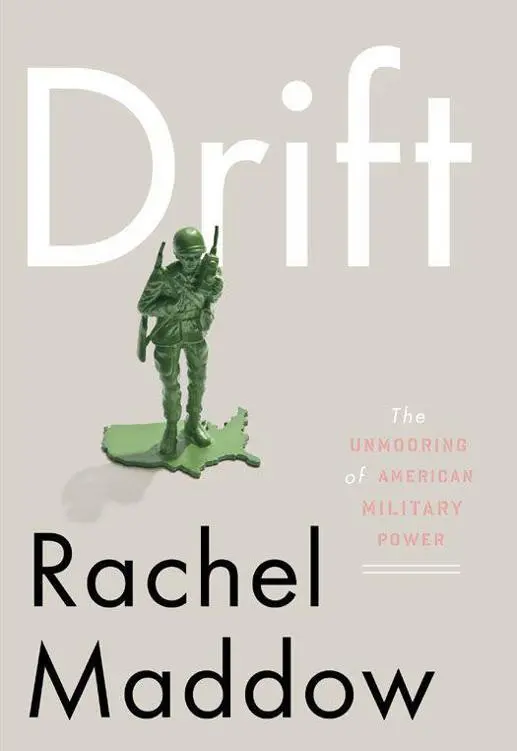
- Название:Drift
- Автор:
- Издательство:Crown Publishers
- Жанр:
- Год:2012
- Город:New York
- ISBN:978-0-307-46100-1
- Рейтинг книги:4 / 5. Голосов: 1
-
Избранное:Добавить в избранное
- Отзывы:
-
Ваша оценка:
Drift: краткое содержание, описание и аннотация
Предлагаем к чтению аннотацию, описание, краткое содержание или предисловие (зависит от того, что написал сам автор книги «Drift»). Если вы не нашли необходимую информацию о книге — напишите в комментариях, мы постараемся отыскать её.
Written with bracing wit and intelligence, Rachel Maddow’s
argues that we’ve drifted away from America’s original ideals and become a nation weirdly at peace with perpetual war, with all the financial and human costs that entails. To understand how we’ve arrived at such a dangerous place, Maddow takes us from the Vietnam War to today’s war in Afghanistan, along the way exploring the disturbing rise of executive authority, the gradual outsourcing of our war-making capabilities to private companies, the plummeting percentage of American families whose children fight our constant wars for us, and even the changing fortunes of G.I. Joe. She offers up a fresh, unsparing appraisal of Reagan’s radical presidency. Ultimately, she shows us just how much we stand to lose by allowing the priorities of the national security state to overpower our political discourse.
Sensible yet provocative, dead serious yet seriously funny,
will reinvigorate a “loud and jangly” political debate about how, when, and where to apply America’s strength and power—and who gets to make those decisions.
http://www.youtube.com/watch?v=Y9xoM7TMiTA
Drift — читать онлайн бесплатно полную книгу (весь текст) целиком
Ниже представлен текст книги, разбитый по страницам. Система сохранения места последней прочитанной страницы, позволяет с удобством читать онлайн бесплатно книгу «Drift», без необходимости каждый раз заново искать на чём Вы остановились. Поставьте закладку, и сможете в любой момент перейти на страницу, на которой закончили чтение.
Интервал:
Закладка:
While America has been fighting two of its longest-ever boots-on-the-ground wars in the decade following 9/11, and fighting them simultaneously, less than one percent of the adult US population has been called upon to strap on those boots. “Not since the peacetime years between World War I and World War II,” according to a 2011 Pew Research Center study, “has a smaller share of Americans served in the armed forces.” Half of the American public says it has not been even marginally affected by ten years of constant war. We’ve never in our long history been further from the ideal of the citizen-soldier, from the idea that America would find it impossible to go to war without disrupting domestic civilian life.
The reason the founders chafed at the idea of an American standing army and vested the power of war making in the cumbersome legislature was not to disadvantage us against future enemies, but to disincline us toward war as a general matter. Their great advice was that we should structure ourselves as a country in a way that deliberately raised the price of admission to any war. With citizen-soldiers, with the certainty of a vigorous political debate over the use of a military subject to politicians’ control, the idea was for us to feel it—uncomfortably—every second we were at war. But after a generation or two of shedding the deliberate political encumbrances to war that they left us—of dropping Congress from the equation altogether, of super-empowering the presidency with total war-making power and with secret new war-making resources that answer to no one but him, of insulating the public from not only the cost of war but sometimes even the knowledge that it’s happening—war making has become almost an autonomous function of the American state. It never stops.
The war in Afghanistan was an all but foregone conclusion after 9/11. The Taliban overthrow was engineered by CIA operatives, Special Forces, and a smallish contingent of US troops. It took a few weeks, but then we decided we should stay on and save Afghanistan from itself. Starting the war in Iraq took deceit and trickery on the part of the Bush administration (and severe chickenshittery on the part of the Congress). But once we had both those wars under way, what’s more telling—what’s less about specific politicians and temporal politics and more about us as a country—is how freaking long it’s taken to end them. Regardless of the culpability of the Paul Wolfowitzes and Donald Rumsfelds and Dick Cheneys in starting the Iraq War, there’s a national culpability for the fact that we have, without any real debate or thought, settled into a way of waging war that ensures minimal political pushback.
No matter how long the troops slog through the muck, no matter how many deployments they endure, the American public can no longer really be touched by war. Need twenty thousand more soldiers for the surge in Iraq? Military commanders simply extended the combat tours from twelve months to fifteen, no guarantee about how long a rest you’d get between deployments—and this in spite of what the military bosses already knew about the toll on the minuscule slice of American society that would shoulder this burden. “We’ve done these mental-health assessment team studies for six years now—between nine and twelve [months] is where a lot of the stress problems really manifest themselves, where the family problems really manifest themselves,” former Army chief of staff George Casey said recently. “The human mind and body weren’t made to do repeated combat deployments without substantial time to recover.” The suicide rate among active-duty servicemen doubled in the first five years of the Afghanistan War and then kept rising. In the past decade, the US Army lost more soldiers to suicide than to enemy fire in Afghanistan.
Civilian life has rolled on virtually uninterrupted. If you’re not in a military family, you’ve barely even felt it. The country has perfected the art of frictionless war. America’s wars thrum away like Muzak in the background here in the United States, kind of annoying when you tune in, but easy enough to tune out. Three years? Five? Ten? What’s the difference? And where are we fighting, anyway? We’re shooting missiles into Pakistan all the time. Does that count? Are we allowed to know?
In a statement on the House floor in February 2007, arguing against a reduction in US troop levels in Iraq, Congressman Phil Gingrey of Georgia said, “What indeed are we going to save our troops for? Working the rope lines at Fourth of July parades? Helping senior citizens across the street?” The rhetorical answer to his rhetorical question is of course that America should not save the troops for any such peaceable nonsense—they’re there to be used, in combat.
And not just the full-on active-duty military, mind you. We’d found a way to do smaller missions like Rwanda, Haiti, and Somalia without reserve troops—even the Balkans, with some help from our friends at DynCorp and Halliburton. But the Iraq War (and the Iraq War at the same time as the Afghanistan War) was of a different magnitude. The administration had hoped it wouldn’t be. Bush’s war council had hopefully supposed that Iraq would be quick work. “It could last six days, six weeks,” Rumsfeld said the month before the invasion. “I doubt six months.” Yeah, no.
As the war dragged on, the initial Bush administration decision to leave the reserves at home became untenable. So they deployed them—and how. In the third year of the war, at one point in 2005 more than half the soldiers in Iraq were from the National Guard. This was a first in American history, but it was a necessity. Thanks to the good old Abrams Doctrine, it remains true that we can’t do big wars with active-duty forces alone: two-thirds or more of our military’s transportation, engineer, medical, military police, and logistics corps is in the Reserves. But a funny thing about the Reserves now, and about the Abrams Doctrine: through ten years of fighting in Afghanistan and Iraq, the connection’s gone bad in the whole idea of the citizen-soldier . That hyphen’s doing way more work than it used to. The Guardsmen and reservists have been called to duty so often in the last ten years that it’s hard to distinguish between regular and reserve forces. Maybe our neighbors in the Guard and Reserves were having their lives turned upside down in the last ten years, maybe they were wounded and killed in staggering numbers in Iraq and Afghanistan, but we got used to it.
The Abrams Doctrine only functions as a constraint on war making to the extent that we’re shocked by Americans being called away from their regular lives to join combat. Through sheer repetition, sheer volume, though, those call-ups eventually just stopped being shocking. The post-9/11 deployment pace has put Guardsmen and reservists and their families squarely on the soldier side of the citizen-soldier ideal. Calling them up no longer ensures a big national debate about the merits of a given war. The Abrams Doctrine still forces us to use the reserves if we want to fight a big war, but that’s ceased to be a check against wars the American public doesn’t want to fight.
We’re using everybody in uniform, right up to the limit, and price has been no object. In this past decade, the United States took what was already the world’s most robust military budget and supersized it (and also funded a slew of permanent and highly operational intelligence agencies, and special adventure teams and privately owned contract-warrior companies). By 2011, the total federal R&D budget for alternative energy sources—derided by the right as a huge Obama-era boondoggle—was about $3 billion a year. Meanwhile, the defense R&D budget was $77 billion a year—derided by no one, ever. If you added up what every other country spent on its military in 2001, the US military budget was about half that total; by 2005, those two numbers were equal. In other words, the United States spent as much on national defense as every other country in the world combined. And the Pentagon can now spend those dollars in a way that insulates the decision makers from the political consequences of making life uncomfortable for the voting public.
Читать дальшеИнтервал:
Закладка:
Похожие книги на «Drift»
Представляем Вашему вниманию похожие книги на «Drift» списком для выбора. Мы отобрали схожую по названию и смыслу литературу в надежде предоставить читателям больше вариантов отыскать новые, интересные, ещё непрочитанные произведения.








Обсуждение, отзывы о книге «Drift» и просто собственные мнения читателей. Оставьте ваши комментарии, напишите, что Вы думаете о произведении, его смысле или главных героях. Укажите что конкретно понравилось, а что нет, и почему Вы так считаете.