Rachel Maddow - Drift
Здесь есть возможность читать онлайн «Rachel Maddow - Drift» весь текст электронной книги совершенно бесплатно (целиком полную версию без сокращений). В некоторых случаях можно слушать аудио, скачать через торрент в формате fb2 и присутствует краткое содержание. Город: New York, Год выпуска: 2012, ISBN: 2012, Издательство: Crown Publishers, Жанр: Публицистика, на английском языке. Описание произведения, (предисловие) а так же отзывы посетителей доступны на портале библиотеки ЛибКат.
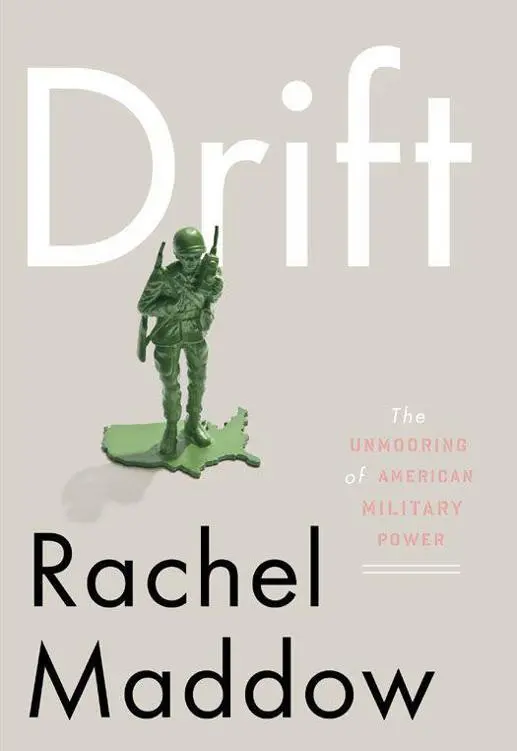
- Название:Drift
- Автор:
- Издательство:Crown Publishers
- Жанр:
- Год:2012
- Город:New York
- ISBN:978-0-307-46100-1
- Рейтинг книги:4 / 5. Голосов: 1
-
Избранное:Добавить в избранное
- Отзывы:
-
Ваша оценка:
Drift: краткое содержание, описание и аннотация
Предлагаем к чтению аннотацию, описание, краткое содержание или предисловие (зависит от того, что написал сам автор книги «Drift»). Если вы не нашли необходимую информацию о книге — напишите в комментариях, мы постараемся отыскать её.
Written with bracing wit and intelligence, Rachel Maddow’s
argues that we’ve drifted away from America’s original ideals and become a nation weirdly at peace with perpetual war, with all the financial and human costs that entails. To understand how we’ve arrived at such a dangerous place, Maddow takes us from the Vietnam War to today’s war in Afghanistan, along the way exploring the disturbing rise of executive authority, the gradual outsourcing of our war-making capabilities to private companies, the plummeting percentage of American families whose children fight our constant wars for us, and even the changing fortunes of G.I. Joe. She offers up a fresh, unsparing appraisal of Reagan’s radical presidency. Ultimately, she shows us just how much we stand to lose by allowing the priorities of the national security state to overpower our political discourse.
Sensible yet provocative, dead serious yet seriously funny,
will reinvigorate a “loud and jangly” political debate about how, when, and where to apply America’s strength and power—and who gets to make those decisions.
http://www.youtube.com/watch?v=Y9xoM7TMiTA
Drift — читать онлайн бесплатно полную книгу (весь текст) целиком
Ниже представлен текст книги, разбитый по страницам. Система сохранения места последней прочитанной страницы, позволяет с удобством читать онлайн бесплатно книгу «Drift», без необходимости каждый раз заново искать на чём Вы остановились. Поставьте закладку, и сможете в любой момент перейти на страницу, на которой закончили чтение.
Интервал:
Закладка:
When the Pentagon farms out soldiers’ work to contractors, it not only puts extra bodies in the field, it puts a different type of body in the field; the American public doesn’t mourn contractor deaths the way we do the deaths of our soldiers. We rarely even hear about them. Private companies are under no obligation to report when their employees are killed while, say, providing armed security to tractor-trailer convoys running supplies into Iraq. In the 1991 Gulf War, the United States employed one private contract worker for every one hundred American soldiers on the ground; in the Clinton-era Balkans, it neared one to one—about 20,000 privateers tops. In early 2011, there were 45,000 US soldiers stationed inside Iraq, and 65,000 private contract workers there.
Thanks to the skyrocketing use of privateers, and thanks to our new quasi-military institutions empowered to make war while keeping the details of that war making (and often even the simple fact of that war making) hidden from us, and thanks to public relations triumphs like the Bush administration sparing us the sight of the flag-draped caskets of dead American soldiers deplaning week after week at Dover Air Force Base, thanks to all that and more, the American public has been delicately insulated from the actuality of our ongoing wars. While a tiny fraction of men and women fighting our wars are deploying again and again, civilian life remains pretty much isolated in cost-free complacency.
And about those costs …
In June 2001, George W. Bush signed into law a massive, budget-busting tax cut that would add about $2 trillion to the deficit over the next decade. Three months later, the 9/11 attacks happened. US troops (and the CIA) were at war in Afghanistan within weeks, but we decided to keep the tax cuts in place anyway. Less than two years later we’d shipped troops off to a second and simultaneous war, in Iraq. Weeks after that invasion, Bush signed another huge round of tax cuts. We also started massively scaling up on the secret intel side of things. Washington Post reporters Dana Priest and William M. Arkin, in their seminal 2010 investigative series, detailed more than three thousand government organizations and private companies in ten thousand separate locations at work on counterterrorism. In just less than ten years, the US federal government had deputized 854,000 people with top secret security clearances, invented or reorganized nearly three hundred government agencies, and built office space equivalent to twenty-two US Capitols to create what Priest and Arkin call Top Secret America. The country never debated the need for this vast new superstructure, and still doesn’t, mostly because we’ve never been asked to cover the massive new expense. We just added the cost to the growing deficit, like we have the trillion or two in recent war spending.
This deferred-payment plan has been one of the few bipartisan points of agreement in the last decade. After Bush’s pre-Afghanistan War tax cuts, and the second round after the Iraq invasion, his successor followed suit. In 2010, President Obama added thirty thousand more soldiers to Afghanistan, extended the military stay there until 2014, ordered up a few hundred more drones for the CIA, and then—yes—extended those Bush tax cuts.
When civilians are not asked to pay any price, it’s easy to be at war—not just to intervene in a foreign land in the first place, but to keep on fighting there. The justifications for staying at war don’t have to be particularly rational or cogently argued when so few Americans are making the sacrifice that it takes to stay. When we invaded Iraq in 2003, the first official justification from the White House was that we had to secure Saddam’s dangerous piles of weapons of mass destruction. (“We don’t want the smoking gun to be a mushroom cloud” was the Bush administration line.) There was plenty of evidence at the time that this threat was bullpucky, and that was proven as soon as we got there. So then we decided we were really there to get rid of Saddam. It took three weeks for Baghdad to fall, and he was caught in his hidey-hole by December.
So why stay after that, for a whole second year? For a third, fourth, sixth… eighth? Our official stated reason for staying in Iraq after Saddam was in his grave was a moving target: we were restoring order, we were protecting Iraqi women, we were keeping the Shiites and the Sunnis and the Kurds from killing one another, we were there until the Shiites and the Sunnis and the Kurds learned how to share power in their new government, we were there to defeat the terrorists, we were trying to reform Iraq as a beacon of Jeffersonian democracy in the Middle East (There would be elections! We would have an ally!), we were there to make sure Iran didn’t undercut our fledgling democracy and make Iraq its Crazy Muslim Theocrat ally. As time went on, it didn’t much matter what the president said. Eventually the Bushies quit trying to be creative and just settled on the accusation that leaving would be cowardly. The entire justification for being at war—“Withdrawal is not an option,” the Senate majority leader offered three years into the Iraq escapade, “surrender is not a solution”—fit neatly on a bumper sticker. As Ford said, we don’t cut and run.
The Bush administration did start to feel some heat about three years into the war: the Republicans lost control of both houses of Congress in 2006 and polls showed as much as two-thirds of the voting public opposed the continuation of the war in Iraq. The White House turned for help to the one national institution of sufficient size and public esteem to provide necessary political cover—the military. If the country didn’t trust the president anymore on the war or on foreign policy, the president would get out of the way and let the “commanders on the ground” take the lead. And they wouldn’t simply be in charge of prosecuting the war, they’d be commander-in-chiefing it too.
Bush charged the military with more than just coming up with a plan for how to win the war; he charged them with creating something he never really had: a vision of what a win would look like. And if the military brass was becoming the foreign policy maker in the Middle East, the Pentagon—can-do central—had just the man for the job. He was regarded in most circles as the smartest general we had, David Petraeus, a PhD in international relations from Princeton. And the smartest man in the Army decided the military wasn’t going to simply win a war, it was going to win a country.
General Petraeus had already authored a textbook on how the military would execute this maximalist mission. Field Manual 3–24 was a can-do treatise on how to fight wars that were both indefinite and expandable, a full-on twenty-first-century rewrite of US military doctrine. The new doctrine—counterinsurgency—was basically a plan to double down in Iraq. The US military could do it, if the rest of America could just relax. The general judged his new plan a much easier sell now than it would have been back in the early days of his military career, when the public was so… engaged . “Vietnam was an extremely painful reaffirmation that when it comes to intervention, time and patience are not American virtues in abundant supply,” General Petraeus had written while working on his PhD. He turned out to be right, about the selling part anyway. Field Manual 3–24 was such a hit in Washington policy circles that the University of Chicago Press decided to publish it for the general public under a more marketable title: The U.S. Army/Marine Corps Counterinsurgency Field Manual . You can read the reviews at Amazon: “a nifty volume”… “the most important piece of doctrine written in the past 20 years”… “has helped make Counterinsurgency part of the zeitgeist… In short, this is not your parents’ military field manual.”
Читать дальшеИнтервал:
Закладка:
Похожие книги на «Drift»
Представляем Вашему вниманию похожие книги на «Drift» списком для выбора. Мы отобрали схожую по названию и смыслу литературу в надежде предоставить читателям больше вариантов отыскать новые, интересные, ещё непрочитанные произведения.









Обсуждение, отзывы о книге «Drift» и просто собственные мнения читателей. Оставьте ваши комментарии, напишите, что Вы думаете о произведении, его смысле или главных героях. Укажите что конкретно понравилось, а что нет, и почему Вы так считаете.