Rachel Maddow - Drift
Здесь есть возможность читать онлайн «Rachel Maddow - Drift» весь текст электронной книги совершенно бесплатно (целиком полную версию без сокращений). В некоторых случаях можно слушать аудио, скачать через торрент в формате fb2 и присутствует краткое содержание. Город: New York, Год выпуска: 2012, ISBN: 2012, Издательство: Crown Publishers, Жанр: Публицистика, на английском языке. Описание произведения, (предисловие) а так же отзывы посетителей доступны на портале библиотеки ЛибКат.
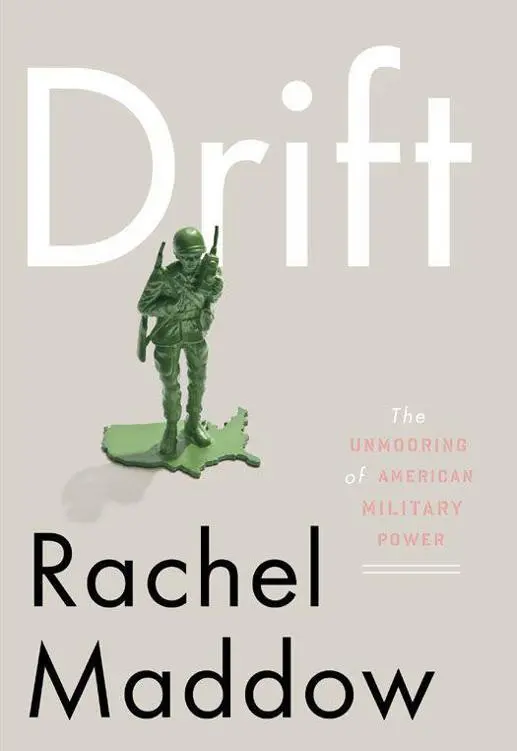
- Название:Drift
- Автор:
- Издательство:Crown Publishers
- Жанр:
- Год:2012
- Город:New York
- ISBN:978-0-307-46100-1
- Рейтинг книги:4 / 5. Голосов: 1
-
Избранное:Добавить в избранное
- Отзывы:
-
Ваша оценка:
Drift: краткое содержание, описание и аннотация
Предлагаем к чтению аннотацию, описание, краткое содержание или предисловие (зависит от того, что написал сам автор книги «Drift»). Если вы не нашли необходимую информацию о книге — напишите в комментариях, мы постараемся отыскать её.
Written with bracing wit and intelligence, Rachel Maddow’s
argues that we’ve drifted away from America’s original ideals and become a nation weirdly at peace with perpetual war, with all the financial and human costs that entails. To understand how we’ve arrived at such a dangerous place, Maddow takes us from the Vietnam War to today’s war in Afghanistan, along the way exploring the disturbing rise of executive authority, the gradual outsourcing of our war-making capabilities to private companies, the plummeting percentage of American families whose children fight our constant wars for us, and even the changing fortunes of G.I. Joe. She offers up a fresh, unsparing appraisal of Reagan’s radical presidency. Ultimately, she shows us just how much we stand to lose by allowing the priorities of the national security state to overpower our political discourse.
Sensible yet provocative, dead serious yet seriously funny,
will reinvigorate a “loud and jangly” political debate about how, when, and where to apply America’s strength and power—and who gets to make those decisions.
http://www.youtube.com/watch?v=Y9xoM7TMiTA
Drift — читать онлайн бесплатно полную книгу (весь текст) целиком
Ниже представлен текст книги, разбитый по страницам. Система сохранения места последней прочитанной страницы, позволяет с удобством читать онлайн бесплатно книгу «Drift», без необходимости каждый раз заново искать на чём Вы остановились. Поставьте закладку, и сможете в любой момент перейти на страницу, на которой закончили чтение.
Интервал:
Закладка:
Warheads, and the missiles that carry them, and all the nuts and bolts that support them from shelter to bomber wing and back again have been on the shelf for way too long. The nukes and their auxiliary equipment were generally designed to have a life span of about ten to twenty years. Constant manufacturing and modernization were the assumptions back in the glory days, especially with Team B’s armchair instigators kicking up all that magic fear dust. But by the start of the Barack Obama presidency, some of that hardware had been in service for forty or even fifty years.
Bad enough that missiles were growing wing fungus and storage containers were rusting through, but at least those problems were mostly solvable with Lysol and Rustoleum. For the more serious nuclear maintenance issues, we had by then started shoveling money into something called the Stockpile Life Extension Program, which—even if you avoid the temptation to call it SchLEP—is still essentially a program of artificial hips, pacemakers, and penile implants for aging nukes. How’d you like to be responsible for operating on a half-century-old nuclear bomb?
These were fixes that required real, hard-won technical nuclear expertise—expertise we unfortunately also seemed to be aging out of. Fuzes, for example, were failing, and there was nobody around who could fix them: “Initial attempts to refurbish Mk21 fuzes were unsuccessful,” admitted an Air Force general, “in large part due to their level of sophistication and complexity.” The fuze that previous generations of American engineers had invented to trigger a nuclear explosion (or to prevent one) were apparently too complicated for today’s generation of American engineers. The old guys, who had designed and understood this stuff, had died off, and no one thought to have them pass on what they knew while they still could.
Then there was the W76 problem. W76s were nuclear bombs based mostly on the Navy’s Trident submarines. By refurbishing them, we thought we might get another twenty or thirty years out of them before they needed replacing. The problem with refurbishing the W76s—with taking them apart, gussying them up, and putting them back together—is that we had forgotten how to make these things anymore. One part of the bomb had the code name “Fogbank.” Fogbank’s job was to ensure that the hydrogen in the bomb reached a high enough energy level to explode on cue. But no one could remember how to make Fogbank. It was apparently dependent on some rare and highly classified X-Men-like material conjured by US scientists and engineers in the 1970s, but no one today remembers the exact formula for making it. Very embarrassing.
The Department of Energy was not going to take this lying down; they promised the Navy, “We did it before, so we can do it again.” I like that can-do spirit! But sadly, no. It took more than a year just to rebuild the long-dismantled Fogbank manufacturing plant at the Oak Ridge nuclear lab, and from there, while a bunch of aging W76 warheads lay opened up like patients on an operating table, government scientists and engineers tried to whip up new life-extending batches of Fogbank. But even after years of trying, even after the Fogbank production program went to “Code Blue” high priority, the technicians were never able to reproduce a single cauldron of Fogbank possessed of its former potency. The Department of Energy, according to an official government report, “had lost knowledge of how to manufacture the material because it had kept few records of the process when the material was made in the 1980s and almost all staff with expertise on production had retired or left the agency.” The experts were gone. And nobody had bothered to write anything down!
Maybe this should have been a sign. When all the scientists and engineers are dead, or senile, or at least just fishing, and the know-how is gone with them, isn’t it fair to say that a destroy-the-world-thousands-of-times-over nuclear weapons program has run its course?
It’s not worth (at least here) querying the sanity of how we got all these nukes in the first place. There was a logic to it. In the Cold War, with the Soviet Union pointing Armageddon-making bombs in our direction, we answered in kind. The deterrent force of our nukes—you move to wipe us out, you’re going down with us—was rational, although kind of bizarre. The perfectly acronymed doctrine of Mutually Assured Destruction (MAD) required that we have whatever the Russians had, plus better, plus one. And the same for them toward us. Last superpower with a bullet in the chamber wins. At one remarkable moment in the completely MAD Atomic Age of the 1960s we possessed more than 31,000 armed nuclear warheads, scattered around the globe aboard submarines, in underground missile silos, or strapped on the underside of bomber wings. And most of the warheads in this sea-land-air triad were a simple key-turn away from launch. We had to be ready to fire those suckers in a hurry.
If your desire is to discourage (in the biggest way possible) imminent thermonuclear war with the Soviets, MAD at least theoretically justified keeping that many missiles ready to fly on the shortest possible notice. Once the Soviet Union dissolved, though, what was the remaining justification for our keeping an arsenal of that size on hair-trigger alert?
How about the fact that it is not a simple thing to walk away from a sixty-year, eight-trillion-dollar investment? Eight-trillion-dollar habits die hard. In 2005, Gen. Lance Lord, described as a “man with missile in his DNA,” said in a speech to a Washington think tank, “As the wing commander at F. E. Warren, routinely I was asked, ‘How does winning the Cold War change your mission?’ ” His answer: “It doesn’t.” Institutions have inertia. When the original justification for a huge investment goes away, the huge investment finds another reason to live. It’s not just the military; it’s true of pretty much all organizations. The more money and work and time it takes to build something, the more power it accrues, and the more effort it takes to make it go away.
But in the case of the nuclear arms race, what built it wasn’t just money ( tons of money), work, and time, it was also a grab-you-by-the-throat existential urgency. To convince ourselves we needed a nationwide web of hair-trigger-alert nuclear weapons capable of destroying the earth thousands of times over, we had to commit ourselves to a beautifully apocalyptic theory of how we would not just possess but also use these weapons. We would push the button, maybe even hundreds of times. We’d do it because we’d need to—because an enemy was in the act of doing the same or worse to us.
After the Cold War, without the realistic threat of a massive, multistrike nuclear assault by the USSR, our bristling-with-nukes posture made no sense. If we wanted to keep this huge web of nukes in place, we needed a post-Soviet scenario for how and why we’d ever want to push the button, maybe even hundreds of times.
Cue the American spirit of invention. In that same no-change-in-my-mission speech in 2005, General Lord ventured a new idea for why his Wyoming missileers should keep going to work every day tending their ICBMs: “The triad no longer means ICBMs, bombers, and submarines. The new triad consists of offensive strike, defensive capabilities, and highlights the revitalization of the defense infrastructure to meet emerging threats.” When military planners start talking about new paradigms and using nukes for offensive strikes, don’t look for the budget requests to go down.
If we’re in the business of thinking up constructive new uses for all these nukes, let’s think big. After all, it’s not just us and the USSR anymore. The UK, France, China, Pakistan, and India have nukes too. Oh, and Israel, but that’s supposed to be a secret. Apartheid-era South Africa had them—yikes—but decided to get rid of them, as did the former Soviet states of Belarus, Kazakhstan, and Ukraine. Brazil and Argentina could very well have had them, but they agreed to be part of a nuclear-weapons-free Latin America instead.
Читать дальшеИнтервал:
Закладка:
Похожие книги на «Drift»
Представляем Вашему вниманию похожие книги на «Drift» списком для выбора. Мы отобрали схожую по названию и смыслу литературу в надежде предоставить читателям больше вариантов отыскать новые, интересные, ещё непрочитанные произведения.








Обсуждение, отзывы о книге «Drift» и просто собственные мнения читателей. Оставьте ваши комментарии, напишите, что Вы думаете о произведении, его смысле или главных героях. Укажите что конкретно понравилось, а что нет, и почему Вы так считаете.