Rachel Maddow - Drift
Здесь есть возможность читать онлайн «Rachel Maddow - Drift» весь текст электронной книги совершенно бесплатно (целиком полную версию без сокращений). В некоторых случаях можно слушать аудио, скачать через торрент в формате fb2 и присутствует краткое содержание. Город: New York, Год выпуска: 2012, ISBN: 2012, Издательство: Crown Publishers, Жанр: Публицистика, на английском языке. Описание произведения, (предисловие) а так же отзывы посетителей доступны на портале библиотеки ЛибКат.
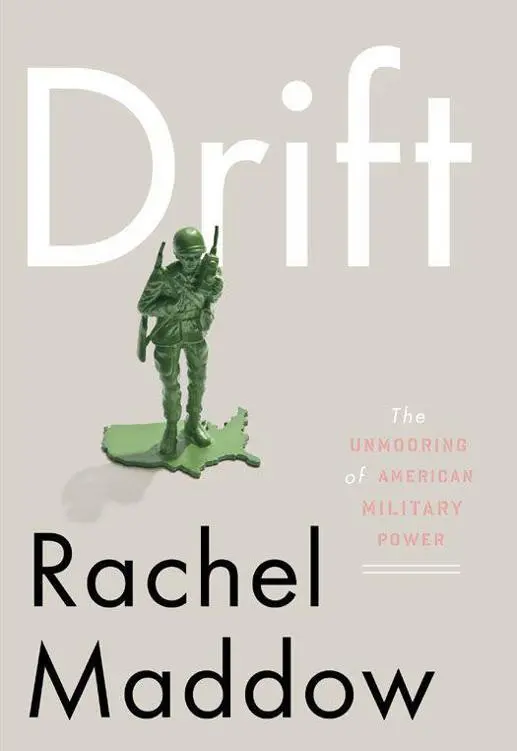
- Название:Drift
- Автор:
- Издательство:Crown Publishers
- Жанр:
- Год:2012
- Город:New York
- ISBN:978-0-307-46100-1
- Рейтинг книги:4 / 5. Голосов: 1
-
Избранное:Добавить в избранное
- Отзывы:
-
Ваша оценка:
Drift: краткое содержание, описание и аннотация
Предлагаем к чтению аннотацию, описание, краткое содержание или предисловие (зависит от того, что написал сам автор книги «Drift»). Если вы не нашли необходимую информацию о книге — напишите в комментариях, мы постараемся отыскать её.
Written with bracing wit and intelligence, Rachel Maddow’s
argues that we’ve drifted away from America’s original ideals and become a nation weirdly at peace with perpetual war, with all the financial and human costs that entails. To understand how we’ve arrived at such a dangerous place, Maddow takes us from the Vietnam War to today’s war in Afghanistan, along the way exploring the disturbing rise of executive authority, the gradual outsourcing of our war-making capabilities to private companies, the plummeting percentage of American families whose children fight our constant wars for us, and even the changing fortunes of G.I. Joe. She offers up a fresh, unsparing appraisal of Reagan’s radical presidency. Ultimately, she shows us just how much we stand to lose by allowing the priorities of the national security state to overpower our political discourse.
Sensible yet provocative, dead serious yet seriously funny,
will reinvigorate a “loud and jangly” political debate about how, when, and where to apply America’s strength and power—and who gets to make those decisions.
http://www.youtube.com/watch?v=Y9xoM7TMiTA
Drift — читать онлайн бесплатно полную книгу (весь текст) целиком
Ниже представлен текст книги, разбитый по страницам. Система сохранения места последней прочитанной страницы, позволяет с удобством читать онлайн бесплатно книгу «Drift», без необходимости каждый раз заново искать на чём Вы остановились. Поставьте закладку, и сможете в любой момент перейти на страницу, на которой закончили чтение.
Интервал:
Закладка:
The second missile pylon on the schedule sheet, GZ203, was stored just down the way in igloo 1854. The handlers were in and out of igloo 1854 in twenty-two minutes, not enough time to do the most cursory of checks. The junior member of the team was apparently told not to bother with the whole flashlight thing—not that he really knew what that meant, because he was new on the job and had never performed any such check. The second tow driver, as far as anyone could see, also failed to check the little window for signs of nuclear warheads aboard. In fact, one member of the team said he did not see anyone even carrying a flashlight that day, much less putting one to use.
Oh, and one more thing: the second pylon displayed no TacFerry signs, but this did not raise any red flags for the team. Nobody called a higher-ranking officer to ask why GZ203 lacked a TacFerry placard or checked the computer database to verify the status of the pylon. So nobody on the team got the information that a few weeks earlier an officer at Minot had made a switch and ordered an older pylon prepped for shipment instead. She put it on the official schedule. Problem was, nobody ever checked the updated official schedule. So the prepped pylon with its dummy warheads sat undisturbed in its igloo that morning, while the tow driver carrying the unplacarded GZ203 pulled onto Bomber Boulevard, completely unaware that he was hauling six real operational nukes.
In the eight hours it took to attach the two pylons to a forty-five-year-old B-52H Stratofortress, no member of the loading crew noticed the warheads aboard, or the fact that one of the pylons was not marked for shipment. The six nuclear bombs strapped to the Stratofortress then sat on the runway unguarded except for a chain-link fence from five o’clock that afternoon until early the next morning, when an aircrew from the 2nd Bomb Wing out of Barksdale arrived to prep for flight. Happily, there was a member of the flight crew, the instructor radar navigator, whose job it was to check and see what exactly his aircraft was carrying before the bomber could take off.
But the navigator had apparently been infected with the general feeling about this mission of decommissioning old missiles; as one of his fellow airmen put it, “We’re only ferrying carcasses from Point A to Point B.” Others told investigators, without a hint of shame, that they weren’t sure that verifying meant, like, actually physically checking something. And so it was that “the Instructor Radar Navigator only did a ‘spot check’ on one missile, and only on the right pylon loaded with nuclear-inert payloads,” according to the report of an after-incident investigation. “If the IRN had accomplished a full and complete weapons preflight, the IRN should have discovered the nuclear warheads.” He did not.
The bomber, named, interestingly, Doom 99 , departed North Dakota on schedule on the morning of August 30, 2007. “The takeoff from Minot,” noted the after-incident report, “was uneventful.” The flight itself was notable: it was the first time in forty years a nuclear-armed bomber had traversed US airspace without clearance. Six nuclear warheads—each one capable of Hiroshima-size damage times ten—were unwittingly flown 1,400 miles, from up around the US–Canadian border to within a few hundred miles of the Gulf of Mexico, within plutonium-spittin’ distance of Sioux Falls and Sioux City and Omaha and Kansas City and Tulsa. The instructor pilot on Doom 99 was not qualified for a nuclear mission. In fact, she later told investigators, she had never physically touched a nuclear weapon.
Happily, the nukes did get back to land without incident. They then sat unguarded on the runway at Barksdale Air Force Base in Louisiana for another nine hours before the ground crew there discovered that its command had accidentally acquired six new nuclear warheads, and they decided they’d better get them in a safe place, under guard. All told, six nuclear warheads were misplaced for a day and a half.
Here was the good news, according to the testimony of Air Force generals at the Senate Armed Services Committee on the occasion of presenting findings from the blue-ribbon review of the incident: “During the incident there was never any unsafe condition, and the incident was promptly reported to our national leadership including the Secretary of Defense and the President. These weapons were secure and always in the hands of America’s Airmen.”
“General,” the chairman of that Senate committee responded, “I’m a little taken aback by your statement that warheads were—there was never a safety issue and they were always under the control of American pilots. Did the pilots know they had nuclear weapons on board?”
“Sir, they did not.”
“So when you say they were under the control of the pilots, not knowing that you have nuclear weapons on board makes a difference, doesn’t it?”
“Yes sir, it does. The intent behind that statement is to make it clear that they never migrated off the aircraft anywhere else.”
Migrated?
As for whether or not an accident involving Doom 99 could have occasioned a spread of plutonium from the warheads, one of the generals at the hearing was forced to plead ignorance. “I’m a logistician, not a technician. But knowing the knowledge of how a system is developed, and that’s part of the reliability of the system, is that there is no inadvertent detonation of the system.”
“I’m not talking about detonation,” the chairman said. “I’m talking about could the plutonium be released inadvertently if this weapon were smashed into the ground from fifteen thousand feet.”
“That piece,” said the general, “I would not know.”
It was left to the senator to remind the Air Force that the United States was still cleaning up pieces of Spain forty years after the Palomares accident.
One of the first things the Air Force did in the aftermath of the Minot-to-Barksdale debacle was to institute no-warning inspections, and the first one they ran was on the 2nd Bomb Wing. Thirty-one inspectors (including six civilian augmentees) were detailed to assess the Barksdale nuclear team, and they spent ten months’ worth of man-days doing it. (That was the assessment that turned up the wing fungus.) Barksdale’s first inspector-assigned task was to stick a pylon full of cruise missiles onto a Stratofortress bomber and ready the bomber for a combat mission. The first try failed because the $450,000 bomb hoists kept malfunctioning and the electrical generators crapped out three times. After fourteen hours and two separate “mating/demating” operations, the loading crew decided to give up and start from scratch. The second try was delayed when the loading team parked the weapons bay over uneven pavement and the bomb hoist could not gain proper purchase, and then delayed again when the bomb hoist “boogie wheel” failed. The second mating attempt was aborted after fifteen hours. On the fourth attempt—after only a minor lift-arm malfunction—the Barksdale technicians managed to generate a combat-ready mission.
The 2nd Bomb Wing received a rating of Excellent from the inspectors in the following areas:
• Weapons Maintenance Technical Operations
• Storage and Maintenance Facilities
• Motor Vehicle Operations
• Safety
They had to settle for a Satisfactory in Loading and Mating. The inspectors did give extra-credit points to the loading and mating team for gamely fighting through the failure of six weapons load trailers, five power generators, a power-controller-unit trailer malfunction, and a range of unfortunate tire-pressure issues. “The weapons loading community overcame numerous equipment malfunctions,” the inspectors reported. They also commented favorably on the loading community’s “strong two-person concept adherence,” its “cohesive squadron teamwork,” and its “highly effective communication.” The inspectors did ding the loading and mating team for not prepositioning chocks to keep the loading trailers from accidentally bashing into the bomber, and suggested that they get some foam cutouts in the weapons expediter truck to keep the enabling switches and data cartridge safe during transport. But they gave Team Barksdale a thumbs-up for successfully preparing one bombing run… after three failed attempts… at somewhere past the thirty-hour mark.
Читать дальшеИнтервал:
Закладка:
Похожие книги на «Drift»
Представляем Вашему вниманию похожие книги на «Drift» списком для выбора. Мы отобрали схожую по названию и смыслу литературу в надежде предоставить читателям больше вариантов отыскать новые, интересные, ещё непрочитанные произведения.










Обсуждение, отзывы о книге «Drift» и просто собственные мнения читателей. Оставьте ваши комментарии, напишите, что Вы думаете о произведении, его смысле или главных героях. Укажите что конкретно понравилось, а что нет, и почему Вы так считаете.