Rachel Maddow - Drift
Здесь есть возможность читать онлайн «Rachel Maddow - Drift» весь текст электронной книги совершенно бесплатно (целиком полную версию без сокращений). В некоторых случаях можно слушать аудио, скачать через торрент в формате fb2 и присутствует краткое содержание. Город: New York, Год выпуска: 2012, ISBN: 2012, Издательство: Crown Publishers, Жанр: Публицистика, на английском языке. Описание произведения, (предисловие) а так же отзывы посетителей доступны на портале библиотеки ЛибКат.
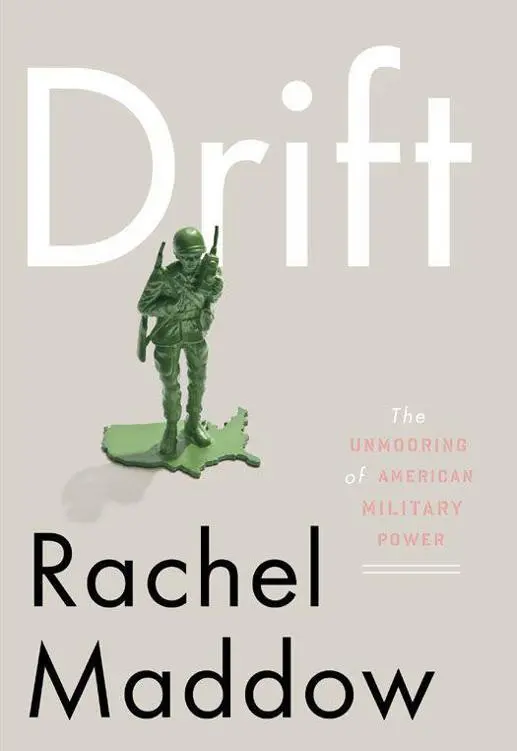
- Название:Drift
- Автор:
- Издательство:Crown Publishers
- Жанр:
- Год:2012
- Город:New York
- ISBN:978-0-307-46100-1
- Рейтинг книги:4 / 5. Голосов: 1
-
Избранное:Добавить в избранное
- Отзывы:
-
Ваша оценка:
Drift: краткое содержание, описание и аннотация
Предлагаем к чтению аннотацию, описание, краткое содержание или предисловие (зависит от того, что написал сам автор книги «Drift»). Если вы не нашли необходимую информацию о книге — напишите в комментариях, мы постараемся отыскать её.
Written with bracing wit and intelligence, Rachel Maddow’s
argues that we’ve drifted away from America’s original ideals and become a nation weirdly at peace with perpetual war, with all the financial and human costs that entails. To understand how we’ve arrived at such a dangerous place, Maddow takes us from the Vietnam War to today’s war in Afghanistan, along the way exploring the disturbing rise of executive authority, the gradual outsourcing of our war-making capabilities to private companies, the plummeting percentage of American families whose children fight our constant wars for us, and even the changing fortunes of G.I. Joe. She offers up a fresh, unsparing appraisal of Reagan’s radical presidency. Ultimately, she shows us just how much we stand to lose by allowing the priorities of the national security state to overpower our political discourse.
Sensible yet provocative, dead serious yet seriously funny,
will reinvigorate a “loud and jangly” political debate about how, when, and where to apply America’s strength and power—and who gets to make those decisions.
http://www.youtube.com/watch?v=Y9xoM7TMiTA
Drift — читать онлайн бесплатно полную книгу (весь текст) целиком
Ниже представлен текст книги, разбитый по страницам. Система сохранения места последней прочитанной страницы, позволяет с удобством читать онлайн бесплатно книгу «Drift», без необходимости каждый раз заново искать на чём Вы остановились. Поставьте закладку, и сможете в любой момент перейти на страницу, на которой закончили чтение.
Интервал:
Закладка:
With tax cuts in wartime, with no sense of collective national sacrifice on behalf of the war effort, with less than 1 percent of the American population taking up arms to fight, with US casualties politically and literally shielded from public view, the cumulative effect was to normalize our national wartime. We’ve become a nation “at peace with being at war,” in the words of the New York Times media critic David Carr.
And as the country learned to be untroubled by the fact that we had troops at war, troops coming home from those wars learned to look out for themselves. “It’s like AIDS was thirty years ago,” Iraq veteran Paul Rieckhoff told me in 2011. “It’s a huge crisis for us, but no one else in the country thinks they’re us. No one even thinks they’re like us.” Shortly after his return from Baghdad in 2004, Rieckhoff founded Iraq and Afghanistan Veterans of America, the first and largest group of veterans of our post-9/11 wars. IAVA’s slogan is “We’ve Got Your Back”—with the implication that it might not feel like anyone else does. Online, they’ve organized a “Community of Veterans” social media site, essentially a version of Facebook for Iraq and Afghanistan veterans only. Their 2010 public service announcement, titled “Alone,” won the advertising industry’s Ogilvy Award for its disorienting turn-Norman-Rockwell-on-his-head depiction of a soldier’s lonely homecoming, until he finds other Iraq and Afghanistan veterans.
Another PSA, called “Camo,” shows empty street scenes, and a newly returned veteran at home, sitting at his computer; the voice-over says, “You may feel like you’re all alone,” and then the seemingly empty streets are revealed to be camouflaging other veterans, hiding in plain sight. The visual trick gives way to the emotional payoff of the ad—the palpable relief of the once-isolated soldier who finds other veterans to connect with.
A 2011 Pew poll found that 84 percent of post-9/11 veterans felt the public didn’t understand the problems faced by service members and their families. It also found that more than two-thirds of Americans believe the disproportionate burden shouldered by those who have served is “just part of being in the military.” Iraq and Afghanistan veterans are nearly twice as likely as veterans of other wars to say they found readjusting to civilian life to be difficult. The distance between the lived experience of Iraq and Afghanistan veterans and the rest of the country since 9/11 ought to unsettle all of us, not just veterans.
As we’ve pushed military experience further and further away from civilian life, we’ve also pushed decision making about the use of the military further and further away from political debate.
“We don’t have any enemies in Congress,” a senior defense official told me in 2011. “We have to fight Congress to cut programs, not keep them.” And those are basically the only fights the Pentagon ever loses. To paraphrase Ronald Reagan plagiarizing Sen. James F. Byrnes talking smack about government bureaucracy, if you want to achieve immortality, see what you can do about getting yourself turned into a Pentagon program. You may eventually grow wing fungus, but you’ll never die. The nuclear weapons complex, the counterinsurgency nation-building apparatus, $20 billion worth of mine-resistant, ambush-protected vehicles with V-shaped hulls to disperse the energy from bombs underneath—we built ’em, we own ’em, and we’re looking for ways to use ’em. “The Army has only recently started to plan to incorporate MRAPs into its force structure to take advantage of this investment,” a recent think-tank study found, “instead of mothballing them as they withdraw from Iraq.” Maybe we could park them on top of malfunctioning missile silos. The tasks we assign to our service members are hard enough without asking them to get their work done in the world’s largest organization, dragging around decades’ worth of clattering battle rattle in the form of defunct and deathless programs.
We all have an interest in America having an outstanding military, but that aim is not helped by exempting the military from the competition for resources. With no check on its growth and no rival for its political influence, the superfunded, superempowered national security state has become a leviathan.
The artificial primacy of defense among our national priorities is a constant unearned windfall for some, but it’s privation for the rest of America; it steals from what we could be and can do. In Econ 101, they teach that the big-picture fight over national priorities is guns versus butter. Now it’s butter versus margarine—guns get a pass.
Overall, we’re weaker for it, and at enormous cost.
As the national security state has metastasized, decisions to use force have become painless and slick, almost automatic. The disincentives to war deliberately built into our American system of government—particularly the citizen-soldier, and leaving the power to declare war with Congress instead of the president—we’ve worked around them. We ought to see that constitutional inheritance as a national treasure, yet we’ve divested ourselves of it without much of a debate.
It’s not done and forever, though. We can go back. Policy decisions matter. Our institutions matter. The structure of government matters. They can all be changed. We saw that happen over the last forty years. There were specific decisions made in time that set us on our current war-is-normal course. If specific decisions in time landed us where we are today, we can unmake those specific decisions. We can walk them back. We could at least start with a to-do list.
• Going to war, being at war, should be painful for the entire country, from the start. Henceforth, when we ship the troops off to battle, let’s pay for it. War costs money. Lots and lots of money. Whenever we start a new one, we should raise the money to pay for it, contemporaneously. Taxes, war bonds, what-have-you. “Freedom isn’t free” shouldn’t be a bumper sticker—it should be policy.
• Let’s do away with the secret military. If we are going to use drones to vaporize people in Pakistan and Yemen and Somalia, the Air Force should operate those drones, and pull the trigger. And we should know about it. If the CIA is doing military missions, the agency needs to be as accountable as the military is, and the same goes for the policy makers giving them their orders. The chain of command should never be obscured by state secrets. Special Forces can be unconstrained and clandestine to the bad guys, but not to Congress.
• Let’s quit asking the military to do things best left to our State Department, or the Peace Corps or FEMA. And let’s please stop expecting military leaders to make judgments and decisions about policy. If presidential candidates talk about “deferring to military commanders” as to whether or not to bomb Iran, stand up and point at them and holler until they understand how backward they’ve got it. That’s got to stop. It’s no favor to the military, and it’s an affront to the Constitution.
• Our Guard and Reserves need to be the Guard and Reserves again, which is to say the institutions that weave civilian life and military life together. The life of a National Guardsman or Guardswoman should be mostly a peacetime, civilian life. When we ship these men and women off to war, civilian communities all over America should feel that loss.
• Let’s wind back the privatization of war and the military’s dependence on contractors for what used to be military functions. Our troops need to peel their own potatoes again, drive their own supply trucks, build their own barracks, guard their own generals. Enough with the LOGCAP boondoggle. Private contractors are not cheaper, and they are certainly not indispensable. We operated without them for a long, long time, and did just fine, thank you very much. And when private contractors on our payroll commit illegal acts, like statutory rape, or murder, or outright fraud, they should be prosecuted, not given more contracts.
Читать дальшеИнтервал:
Закладка:
Похожие книги на «Drift»
Представляем Вашему вниманию похожие книги на «Drift» списком для выбора. Мы отобрали схожую по названию и смыслу литературу в надежде предоставить читателям больше вариантов отыскать новые, интересные, ещё непрочитанные произведения.








Обсуждение, отзывы о книге «Drift» и просто собственные мнения читателей. Оставьте ваши комментарии, напишите, что Вы думаете о произведении, его смысле или главных героях. Укажите что конкретно понравилось, а что нет, и почему Вы так считаете.