Rachel Maddow - Drift
Здесь есть возможность читать онлайн «Rachel Maddow - Drift» весь текст электронной книги совершенно бесплатно (целиком полную версию без сокращений). В некоторых случаях можно слушать аудио, скачать через торрент в формате fb2 и присутствует краткое содержание. Город: New York, Год выпуска: 2012, ISBN: 2012, Издательство: Crown Publishers, Жанр: Публицистика, на английском языке. Описание произведения, (предисловие) а так же отзывы посетителей доступны на портале библиотеки ЛибКат.
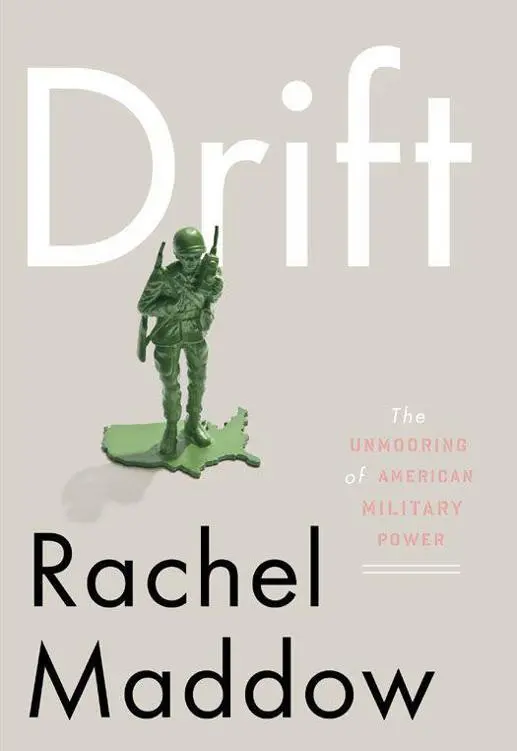
- Название:Drift
- Автор:
- Издательство:Crown Publishers
- Жанр:
- Год:2012
- Город:New York
- ISBN:978-0-307-46100-1
- Рейтинг книги:4 / 5. Голосов: 1
-
Избранное:Добавить в избранное
- Отзывы:
-
Ваша оценка:
Drift: краткое содержание, описание и аннотация
Предлагаем к чтению аннотацию, описание, краткое содержание или предисловие (зависит от того, что написал сам автор книги «Drift»). Если вы не нашли необходимую информацию о книге — напишите в комментариях, мы постараемся отыскать её.
Written with bracing wit and intelligence, Rachel Maddow’s
argues that we’ve drifted away from America’s original ideals and become a nation weirdly at peace with perpetual war, with all the financial and human costs that entails. To understand how we’ve arrived at such a dangerous place, Maddow takes us from the Vietnam War to today’s war in Afghanistan, along the way exploring the disturbing rise of executive authority, the gradual outsourcing of our war-making capabilities to private companies, the plummeting percentage of American families whose children fight our constant wars for us, and even the changing fortunes of G.I. Joe. She offers up a fresh, unsparing appraisal of Reagan’s radical presidency. Ultimately, she shows us just how much we stand to lose by allowing the priorities of the national security state to overpower our political discourse.
Sensible yet provocative, dead serious yet seriously funny,
will reinvigorate a “loud and jangly” political debate about how, when, and where to apply America’s strength and power—and who gets to make those decisions.
http://www.youtube.com/watch?v=Y9xoM7TMiTA
Drift — читать онлайн бесплатно полную книгу (весь текст) целиком
Ниже представлен текст книги, разбитый по страницам. Система сохранения места последней прочитанной страницы, позволяет с удобством читать онлайн бесплатно книгу «Drift», без необходимости каждый раз заново искать на чём Вы остановились. Поставьте закладку, и сможете в любой момент перейти на страницу, на которой закончили чтение.
Интервал:
Закладка:
• If all those Team B cranks in the hawk nest want to indulge in exhaustive paranoia, they can knock themselves out. But the rest of us should try to keep it together. We can cede their point that the world is a threatening place. We can cede their point that the US military is a remarkable and worthy fighting force. But we ought to realize by now (see Korea, see Vietnam, see Afghanistan, see Iraq, see Iran) that deploying the US military, or dealing billions of dollars a year of arms to our ally of the moment that can serve as a regional rival to our enemy of the moment, is not always the best way to make threats go away. Our military and weapons prowess is a fantastic and perfectly weighted hammer, but that doesn’t make every international problem a nail.
• Let’s ensure that our nuclear infrastructure shrinks to fit our country’s realistic nuclear mission. Let’s decide exactly what we mean to deter with our nukes, and expend just exactly what we need to do that. There’s a cost to keeping these chemistry experiments lying around for decades. Let’s up the way-too-slow decommissioning process and shrink our nuclear inventory before another pylon of live missiles goes walkies.
• And finally, there’s the Gordian knot of executive power. It needs a sword something fierce. The glory of war success will always attach itself to the president, so presidents are always going to be prey to the temptation to make war. That’s a generic truth of power, and all the more reason to take decision making about war out of the hands of the executive. It is not one man’s responsibility. The “imperial presidency” malarkey that was invented to save Ronald Reagan’s neck in Iran-Contra, and that played as high art throughout the career of Richard Cheney, is a radical departure from previous views of presidential power, and it should be taught and understood that way. This isn’t a partisan thing—constitutionalists left and right have equal reason to worry over the lost constraint on the executive. Republicans and Democrats alike have options to vote people into Congress who are determined to stop with the chickenshittery and assert the legislature’s constitutional prerogatives on war and peace. It would make a difference and help reel us back toward balance and normalcy.
None of this is impossible. This isn’t bigger than us. Decisions about national security are ours to make. And the good news is that this isn’t rocket science—we don’t need to reinvent Fogbank. We just need to revive that old idea of America as a deliberately peaceable nation. That’s not simply our inheritance, it’s our responsibility.
Notes on Sources
The source notes that follow are not intended to be comprehensive. They’re meant to give you a sense of where I went digging, and where you might follow up yourself if you’re interested in learning more. You will have found many citations in the body of the book, but it would have been jarring to keep stopping for specific attribution, especially when a fact has two or three or four sources; where there are conflicts I have used my best judgment.
One general note in dealing with presidents in particular: whenever possible, I have tried to rely on their own words. The less recent ones—Johnson, Nixon, Reagan, Bush the elder, and Clinton—already have accessible libraries full of diaries and documents and speech texts and audiotapes and even video. If you’re interested in chasing down specific notes or utterances of a president of that era, having a date and key word in mind is often enough to find what you’re looking for online.
When I was unable to get an official transcription of an important press conference or hearing, I found that newspapers like the New York Times had often provided its readers a pretty full account (or even a transcription) the day after.
Prologue: Is It Too Late to Descope This?
Hampshire County, Massachusetts, and Wazir Akbar Khan in Kabul are places I have seen with my own eyes. The debacle of the water treatment plant in Fallujah is detailed in official government reports made by the Special Inspector General for Iraq Reconstruction. The 2010 Washington Post series “Top Secret America” by Dana Priest and William M. Arkin is a seminal account of our shoveling good money after bad into the vague and very profitable intel and “security” industries after 9/11. The series is available online at washingtonpost.comwith a lot of supporting documentation and interactive resources—it’s worth every prize it won and more.
Chapter 1: G.I. Joe, Ho Chi Minh, and the American Art of Fighting About Fighting
Direct quotes from Thomas Jefferson, James Madison, Alexander Hamilton, and Abraham Lincoln have been taken from letters, speeches, or writings that can all be found at the Library of Congress. Sources there include the Thomas Jefferson Papers, the James Madison Papers, the Abraham Lincoln Papers, Annals of Congress , and The Records of the Federal Convention of 1787 , in Farrand’s Records , vol 2. Hamilton’s Federalist Paper #8 is central to the argument in this chapter.
For troop numbers across the years I have relied on the Records of the American Expeditionary Forces (World War I) , available at the National Archives, and official statistics compiled and published by the US Department of Defense. Also helpful was the US Army Center for Military History’s American Military History , vol. 2, The United States Army in a Global Era, 1917–2003 .
Instrumental to my understanding of Gen. Creighton Abrams was the work of Lewis Sorley, most especially his book Thunderbolt: General Creighton Abrams and the Army of His Times . Robert Timberg’s The Nightingale’s Song provided important insight on the breach between civilian and soldier that cracked open during the Vietnam War. Also helpful was Neil Sheehan’s A Bright Shining Lie: John Paul Vann and America in Vietnam .
Lyndon B. Johnson’s taped conversation with Sen. Richard Russell on July 26, 1965, is available at the University of Virginia’s Miller Center, Presidential Recordings Program. It’s accessible online, and well worth listening to, even just for fun. (The same archive also includes the amazing tape of LBJ ordering pants to be delivered to the White House—someone should have made that into a ringtone by now.) Also available there is the April 18, 1971, recording of Nixon discussing Abrams with Henry Kissinger.
The specifics of the Senate Foreign Relations Committee’s visit to President Gerald Ford’s White House are found in Memorandum of Conversation, Monday, April 14, 1975, declassified in 1992 and available online at the Gerald R. Ford Presidential Digital Library. Other details come from A Time to Heal: The Autobiography of Gerald R. Ford .
Chapter 2: A Nation at Peace Everywhere in the World
In understanding Ronald Reagan’s life and politics I was greatly aided by Edmund Morris’s authorized biography, Dutch: A Memoir of Ronald Reagan , as well as Lou Cannon’s books, including Governor Reagan: His Rise to Power; Reagan; and President Reagan: The Role of a Lifetime . Particularly helpful on Reagan’s experience in World War II was Ronald Reagan in Hollywood: Movies and Politics , by Stephen Vaughn. I also drew from Reagan’s autobiography, An American Life .
Contemporaneous coverage by the New York Times and Time magazine provided nice color to the story of the 1976 Republican presidential primaries.
On the politics of the Panama Canal in the late 1970s, I benefited from and highly recommend Adam Clymer’s Drawing the Line at the Big Ditch: The Panama Canal Treaties and the Rise of the Right . Also helpful was William F. Buckley’s The Reagan I Knew . The text of Reagan’s “To Restore America” speech is available at the Reagan Presidential Foundation and Library Archives. Reagan, In His Own Hand: The Writings of Ronald Reagan That Reveal His Revolutionary Vision for America was a useful source not only for the text of Reagan’s radio broadcasts, but for his own thinking.
Читать дальшеИнтервал:
Закладка:
Похожие книги на «Drift»
Представляем Вашему вниманию похожие книги на «Drift» списком для выбора. Мы отобрали схожую по названию и смыслу литературу в надежде предоставить читателям больше вариантов отыскать новые, интересные, ещё непрочитанные произведения.




Обсуждение, отзывы о книге «Drift» и просто собственные мнения читателей. Оставьте ваши комментарии, напишите, что Вы думаете о произведении, его смысле или главных героях. Укажите что конкретно понравилось, а что нет, и почему Вы так считаете.