Rachel Maddow - Drift
Здесь есть возможность читать онлайн «Rachel Maddow - Drift» весь текст электронной книги совершенно бесплатно (целиком полную версию без сокращений). В некоторых случаях можно слушать аудио, скачать через торрент в формате fb2 и присутствует краткое содержание. Город: New York, Год выпуска: 2012, ISBN: 2012, Издательство: Crown Publishers, Жанр: Публицистика, на английском языке. Описание произведения, (предисловие) а так же отзывы посетителей доступны на портале библиотеки ЛибКат.
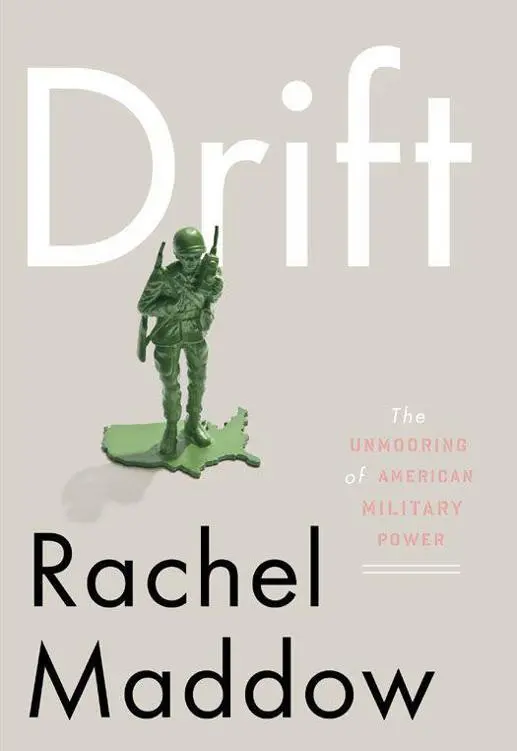
- Название:Drift
- Автор:
- Издательство:Crown Publishers
- Жанр:
- Год:2012
- Город:New York
- ISBN:978-0-307-46100-1
- Рейтинг книги:4 / 5. Голосов: 1
-
Избранное:Добавить в избранное
- Отзывы:
-
Ваша оценка:
Drift: краткое содержание, описание и аннотация
Предлагаем к чтению аннотацию, описание, краткое содержание или предисловие (зависит от того, что написал сам автор книги «Drift»). Если вы не нашли необходимую информацию о книге — напишите в комментариях, мы постараемся отыскать её.
Written with bracing wit and intelligence, Rachel Maddow’s
argues that we’ve drifted away from America’s original ideals and become a nation weirdly at peace with perpetual war, with all the financial and human costs that entails. To understand how we’ve arrived at such a dangerous place, Maddow takes us from the Vietnam War to today’s war in Afghanistan, along the way exploring the disturbing rise of executive authority, the gradual outsourcing of our war-making capabilities to private companies, the plummeting percentage of American families whose children fight our constant wars for us, and even the changing fortunes of G.I. Joe. She offers up a fresh, unsparing appraisal of Reagan’s radical presidency. Ultimately, she shows us just how much we stand to lose by allowing the priorities of the national security state to overpower our political discourse.
Sensible yet provocative, dead serious yet seriously funny,
will reinvigorate a “loud and jangly” political debate about how, when, and where to apply America’s strength and power—and who gets to make those decisions.
http://www.youtube.com/watch?v=Y9xoM7TMiTA
Drift — читать онлайн бесплатно полную книгу (весь текст) целиком
Ниже представлен текст книги, разбитый по страницам. Система сохранения места последней прочитанной страницы, позволяет с удобством читать онлайн бесплатно книгу «Drift», без необходимости каждый раз заново искать на чём Вы остановились. Поставьте закладку, и сможете в любой момент перейти на страницу, на которой закончили чтение.
Интервал:
Закладка:
The October 1995 “Report of the Defense Science Board: Task Force on Quality of Life” and the August 1996 “Report of the Defense Science Board: Task Force on Outsourcing and Privatization” were useful guides to the fiscal situation and thinking at the Pentagon in the 1990s. Anthony Bianco and Stephanie Anderson Forest did farsighted and smart reporting on the rise of private military contractors in BusinessWeek .
The United States General Accounting Office (GAO) reports on LOGCAP operations published in February 1997 and September 2000 provided details into both the benefits and costs of civilian augmentation in the Balkans.
The best reporting on the DynCorp sex-trafficking problems was done by Kelly Patricia O’Meara in the Washington Times magazine Insight and by Robert Capps in Salon . A November 2002 report by Human Rights Watch, “Hopes Betrayed: Trafficking of Women and Girls to Post-Conflict Bosnia and Herzegovina for Forced Prostitution,” is a harrowing portrait of that world. Kathryn Bolkovac’s memoir of her experiences in Bosnia, The Whistleblower: Sex Trafficking, Military Contractors, and One Woman’s Fight for Justice , was a useful guide to the culture inside DynCorp.
Again, I drew largely from the memoirs of Dick Cheney and Colin Powell, as well as Karen DeYoung’s biography of Powell, to understand their thinking about the budget realities at the Pentagon during the George Herbert Walker Bush administration. Rise of the Vulcans , by James Mann, provided further detail. “Defense Strategy for the 1990s: The Regional Defense Strategy,” published in January 1993, and authored by Cheney, was useful reading, as was the Clinton administration’s “National Performance Review. Report on Reinventing the Department of Defense,” published in September 1996.
Corporate Warriors: The Rise of the Privatized Military Industry by P. W. Singer provides great information about MPRI and other private military operations; so does author David Isenberg’s Shadow Force .
To understand the conflict in the Balkans and the Clinton administration’s response, I recommend A Problem from Hell: America and the Age of Genocide by Samantha Power. I also drew on reports by the US State Department and the Senate Foreign Relations Committee; President Bill Clinton’s autobiography, My Life; and writings by Clinton administration officials Madeleine K. Albright and Nancy Soderberg.
Chapter 8: “One Hell of a Killing Machine”
There has been much good reporting on the drone warfare and other secret and privatized military operations in recent years. For bringing to light what the government would prefer to be essentially secret, credit is due Jane Mayer, James Risen, Mark Mazzetti, Greg Miller, Julie Tate, Nick Turse, Jeremy Scahill, and Eric Schmitt. The Long War Journal and New America Foundation have made it their mission to track each and every drone strike in Pakistan, and should be commended for it.
Thanks to David Corn for the “million years” quote from John McCain in 2008.
The reporting at the Army Times proved a great source throughout, but especially on the issues of the Guard and Reserves.
Chapter 9: An $8 Trillion Fungus Among Us
A number of official government and military reports on the nation’s nuclear program, as well as congressional testimony of Air Force generals, helped in telling the recent (and not so recent) history of American nuclear weapons. The GAO’s March 2009 report for a House subcommittee, entitled “NNSA and DOD Need to More Effectively Manage the Stockpile Life Extension Program,” explains the Fogbank problem.
For the events surrounding the Minot-Barksdale whoopsie and the general readiness at Barksdale, I have relied in the main on the official reports commissioned by the Air Force and the Pentagon in the debacle’s aftermath. Thank you to the pseudonymous “Nate Hale” for shaking loose the “Limited Nuclear Surety Inspection Report” that followed the September 2007 Air Combat Command inspection at Barksdale. Reporting by Joby Warrick and Walter Pincus in the Washington Post offered extra detail of the Minot-to-Barksdale mishap.
Jaya Tiwari and Cleve J. Gray have compiled a most useful index of nuclear near-disasters in their paper “U.S. Nuclear Weapons Accidents.” For those particularly interested in the North Carolina incident, it’s worth poking around the website Broken Arrow: Goldsboro, NC, The Truth Behind North Carolina’s Brush with Disaster at www.ibiblio.org/bomb/index.html.
Readers might also enjoy Nuclear Family Vacation: Travels in the World of Atomic Weaponry , by Nathan Hodge and Sharon Weinberger; and Bomb Scare: The History and Future of Nuclear Weapons , by my friend Joseph Cirincione.
Epilogue: You Build It, You Own It
Although I have not used them as sources per se, readers interested in exploring the basic thesis here from different analytical and historical vantage points might find useful the writings of James Fallows ( National Defense ), Andrew Bacevich ( The New American Militarism , The Long War , The Limits of Power ), James Carroll ( House of War ), and Eugene Jarecki ( The American Way of War ).
Acknowledgments
I’m the slowest writer on earth. I make sloth look blurry with speed. First thanks therefore go to Crown and the very patient Rachel Klayman for letting this whole process take as long as it needed to.
Thanks to Mark Zwonitzer for expert research, assistance, and yet further calm, good-humored patience. With Mark: book; without Mark: no book. And thanks to Sierra Pettengill for appropriately ferocious fact checking.
If I ever write a sequel to this book that’s just about the inadvertently hilarious policy and culture of nuclear weapons, it will be thanks to the early and very fun research I did on that topic with my friend Shelley Lewis.
Laurie Liss at Sterling Lord Literistic has been a stalwart pal as well as an extraordinarily effective noodge; I’m thankful also to the SLL office staff for letting me essentially take up room and board in their conference room on Bleecker Street for months at a time.
My boss at MSNBC, Phil Griffin, my executive producer, Bill Wolff, and the whole staff of The Rachel Maddow Show have been more than indulgent with the time, brainpower, and stress diversion this book entailed. Special thanks to Lauren Skowronski and Julia Nutter for making impossible logistics work as if by magic.
Thank you to Penny Simon at Crown for deftly ushering the book into the world in a way that I’d have no clue how to arrange on my own.
But mostly I am thankful to my beloved Susan, for letting this project and my obsession with these ideas take up so much space in our lives. Without family support, I never would have been able to do this.
And without the genuine inspiration I get from my generation of veterans, I never would have wanted to do this. Iraq and Afghanistan veterans are less than 1 percent of the US population. But they are a huge part of why I’m bullish on America’s capacity to adapt, lead, and succeed in the twenty-first century.
About the Author
Rachel Maddow has hosted the Emmy Award–winning Rachel Maddow Show on MSNBC since 2008. Before that, she was at Air America Radio for the duration of that underappreciated enterprise. She has a doctorate in politics from Oxford and a bachelor’s degree in public policy from Stanford. She lives in rural western Massachusetts and New York City with her partner, artist Susan Mikula, and an enormous dog.
Читать дальшеИнтервал:
Закладка:
Похожие книги на «Drift»
Представляем Вашему вниманию похожие книги на «Drift» списком для выбора. Мы отобрали схожую по названию и смыслу литературу в надежде предоставить читателям больше вариантов отыскать новые, интересные, ещё непрочитанные произведения.






Обсуждение, отзывы о книге «Drift» и просто собственные мнения читателей. Оставьте ваши комментарии, напишите, что Вы думаете о произведении, его смысле или главных героях. Укажите что конкретно понравилось, а что нет, и почему Вы так считаете.