Rachel Maddow - Drift
Здесь есть возможность читать онлайн «Rachel Maddow - Drift» весь текст электронной книги совершенно бесплатно (целиком полную версию без сокращений). В некоторых случаях можно слушать аудио, скачать через торрент в формате fb2 и присутствует краткое содержание. Город: New York, Год выпуска: 2012, ISBN: 2012, Издательство: Crown Publishers, Жанр: Публицистика, на английском языке. Описание произведения, (предисловие) а так же отзывы посетителей доступны на портале библиотеки ЛибКат.
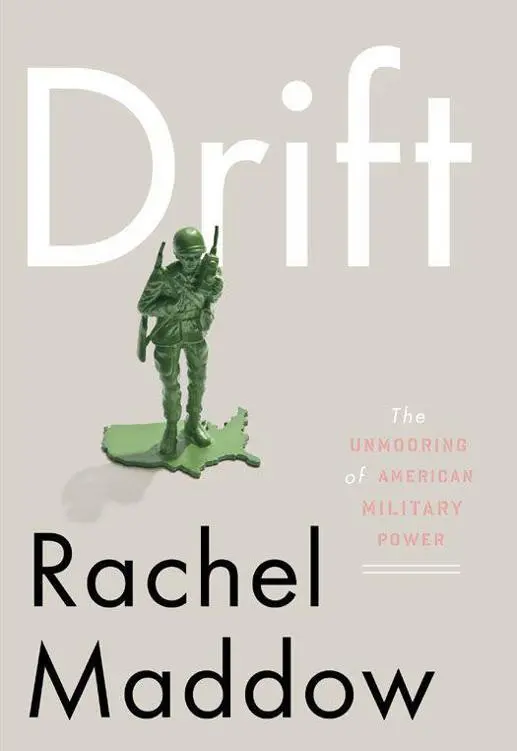
- Название:Drift
- Автор:
- Издательство:Crown Publishers
- Жанр:
- Год:2012
- Город:New York
- ISBN:978-0-307-46100-1
- Рейтинг книги:4 / 5. Голосов: 1
-
Избранное:Добавить в избранное
- Отзывы:
-
Ваша оценка:
Drift: краткое содержание, описание и аннотация
Предлагаем к чтению аннотацию, описание, краткое содержание или предисловие (зависит от того, что написал сам автор книги «Drift»). Если вы не нашли необходимую информацию о книге — напишите в комментариях, мы постараемся отыскать её.
Written with bracing wit and intelligence, Rachel Maddow’s
argues that we’ve drifted away from America’s original ideals and become a nation weirdly at peace with perpetual war, with all the financial and human costs that entails. To understand how we’ve arrived at such a dangerous place, Maddow takes us from the Vietnam War to today’s war in Afghanistan, along the way exploring the disturbing rise of executive authority, the gradual outsourcing of our war-making capabilities to private companies, the plummeting percentage of American families whose children fight our constant wars for us, and even the changing fortunes of G.I. Joe. She offers up a fresh, unsparing appraisal of Reagan’s radical presidency. Ultimately, she shows us just how much we stand to lose by allowing the priorities of the national security state to overpower our political discourse.
Sensible yet provocative, dead serious yet seriously funny,
will reinvigorate a “loud and jangly” political debate about how, when, and where to apply America’s strength and power—and who gets to make those decisions.
http://www.youtube.com/watch?v=Y9xoM7TMiTA
Drift — читать онлайн бесплатно полную книгу (весь текст) целиком
Ниже представлен текст книги, разбитый по страницам. Система сохранения места последней прочитанной страницы, позволяет с удобством читать онлайн бесплатно книгу «Drift», без необходимости каждый раз заново искать на чём Вы остановились. Поставьте закладку, и сможете в любой момент перейти на страницу, на которой закончили чтение.
Интервал:
Закладка:
Sessions wanted the generals to know he was going to make sure their new positions were safe and sound, that he was going to see to it that there was plenty of arsenal to keep them all busy for a very long time. “Last month, along with forty of my colleagues,” Senator Sessions told the military men, “I sent a letter to the president regarding our desire to be consulted on any further reduction plans to the nuclear stockpile. The New START treaty was only signed a few weeks ago, yet the administration is moving forward in my opinion at a pace that justifies the phrase ‘reckless,’ pursuing more reductions at an expedited and potentially destabilizing pace.”
Yeah, slimming down the stockpile of our thousands of nuclear weapons, that would be reckless. That would be unsafe.
EPILOGUE
You Build It, You Own It
If the military drifts away from its people in this country, that is a catastrophic outcome we as a country can’t tolerate.
—Adm. Mike Mullen, chairman of the Joint Chiefs of Staff, 2007–2011HAVING GROWN UP IN THE SUBURBS IN CALIFORNIA, WHEN I moved to rural New England I was surprised by how much god-awful work it takes to keep a still-life landscape looking unchanged. Leave stuff alone and it blows up. Not metaphorically, literally: if you leave wet hay in a silo, the decomposition of the plant material can make the hay (and your silo) catch fire. And when the trick isn’t keeping things dry, it’s keeping things wet. The logging company I buy firewood from turns its sprinklers on big piles of logs (hey, that’s my firewood!) to stop them from spontaneously combusting on cold days. Rot’s the problem there too—simple, inexorable decay. Rot makes heat, and if there’s dying wood in the middle of that big pile, cold air hitting that rot-generated heat can create a chimney effect. If that channels enough heat over the dry layers of wood in there, then kablooey: your firewood pile has just turned itself into a bonfire without virtue of a match. It catches fire just from sitting there too long, unattended.
Our place in Hampshire County looked like a horror-movie haunted house when we moved in—broke-down busted, overgrown, spongy stairs, clapboards gaping like black teeth. It looked like that because it had been abandoned for… one winter. One long winter untended rendered the place virtually uninhabitable. In our beautiful, unforgiving little hamlet, we developed a shorthand for explaining what had caused the need for a repair of some kind: “The earth took it back.”
It is unsettling to realize that the earth takes back even nuclear missiles, that they’re growing wing fungus down in Shreveport. But stuff left sitting around, unused, still needs attention; there’s a cost and a duty that attend to everything we own. If we built it, we’re responsible for it, unless we take it down and take it apart. Maybe it’s a variation on Colin Powell’s cautionary “Pottery Barn Rule”—you not only own it if you break it, you own it if you build it too. If you’ve ever built it, you own it. And after two centuries of a standing army, and two generations of massive military buildup—the defense budget doubling and then doubling again—we’ve built ourselves a whole lot of national security state. We haven’t made a habit of taking this stuff down, ever, of taking it apart. And we haven’t made a habit of considering the consequences of just letting it roll along unchecked.
That’s not to say that some of it isn’t amazing. A fact that’s underappreciated in the civilian world but very well appreciated in our military is that the US Armed Forces right now are absolutely stunning in their lethality. Deploy, deploy, deploy… practice, practice, practice. The US military was the best and best-equipped fighting force on earth even before 9/11. Now, after a solid decade of war, they’re almost unrecognizably better. Early worries such as how much gear we were burning through in Iraq were solved the way we always solve problems like that now: we doubled the military’s procurement budget between 2000 and 2010.
Consider also the state of the reserves. Thanks to the unprecedented deployment pace of the post-9/11 wars, gone are the days of the weekend warriors and the three-weeks-a-year training at some run-down outpost in the States. “For years, [reserve] soldiers would walk out the door on Fridays and say, ‘I’ve got to go play Army this weekend,’ ” the adjutant general of the Utah National Guard told a reporter from the Salt Lake Tribune . “I don’t think that’s the case anymore. We are the military to most citizens today. If you think of a uniform, you’re probably thinking of a Guardsman or a Reservist, who is your neighbor.” Probably your very physically fit neighbor. As a first sergeant who joined the National Guard in 1986 told the same paper, “There were a lot of overweight soldiers in the Guard back then who stuck around forever and talked big.” Not anymore. Not with the way we use the Guard and Reserves now, he explained: “You can’t [be overweight] if you have to put on body armor.”
America’s reservists have been in top gear or on high idle for ten years now, and their bosses say they want to keep them that way. “If we’re going to train to that level,” says the general in charge of the Army Reserves, “then my position is we’ve got to use them.”
Contrast that with LBJ explaining in 1965 that he didn’t want to call up the reserves because that would be “too dramatic”—it would be a shock to the nation’s system to tap the Guard and Reserves, even with eighty thousand US troops already deployed in Vietnam. Peacetime and civilian life used to be the norm for reservists; war, the unsettling aberration. Now that’s reversed.
As the gap has closed between regular active-duty forces and the reserves, the gap between those fighters and the rest of us has never been wider. One of the stranger political developments of the post-9/11 era was the backlash against efforts to close that gap. On Wednesday, April 28, 2004, about a month after the first anniversary of the Iraq War, Ted Koppel announced that on Friday, April 30, his program, Nightline , would honor Americans killed in Iraq by showing their faces and reading all of their names. It would be a televised memorial to those who had died in a year of war. There are, of course, war memorials to fallen heroes in every town and hamlet in America, but critics pounced on Koppel as though he’d proposed mugging the wounded at Walter Reed rather than airing a solemn memorial to the dead. His critics accused him of undermining the war effort, of being unpatriotic. The pro-war Washington Post accused Koppel of mounting a cynical ratings stunt, headlining its news article on the subject “On Nightline , a Grim Sweeps Roll Call.” The conservative Sinclair Broadcast Group immediately announced they’d boycott Nightline on all of their stations that were ABC affiliates.
Koppel said he was surprised by the controversy. But the controversy itself showed that something had changed about how a war abroad was being viewed at home. The simple and actual fact of American lives lost in the post-9/11 wars was not just a shared source of grief and national honor but had become something to be kept at a distance; casualties, for a time at least, became bad politics.
From 2003 to 2008, the Bush administration exercised a tight hold on imagery about the cost of the wars. Not only were news photographers banned from the solemn transfer ceremonies for flag-draped caskets at Dover Air Base, but the president and vice president did not attend military funerals. Even when families of fallen soldiers wanted to invite the media to cover a funeral or the return of remains, the government maneuvered as best it could to prevent such coverage. The Pentagon ultimately even effectively banned images of wounded troops in Iraq when it quietly changed its rules to require that news agencies get signed consent forms from soldiers photographed after they were wounded.
Читать дальшеИнтервал:
Закладка:
Похожие книги на «Drift»
Представляем Вашему вниманию похожие книги на «Drift» списком для выбора. Мы отобрали схожую по названию и смыслу литературу в надежде предоставить читателям больше вариантов отыскать новые, интересные, ещё непрочитанные произведения.






Обсуждение, отзывы о книге «Drift» и просто собственные мнения читателей. Оставьте ваши комментарии, напишите, что Вы думаете о произведении, его смысле или главных героях. Укажите что конкретно понравилось, а что нет, и почему Вы так считаете.