Rachel Maddow - Drift
Здесь есть возможность читать онлайн «Rachel Maddow - Drift» весь текст электронной книги совершенно бесплатно (целиком полную версию без сокращений). В некоторых случаях можно слушать аудио, скачать через торрент в формате fb2 и присутствует краткое содержание. Город: New York, Год выпуска: 2012, ISBN: 2012, Издательство: Crown Publishers, Жанр: Публицистика, на английском языке. Описание произведения, (предисловие) а так же отзывы посетителей доступны на портале библиотеки ЛибКат.
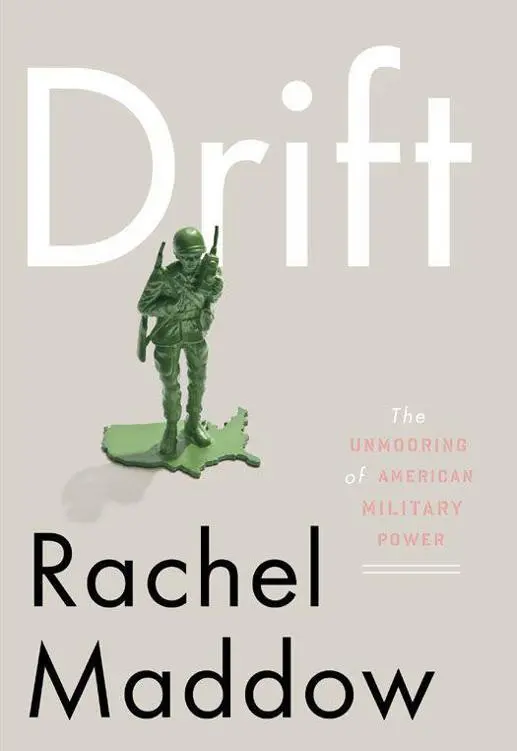
- Название:Drift
- Автор:
- Издательство:Crown Publishers
- Жанр:
- Год:2012
- Город:New York
- ISBN:978-0-307-46100-1
- Рейтинг книги:4 / 5. Голосов: 1
-
Избранное:Добавить в избранное
- Отзывы:
-
Ваша оценка:
Drift: краткое содержание, описание и аннотация
Предлагаем к чтению аннотацию, описание, краткое содержание или предисловие (зависит от того, что написал сам автор книги «Drift»). Если вы не нашли необходимую информацию о книге — напишите в комментариях, мы постараемся отыскать её.
Written with bracing wit and intelligence, Rachel Maddow’s
argues that we’ve drifted away from America’s original ideals and become a nation weirdly at peace with perpetual war, with all the financial and human costs that entails. To understand how we’ve arrived at such a dangerous place, Maddow takes us from the Vietnam War to today’s war in Afghanistan, along the way exploring the disturbing rise of executive authority, the gradual outsourcing of our war-making capabilities to private companies, the plummeting percentage of American families whose children fight our constant wars for us, and even the changing fortunes of G.I. Joe. She offers up a fresh, unsparing appraisal of Reagan’s radical presidency. Ultimately, she shows us just how much we stand to lose by allowing the priorities of the national security state to overpower our political discourse.
Sensible yet provocative, dead serious yet seriously funny,
will reinvigorate a “loud and jangly” political debate about how, when, and where to apply America’s strength and power—and who gets to make those decisions.
http://www.youtube.com/watch?v=Y9xoM7TMiTA
Drift — читать онлайн бесплатно полную книгу (весь текст) целиком
Ниже представлен текст книги, разбитый по страницам. Система сохранения места последней прочитанной страницы, позволяет с удобством читать онлайн бесплатно книгу «Drift», без необходимости каждый раз заново искать на чём Вы остановились. Поставьте закладку, и сможете в любой момент перейти на страницу, на которой закончили чтение.
Интервал:
Закладка:
In 2011, new secretary of defense Leon Panetta was running around Capitol Hill with his hair on fire saying cuts in the annual increase of the Pentagon budget would “hollow out” the military. “This is not as if we’ve come out of a major war and everything is fine,” Panetta said, lamenting “rising powers… rapidly modernizing their militaries and investing in capabilities to deny our forces freedom of movement in vital regions.” He’s right. But the reason those foreign powers were rising in the first place is not necessarily because of their military strength but because of their economies—something this country had largely neglected in our decade of hot war.
However much blood and treasure we shoveled into the Hindu Kush and the deserts of Al Anbar Province after 9/11, we can look back at that expenditure now from a position of grave, grave weakness. Unless three-ton V-hulled armored MRAP trucks and pilotless flying killer robots are going to provide the basis of America’s new manufacturing base for the twenty-first century, we’ve built ourselves—to the exclusion of all other priorities—a military superstructure we can’t use for anything other than war and that we can no longer afford. And it’s going to be really hard to take this thing apart. Even the manifestly hilariously dangerously stupid parts of it we can’t take apart. Have you heard the one about the wing fungus?
CHAPTER 9
An $8 Trillion Fungus Among Us

SAY YOU’RE A HIGH SCHOOL SENIOR IN 2007. WE’RE FOUR YEARS into Iraq, and six years into Afghanistan. If you’re feeling a call to patriotic duty, a sense of adventure, thinking about the training opportunities offered by a career in the US Armed Forces, where do you tell that recruiter that you’d like to end up? Probably not in a missile silo in Minot, North Dakota. In the post-9/11 era, who’d want the job of sitting through the nuclear winter on the high plains, running maintenance on the thirty-five B-52s, guarding the “silos” that housed 150 giant and largely untested intercontinental ballistic missiles (ICBMs), babysitting the hundreds of smaller nuclear warheads stored in sod-topped bunkers like canned fruit shelved in a tornado shelter? The munitions maintenance team and the weapons handlers and the tow crews in Minot could call those bunkers “igloos,” but giving stuff funny names didn’t make life there any more fun.
“Our younger airmen, once they’ve reached that decision point, if they have been stationed in one of our northern bases where the environment’s a little bit tougher, they tend to leave the service,” an Air Force general told the Senate. Those who didn’t leave the service didn’t stick around the tending-the-nukes life for long. In 2007, an Airman assigned to a nuclear bomber wing could look around and note that more than eight in ten members of her wing’s security force were rookies. One senior officer in the Air Force’s nuclear enterprise admitted that standing alert duty in missile silos is not considered “deployed,” and “if you are not a ‘deployer,’ you do not get promoted.”
The Air Force pleaded for more missileers, but “deployments in support of regional conventional operations [i.e., Iraq and Afghanistan] decrease manpower available to the nuclear mission.” But even without Iraq and Afghanistan siphoning off military talent, would anyone expect that ambitious young airmen would be clamoring for silo duty?
“We need a nuclear career field,” concluded a Pentagon blue-ribbon task force on the nation’s nuclear mission in 2008. Sixty years into America’s nuclear superpower age, sixty years as the only nation to have ever used a nuclear weapon against an enemy in wartime, sixty years of hair-trigger nuclear alert, and we don’t have a nuclear career field? We used to have one, but it’s been eclipsed by changing times, changing wars.
That Pentagon report noted that “many Airmen were skeptical of hearing repeated pronouncements that the nuclear mission is ‘number one’… No one explains to junior Air Force personnel why ICBMs are important.” But no matter what they might figure out to say about ICBMs being important, the Air Force’s actions spoke louder. Ask the staff sergeant who got written up for failing a Storage Access and Missile Safe Status Check inspection but still retained his position as a nuclear weapons handler. Status check? The airmen handling weapons capable of unleashing Armageddon were stuck on low.
So was the whole nuclear enterprise. It wasn’t just the personnel; it was the aging hardware, too. Consider page thirteen of a recently declassified 2007 report on the care and feeding of our nation’s nuclear weapons at Barksdale Air Force Base in Shreveport, Louisiana:
RECOMMENDED IMPROVEMENT AREAS:
• Numerous air launched cruise missiles had fungus on leading edge of wings
• Forward missile antenna sealant delaminated
• Corrosion on numerous H1388 storage and shipping containers
While our nuclear-armed cruise missiles were growing leading-edge wing fungus in the subtropical moisture of Louisiana, other US military flying hardware was having rather the opposite problem: in the words of Defense Industry Daily , they “were about to fly their wings off—and not just as a figure of speech.” In 2006, the Air Force embarked on an emergency (and expensive, at $7 million a pop) upgrade of the nation’s fleet of C-130 aircraft. After heavy service moving cargo and flying combat missions as retrofitted gunships, the huge planes’ wing-boxes were failing. Wing-boxes are what keep the wings attached to the fuselage.
So take your pick of your maintenance priorities, Taxpayer: wings falling off enormous gunships in the Middle East and central Asia from constant use in the longest simultaneous land wars in US history, or sedentary nuclear missiles in Shreveport growing fungus. At least we can easily tally the twenty-first-century benefits where the C-130s were concerned; those airplanes have moved a bucketload of troops—along with “beans, boots, Band-Aids, and bullets”—to the various war zones we’ve kept humming since 2001. Operationally speaking, that workhorse fleet of no-frills, have-a-seat-on-your-helmet airplanes has been tremendously effective and cost-efficient.
The nuclear thing is harder to figure.
The United States, according to a 1998 study by the Brookings Institution, spent nearly eight trillion in today’s dollars on nukes in the last half of the twentieth century, which represents something like a third of our total military spending in the Cold War. Just the nuke budget was more than that half-century’s federal spending on Medicare, education, social services, disaster relief, scientific research (of the non-nuclear stripe), environmental protection, food safety inspectors, highway maintenance, cops, prosecutors, judges, and prisons… combined. The only programs that got more taxpayer dollars were Social Security and non-nuclear defense spending.
What do we have to show for that steady, decades-long mushroom cloud of a spending spree? Well, congratulations: we’ve got ourselves a humongous nuclear weaponry complex. Still, today. Yes, the Nevada Test Site is now a museum, and the FBI converted J. Edgar Hoover’s fallout shelter into a Silence of the Lambs– style psychological-profiling unit, but as atomic-kitschy as it all seems, the bottom line is this: twenty-four hours a day, 365 days a twenty-first-century year, we’ve still got thousands of nuclear missiles armed, manned, and ready to go, pointed at the Soviet Union. Er … Russia. Whatever. At the places that still have thousands of live nuclear weapons pointed at us.
Читать дальшеИнтервал:
Закладка:
Похожие книги на «Drift»
Представляем Вашему вниманию похожие книги на «Drift» списком для выбора. Мы отобрали схожую по названию и смыслу литературу в надежде предоставить читателям больше вариантов отыскать новые, интересные, ещё непрочитанные произведения.









Обсуждение, отзывы о книге «Drift» и просто собственные мнения читателей. Оставьте ваши комментарии, напишите, что Вы думаете о произведении, его смысле или главных героях. Укажите что конкретно понравилось, а что нет, и почему Вы так считаете.