Steve LeVine - Putin's Labyrinth
Здесь есть возможность читать онлайн «Steve LeVine - Putin's Labyrinth» весь текст электронной книги совершенно бесплатно (целиком полную версию без сокращений). В некоторых случаях можно слушать аудио, скачать через торрент в формате fb2 и присутствует краткое содержание. Город: New York, Год выпуска: 2008, ISBN: 2008, Издательство: Random House, Жанр: Публицистика, на английском языке. Описание произведения, (предисловие) а так же отзывы посетителей доступны на портале библиотеки ЛибКат.
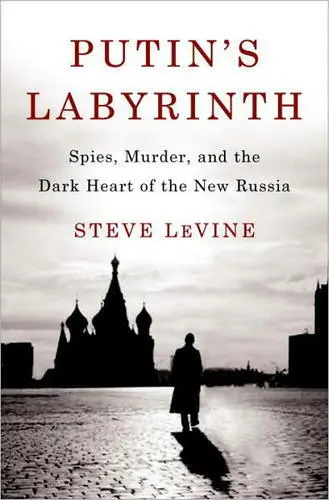
- Название:Putin's Labyrinth
- Автор:
- Издательство:Random House
- Жанр:
- Год:2008
- Город:New York
- ISBN:978-1-58836-815-7
- Рейтинг книги:3 / 5. Голосов: 1
-
Избранное:Добавить в избранное
- Отзывы:
-
Ваша оценка:
Putin's Labyrinth: краткое содержание, описание и аннотация
Предлагаем к чтению аннотацию, описание, краткое содержание или предисловие (зависит от того, что написал сам автор книги «Putin's Labyrinth»). Если вы не нашли необходимую информацию о книге — напишите в комментариях, мы постараемся отыскать её.
Drawing on new interviews with eyewitnesses and the families of victims, LeVine documents the bloodshed that has stained Putin’s two terms as president. Among the incidents chronicled in these pages: The 2002 terrorist takeover of a crowded Moscow theater—which led to the government gassing the building, and the deaths of more than a hundred terrified hostages–seen here from new angles, through the riveting words of those who survived; and the murder of courageous investigative reporter Anna Politkovskaya, shot in the elevator of her apartment building on Putin’s birthday, purportedly as a malicious “gift” for the president from supporters. Finally, a shocking story that made international headlines–the 2006 death of defector Alexander Litvinenko in London—is dramatized as never before. LeVine traces the steps of this KGB-spy-turned-dissident on his way to being poisoned with polonium-210, a radioactive isotope. And in doing so, LeVine is granted a rare series of interviews with a KGB defector who was nearly killed in strangely similar circumstances fifty years earlier. Through LeVine’s exhaustive research, we come to know the victims as real people, not just names in brief news accounts of how they died.
Putin’s Labyrinth
Putin's Labyrinth — читать онлайн бесплатно полную книгу (весь текст) целиком
Ниже представлен текст книги, разбитый по страницам. Система сохранения места последней прочитанной страницы, позволяет с удобством читать онлайн бесплатно книгу «Putin's Labyrinth», без необходимости каждый раз заново искать на чём Вы остановились. Поставьте закладку, и сможете в любой момент перейти на страницу, на которой закончили чтение.
Интервал:
Закладка:
As reporters stood outside the hospital awaiting the latest report on Litvinenko’s condition, filmmaker Andrei Nekrasov visited his bedside. Nekrasov would later say that his friend “looked just like a ghost.” A grimly determined Litvinenko said it was necessary that he endure the suffering. “This is what I have to do to prove I’m right,” he said.
On November 22, his condition worsened. He had been able to answer police questions for three or four hours the previous day, but now it was hard for him to speak. His appearance was “like a seventy-year-old man, bald, gaunt, skin over bones,” said Goldfarb. As Marina prepared to leave the hospital for the evening with their son, Anatoly, Litvinenko spoke his first complete sentence of the entire day. “Oh, Marinochka, I love you so much,” he uttered, using the diminutive of her name.
At Litvinenko’s bedside, his father, Valter, crossed himself and said the Lord’s Prayer. “Father, I’ve converted. I’m a Muslim now,” Litvinenko said. During a visit with Akhmed Zakayev—his neighbor and friend, who was a Muslim—Litvinenko had embraced Islam.
That night, Litvinenko twice had to be resuscitated after his heart stopped. Hospital staff summoned Marina, then after a few hours sent her home.
The following evening, the phone rang again in the Litvinenko home. It was the hospital. “Come quickly,” the voice at the other end told Marina.
Though her husband was unconscious, Marina arrived in time to say good-bye.
At 9:21 p.m., Litvinenko was declared dead.
Outside University College Hospital, Alex Goldfarb read a statement that he said Litvinenko had dictated two days earlier. Addressed directly to Vladimir Putin, it said in part, “You have shown yourself to have no respect for life, liberty, or any civilized value. You have shown yourself to be unworthy of your office, to be unworthy of the trust of civilized men and women. You may succeed in silencing one man but the howl of protest from around the world will reverberate, Mr. Putin, in your ears for the rest of your life. May God forgive you for what you have done, not only to me but to beloved Russia and its people.”
The stunning photograph by Natasja Weitsz and the ghastly manner of his death generated international sympathy for Litvinenko and outrage toward Russia. Many viewed his life story and the way it ended as epic tragedy, and in Hollywood there was a flurry of competition to put it all on the big screen. The contest was won by Johnny Depp, who left open the possibility that he himself would play the slain Russian defector.
What killed Litvinenko? When his doctors saw his hair falling out and his white blood cell count dropping, they had immediately suspected radiation poisoning. So they tested for what they thought to be the most likely culprits—gamma and beta radiation. Finding no evidence of either in his blood, they assumed that they were on the wrong trail. A day before Litvinenko died, however, someone at Britain’s Health Protection Agency had a hunch. Samples of Litvinenko’s urine were sent to the Atomic Weapons Establishment, or AWE, an agency uniquely equipped to solve the mystery.
AWE was just what its name implied—it developed and kept watch over Britain’s nuclear weapons arsenal. At AWE, scientists tested the urine samples for alpha-emitting elements, the rarer, relatively large, and slow-moving particles that, unlike gamma and beta radiation, cannot pass through objects but pack a wallop when they are taken into the body.
The tests came back positive for polonium-210, an alpha emitter.
Around six p.m. on November 23, the news was passed along to Litvinenko’s doctors. But it was too late. He died about three hours later.
The AWE discovery was important in more ways than one. If Litvinenko had not been in such good health when he was first stricken, he probably would have died much sooner. There would have been no urgency to continue testing for radiation poisoning, and the isotope that killed him probably would have gone undetected. Without that clue, investigators might not have found their way to the evidence that Litvinenko had been murdered. Litvinenko himself died without learning the truth.
His doctors could be excused for not knowing that their patient’s body had been ravaged by a few specks of a nuclear isotope so arcane that scientists were startled to hear of its use as a murder weapon. Once upon a time, polonium-210 was something of a household name, at least as far as known elements go. It was discovered in 1898 by Marie and Pierre Curie, and named for her native Poland. Some called it the deadliest element, gram for gram, on the periodic table. A researcher working for Marie Curie died from exposure to polonium. So did Curie’s own daughter, Irène Joliot-Curie, who, like her mother, was a winner of a Nobel Prize.
During World War II and through the 1960s, polonium-210 was used as a triggering device for nuclear weapons. Mixed with beryllium, it emits a neutron and starts the fission process. But by the early 1970s, the substance had fallen out of favor among atomic bomb makers because its relatively fast deterioration rate meant it had to be replaced every few months. More recently its use had been more benign—to eliminate static in smoke detectors and dust from film and lenses, for example. The commercial market’s demand for polonium-210 was so small that its entire global production was just one hundred grams a year—almost all manufactured in Russia and then exported to the United States.
Few were even aware of its existence. Polonium-210 was on no published list of potential poisons, and as far as I could tell had never been used as one. The silvery isotope was so exotic that, even five years after the imposition of heightened security measures in response to the 9/11 attacks, airports around the world were ill equipped to detect it. It was absent from the usual lists of weapons of mass destruction. Its properties were so peculiar that, unlike more familiar radioactive elements such as plutonium-239, it could be stored safely in, say, an ordinary cigarette pack or an aspirin bottle. Anyone with a mind to—and the right credentials—could slip it through almost any ostensibly secure environment.
It was unclear why the isotope had never been employed in any known assassination before Litvinenko’s. Yes, there were far simpler and cheaper methods of killing. But if an assassin favored the use of radioactive poison, polonium-210 was an ideal candidate. First was its novelty, meaning it was less likely to attract suspicion than its brother thallium, which assassins, including the Soviets, had used in its nonradioactive form numerous times over the decades. Second was its nature to wander: Once it invaded an organism, polonium-210 went in many different directions. This set it apart from isotopes that gravitated toward, say, kidneys or bone marrow, thus inflicting largely localized and treatable damage. And polonium-210 threw off its mass with astonishing speed—it dispensed half its atomic particles in just 138 days, a barrage superior to almost any other relatively stable isotope. By comparison, an alternative element such as americium took 432 years to accomplish the same task. A terrorist could release polonium-210 into a crowd in an enclosed space, through food or air, and cause many fatalities in a compressed period of time, with no one learning the cause—and with reduced odds of being caught.
The few scientists familiar with polonium-210 struggled for metaphors to describe its agonizing effects. Perhaps the most chilling likened the relatively large atomic particles it released to bullets, firing away mercilessly at Litvinenko’s soft tissue. Another evoked a football image, the particles knocking over cells like a rampaging fullback flattening every defender in his path. All said, polonium-210 was many times more hazardous than poisons usually associated with excruciating death, such as hydrogen cyanide.
Читать дальшеИнтервал:
Закладка:
Похожие книги на «Putin's Labyrinth»
Представляем Вашему вниманию похожие книги на «Putin's Labyrinth» списком для выбора. Мы отобрали схожую по названию и смыслу литературу в надежде предоставить читателям больше вариантов отыскать новые, интересные, ещё непрочитанные произведения.









Обсуждение, отзывы о книге «Putin's Labyrinth» и просто собственные мнения читателей. Оставьте ваши комментарии, напишите, что Вы думаете о произведении, его смысле или главных героях. Укажите что конкретно понравилось, а что нет, и почему Вы так считаете.