Steve LeVine - Putin's Labyrinth
Здесь есть возможность читать онлайн «Steve LeVine - Putin's Labyrinth» весь текст электронной книги совершенно бесплатно (целиком полную версию без сокращений). В некоторых случаях можно слушать аудио, скачать через торрент в формате fb2 и присутствует краткое содержание. Город: New York, Год выпуска: 2008, ISBN: 2008, Издательство: Random House, Жанр: Публицистика, на английском языке. Описание произведения, (предисловие) а так же отзывы посетителей доступны на портале библиотеки ЛибКат.
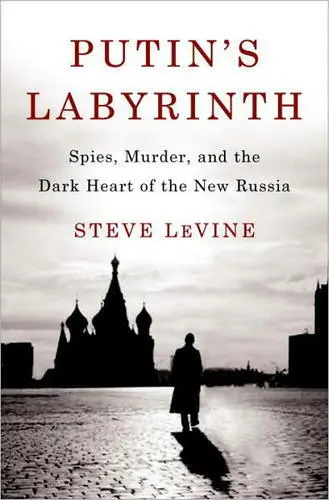
- Название:Putin's Labyrinth
- Автор:
- Издательство:Random House
- Жанр:
- Год:2008
- Город:New York
- ISBN:978-1-58836-815-7
- Рейтинг книги:3 / 5. Голосов: 1
-
Избранное:Добавить в избранное
- Отзывы:
-
Ваша оценка:
Putin's Labyrinth: краткое содержание, описание и аннотация
Предлагаем к чтению аннотацию, описание, краткое содержание или предисловие (зависит от того, что написал сам автор книги «Putin's Labyrinth»). Если вы не нашли необходимую информацию о книге — напишите в комментариях, мы постараемся отыскать её.
Drawing on new interviews with eyewitnesses and the families of victims, LeVine documents the bloodshed that has stained Putin’s two terms as president. Among the incidents chronicled in these pages: The 2002 terrorist takeover of a crowded Moscow theater—which led to the government gassing the building, and the deaths of more than a hundred terrified hostages–seen here from new angles, through the riveting words of those who survived; and the murder of courageous investigative reporter Anna Politkovskaya, shot in the elevator of her apartment building on Putin’s birthday, purportedly as a malicious “gift” for the president from supporters. Finally, a shocking story that made international headlines–the 2006 death of defector Alexander Litvinenko in London—is dramatized as never before. LeVine traces the steps of this KGB-spy-turned-dissident on his way to being poisoned with polonium-210, a radioactive isotope. And in doing so, LeVine is granted a rare series of interviews with a KGB defector who was nearly killed in strangely similar circumstances fifty years earlier. Through LeVine’s exhaustive research, we come to know the victims as real people, not just names in brief news accounts of how they died.
Putin’s Labyrinth
Putin's Labyrinth — читать онлайн бесплатно полную книгу (весь текст) целиком
Ниже представлен текст книги, разбитый по страницам. Система сохранения места последней прочитанной страницы, позволяет с удобством читать онлайн бесплатно книгу «Putin's Labyrinth», без необходимости каждый раз заново искать на чём Вы остановились. Поставьте закладку, и сможете в любой момент перейти на страницу, на которой закончили чтение.
Интервал:
Закладка:
In Litvinenko’s case, once the isotope had reached his stomach, it began to shoot off particles in a ferocious attack on his intestinal lining. Internal bleeding resulted, causing him to feel pain and nausea. By the end of the first day, up to half the poison was lodging in his spleen, kidneys, liver, lymph nodes, and bone marrow. It was delivering a massive punch to his red blood cells, whose natural response was to stop multiplying, and his bone marrow stopped replenishing his body with new blood cells. Ultimately, his organs were ripped apart and his immune system rendered inoperable.
In the early hours of the day after Litvinenko’s death, British police and AWE scientists appeared at the family home. They told Marina to pack her things—she had to get out, and probably wouldn’t be coming back. She wondered what the fuss was about, until they told her for the first time that a nuclear poison had been used to kill her husband.
“You have to understand that we’ve never encountered this before, that we don’t even know what it is, and we don’t know what the consequences will be,” said one of the emergency workers.
Then began an exhaustive effort to retrace Litvinenko’s movements in the last days and hours before he fell ill. Spectrography equipment revealed a clear trail of polonium in places he was known to have visited. Boris Berezovsky’s office was found to be contaminated and was sealed off. Traces of polonium were detected at the sushi restaurant where Litvinenko had dined with Lugovoi and Kovtun on October 16. It was shut down. Investigators also found polonium at the Pine Bar, where Litvinenko had sipped tea with the two Russians on November 1, only to fall ill a few hours later at home. Authorities closed the bar, and would later conclude that Litvinenko had been poisoned there—that the fatal dose of polonium had been slipped into his tea.
Britain’s Health Protection Agency, anxious to avert panic, issued daily briefings on what steps were being taken to secure the public’s safety. In the first weeks afterward, its telephone hotlines fielded some four thousand calls from people around the world concerned that they might have been exposed. The agency found traces of polonium-210 at more than two dozen sites in London. About a dozen people, including Litvinenko’s wife and son, had been exposed to levels high enough to pose long-term health risks.
The painstaking investigation found traces of polonium at a number of locations—other than the Pine Bar—where Lugovoi and Kovtun had been. In some cases, such as Berezovsky’s office and the sushi restaurant, the polonium traces were detected on the very seats that were known to have been occupied by one or both Russians. Investigators also established to their own satisfaction that the polonium had entered the United Kingdom from Russia. The clincher was evidence of the substance found on a British Airways plane that had flown from Moscow to London. It showed up on a seat that had been occupied by Lugovoi.
All signs seemed to point to either Lugovoi or Kovtun—or both—as having carried out Litvinenko’s assassination, or at least participated in it.
But judging by their outward behavior, the two had been as bewildered as anyone about Litvinenko’s illness. Lugovoi had telephoned his business partner in the hospital to offer his sympathy, and also called Marina.
“Marina, this is Andrei Lugovoi,” he said. “Everything that happened strikes me as very strange. I’ll do everything I can to figure it out.”
He and Kovtun voluntarily underwent questioning by officials at the British embassy in Moscow while Litvinenko was still alive. After the ex–KGB agent died, Kovtun telephoned British authorities and said he was willing to talk further if they wished. They didn’t take him up on the offer until some time later, when their investigators arrived in Moscow for interviews.
Lugovoi and Kovtun were examined by doctors in Moscow, who said that both indeed had been exposed to polonium. Lugovoi said someone must have planted the substance on his person to falsely implicate him in Litvinenko’s murder. He dismissed the entire affair as a British plot to discredit Putin. Kovtun confirmed his diagnosis but said an agreement with Russian investigators prevented him from saying anything more.
Some Russians said Boris Berezovsky in London had probably masterminded the killing, and the Kremlin soon added its support to this theory. Another suspect was Semyon Mogilevich, a notorious mafia figure whose supposed motivation was to win the favor of certain powerful Russians. But he was a less than credible candidate.
Others speculated—without any supporting evidence—that Litvinenko was attempting to smuggle nuclear material and accidentally poisoned himself. This scenario sounded to me like the old Soviet habit of blaming the victim. But it was widely accepted within the Russian intelligence community.
“It’s natural that you’re getting sick from what you are transferring,” said Josef Linder, a lecturer and self-described expert on political assassination who subscribed to the Litvinenko-as-smuggler theory. The forty-seven-year-old Muscovite had a shaved head, a tenth-degree black belt in jujitsu, and an apartment that resembled the laboratory of the gadget master Q, of James Bond fame.
Swords, rifles, medals, a thirteenth-century Russian wooden mace, and a fifteenth-century Malaysian knife with an ivory handle were all on display in his foyer. Linder was especially proud of his collection of knives, one of which did double duty as a small pistol. Another, he said, was “a flying knife that can be ejected five to six meters. You push the button and the knife flies.”
Linder was the author, co-author, or editor of twenty books on Russian espionage, which he had tracked back a thousand years. He beamed at the opportunity to relate some of his discoveries. In the ninth century, Russian princes were so fearful of treachery that they paid for multiple layers of intelligence gathering. Leo Tolstoy’s great-great-grandfather served as a sort of spy for Peter I, sleuthing around Ottoman Turkey. Then there was the agent for Czar Nicholas II who snatched a notebook from the inside pocket of a jacket worn by Kaiser Wilhelm II as the two lunched together. By the time the meal ended, the agent had photographed the pages of the notebook and returned it to the jacket pocket without being noticed. The story sounded a bit unbelievable, but that did not bother Linder. He was a romantic who celebrated what he viewed as the most patriotic of Russian professions—spying and its associated black arts.
Linder excluded Alexander Litvinenko from his pantheon. The look on his face conveyed contempt for the very notion of Litvinenko as intelligence agent. “He joined the FSB from the Interior Ministry. He is not an intelligence officer,” Linder said. He added that Litvinenko “tried to make it as though he was a personal enemy of Putin’s. But nobody was interested in him here.”
Mikhail Golovatov, the former commander of the KGB’s elite Alpha troops, was similarly dismissive. Now the director of one of Moscow’s largest security companies, Golovatov was an influential man. When he spoke, the KGB cadre heard the voice of a true comrade who had served in Afghanistan, Vilnius, Tbilisi, Baku, Kishinau, and Dushanbe—all places where the Kremlin sought to put down localized rebellions during the last years of Soviet rule. After years of ostracism during the Yeltsin era, men like Golovatov were back among the cream of Moscow society.
So what did he think of Litvinenko?
“Negative. The most negative.”
Why?
Litvinenko was on Boris Berezovsky’s payroll, Golovatov noted. “How can you work for the state, then join the ranks of someone working against the state? If I gave an oath to protect the state, how can I betray it? If I don’t agree with state politics, I would retire and not fight against the state.”
Читать дальшеИнтервал:
Закладка:
Похожие книги на «Putin's Labyrinth»
Представляем Вашему вниманию похожие книги на «Putin's Labyrinth» списком для выбора. Мы отобрали схожую по названию и смыслу литературу в надежде предоставить читателям больше вариантов отыскать новые, интересные, ещё непрочитанные произведения.









Обсуждение, отзывы о книге «Putin's Labyrinth» и просто собственные мнения читателей. Оставьте ваши комментарии, напишите, что Вы думаете о произведении, его смысле или главных героях. Укажите что конкретно понравилось, а что нет, и почему Вы так считаете.