Steve LeVine - Putin's Labyrinth
Здесь есть возможность читать онлайн «Steve LeVine - Putin's Labyrinth» весь текст электронной книги совершенно бесплатно (целиком полную версию без сокращений). В некоторых случаях можно слушать аудио, скачать через торрент в формате fb2 и присутствует краткое содержание. Город: New York, Год выпуска: 2008, ISBN: 2008, Издательство: Random House, Жанр: Публицистика, на английском языке. Описание произведения, (предисловие) а так же отзывы посетителей доступны на портале библиотеки ЛибКат.
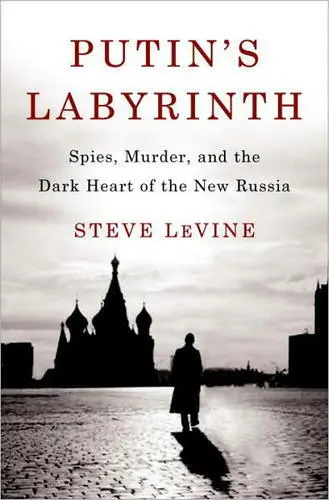
- Название:Putin's Labyrinth
- Автор:
- Издательство:Random House
- Жанр:
- Год:2008
- Город:New York
- ISBN:978-1-58836-815-7
- Рейтинг книги:3 / 5. Голосов: 1
-
Избранное:Добавить в избранное
- Отзывы:
-
Ваша оценка:
Putin's Labyrinth: краткое содержание, описание и аннотация
Предлагаем к чтению аннотацию, описание, краткое содержание или предисловие (зависит от того, что написал сам автор книги «Putin's Labyrinth»). Если вы не нашли необходимую информацию о книге — напишите в комментариях, мы постараемся отыскать её.
Drawing on new interviews with eyewitnesses and the families of victims, LeVine documents the bloodshed that has stained Putin’s two terms as president. Among the incidents chronicled in these pages: The 2002 terrorist takeover of a crowded Moscow theater—which led to the government gassing the building, and the deaths of more than a hundred terrified hostages–seen here from new angles, through the riveting words of those who survived; and the murder of courageous investigative reporter Anna Politkovskaya, shot in the elevator of her apartment building on Putin’s birthday, purportedly as a malicious “gift” for the president from supporters. Finally, a shocking story that made international headlines–the 2006 death of defector Alexander Litvinenko in London—is dramatized as never before. LeVine traces the steps of this KGB-spy-turned-dissident on his way to being poisoned with polonium-210, a radioactive isotope. And in doing so, LeVine is granted a rare series of interviews with a KGB defector who was nearly killed in strangely similar circumstances fifty years earlier. Through LeVine’s exhaustive research, we come to know the victims as real people, not just names in brief news accounts of how they died.
Putin’s Labyrinth
Putin's Labyrinth — читать онлайн бесплатно полную книгу (весь текст) целиком
Ниже представлен текст книги, разбитый по страницам. Система сохранения места последней прочитанной страницы, позволяет с удобством читать онлайн бесплатно книгу «Putin's Labyrinth», без необходимости каждый раз заново искать на чём Вы остановились. Поставьте закладку, и сможете в любой момент перейти на страницу, на которой закончили чтение.
Интервал:
Закладка:
About five p.m. on November 1, 2006, Alexander Litvinenko strolled along the square’s south side and entered the Millennium’s sedate green-and-white marble lobby. He turned into the Pine Bar, where he found Andrei Lugovoi sitting with a cigar-smoking associate, Dmitri Kovtun.
Waiter Norberto Andrade knew Lugovoi as a regular and had already brought shots of gin to the wealthy Russian businessman and his companion. Although everyone knew that Litvinenko was a teetotaler, Kovtun offered the former KGB officer a drink; by Russian custom, it would have been impolite not to do so. Litvinenko declined as expected, and sipped the green tea mixed with honey and lemon that the waiter had also set before them.
The three men were there to continue exploring the possibilities of an informal partnership, one that would use Litvinenko’s talents at intelligence gathering to attract British business for Lugovoi’s security company in Moscow. But the meeting was cut short after about a half-hour by the appearance of Lugovoi’s wife and eight-year-old son. Lugovoi and his family had booked a room at the Millennium and planned to attend a soccer match that evening between Britain’s Arsenal and Russia’s CSKA Moscow.
Litvinenko bid them good-bye and caught a ride home with his Chechen friend Akhmed Zakayev. Around seven-thirty p.m., he sat down for dinner with his wife, Marina, and their son, Anatoly. It was six years to the day since they had arrived at Heathrow Airport and were granted political asylum after defecting from Russia.
As Marina later would recall, her husband was expecting to meet again with Lugovoi and Kovtun the next day. He went to bed around eleven, only to complain of nausea and twice throw up “violently,” she said. She gave him milk of magnesia, which made him vomit once more.
Whatever was troubling his system, he wanted it out. So, as Marina slept, Litvinenko continued to drink the milk of magnesia and vomit through the night. He noticed that what came up was oddly gray. Early the next morning, Litvinenko rang Lugovoi to say he couldn’t make their meeting; he felt terrible.
Over the next two days, Litvinenko began suffering stomach pain and intense diarrhea in addition to the vomiting. Paramedics were summoned, and they concluded that he was dehydrated. Give him liquids, they advised. The next day, Marina summoned a Russian friend who was a doctor, and he was alarmed that Litvinenko cried out in pain at the slightest touch. Paramedics were summoned once again, and this time they rushed Litvinenko to nearby Barnet General Hospital. He was so weak he could barely walk.
“Marina, this is something abnormal,” he told his wife. “When I was in school at the military academy, we studied poisoning like this that was caused by a chemical weapon. This really reminds me of that.” Marina said she couldn’t believe it. How could it be possible that he had been poisoned? But Litvinenko was increasingly certain.
Upon his admission to the hospital, doctors immediately administered intravenous hydration. Marina stroked his head, only to become newly alarmed. His hair was coming out in her hand.
During the next week, Litvinenko’s condition fluctuated. He seemed to be recovering, able to stand and swing his arms for exercise. Then he began vomiting again, this time bringing up blood. His doctors said tests indicated bacteria in his intestine, and they prescribed antibiotics.
Marina became frantic. Her husband’s hair covered his pillow. He could barely speak. His skin was yellow. The doctors delivered disturbing news—Litvinenko’s white blood cell count had dropped sharply. His bone marrow was depleted. They flailed about for an answer, testing him for AIDS, hepatitis, and certain strains of radiation sickness. The results were negative. His symptoms seemed typical for a cancer patient, but there was no clear explanation. When the BBC’s Russian-language service reached Litvinenko on his cell phone, he stated the obvious. “Look,” he told the reporter, “now after a serious poisoning I am still in very bad shape, I feel badly and I am staying at one of London’s clinics.”
Litvinenko kept insisting that he had been poisoned. He told the hospital staff he was a Russian defector, and said that could have something to do with his sickness. Most reacted with skepticism, even long-time patron Boris Berezovsky. But then a nurse appeared with the news that he had tested positive for thallium, a heavy metal, and poisoning was suspected. She gave him a powder, presumably Prussian blue, the same substance administered to Nikolai Khokhlov after the old spy’s poisoning five decades earlier. It was still the accepted treatment to remove certain radioactive materials from people’s bodies, and took its odd name from a dye for Prussian military uniforms.
British police arrived in response to the hospital’s report of a possible poisoning victim. After several hours of questioning, most of it focusing on where he had been in the past few days and with whom, Litvinenko was loaded into another ambulance and moved to University College Hospital, a more secure setting. He was placed under armed guard.
“It was so strange,” Marina said, “because three weeks earlier no one had taken any notice of anything, and now all of a sudden everybody was trying to save him.”
News from Moscow added to the somber atmosphere in Litvinenko’s room. At around six p.m. on November 18, a minor Chechen leader named Movladi Baisarov was gunned down on one of the city’s busiest streets by other Chechens, in full view of policemen across the street. The official account said that his attackers were there to arrest Baisarov for crimes in the republic. Instead of surrendering, he had threatened them with a rocket-propelled grenade, authorities said. The story was totally lacking in credibility. Baisarov, a willing collaborator with the Russian authorities now in command of Chechnya, had found himself on the losing end of a power struggle between pro-Russian factions there. It seemed most probable that unidentified Russian authorities had decided he was fair game for assassination, even if the killing had to be carried out on Leninsky Prospekt, one of Moscow’s busiest thoroughfares. The episode seemed to underline the peril of being perceived to be on the wrong side in Russia.
As for Litvinenko, he assured friends who came to see him that he was fine. But any improvement in his condition was fleeting. On November 20, the sixteenth day of his hospitalization, he seemed to be losing his fight to survive. Doctors moved him into intensive care.
Alex Goldfarb, the Berezovsky operative who had played a central role in getting the Litvinenko family out of Russia, tried with little success to get reporters on the story. He and Berezovsky’s public relations man—Tim Bell, who famously helped to get Margaret Thatcher elected as British prime minister in 1979—finally hit on the idea of photographing Litvinenko. That would tell the whole story. So it was that a previously little-known South African photographer named Natasja Weitsz was slipped into the intensive care ward. Her picture of the stricken defector was shocking—a wasted, completely bald man clad in hospital greens, staring hollow-eyed at the camera. Bell’s company distributed it.
It was as Goldfarb and Bell had hoped—newspapers and television stations around the world splashed the dramatic image before readers and viewers. Litvinenko became a blockbuster story. Reporters poured in to London and wrote vivid accounts of what he was enduring. “Exspy’s poisoning bears hallmarks of Cold War thriller,” said The Daily Telegraph. “Different name, same tactics. How the FSB inherited the KGB’s legacy,” said the Guardian. “Exact Cause of Ex-K.G.B. Agent’s Illness Eludes Poison Experts,” reported The New York Times.
Читать дальшеИнтервал:
Закладка:
Похожие книги на «Putin's Labyrinth»
Представляем Вашему вниманию похожие книги на «Putin's Labyrinth» списком для выбора. Мы отобрали схожую по названию и смыслу литературу в надежде предоставить читателям больше вариантов отыскать новые, интересные, ещё непрочитанные произведения.









Обсуждение, отзывы о книге «Putin's Labyrinth» и просто собственные мнения читателей. Оставьте ваши комментарии, напишите, что Вы думаете о произведении, его смысле или главных героях. Укажите что конкретно понравилось, а что нет, и почему Вы так считаете.