Steve LeVine - Putin's Labyrinth
Здесь есть возможность читать онлайн «Steve LeVine - Putin's Labyrinth» весь текст электронной книги совершенно бесплатно (целиком полную версию без сокращений). В некоторых случаях можно слушать аудио, скачать через торрент в формате fb2 и присутствует краткое содержание. Город: New York, Год выпуска: 2008, ISBN: 2008, Издательство: Random House, Жанр: Публицистика, на английском языке. Описание произведения, (предисловие) а так же отзывы посетителей доступны на портале библиотеки ЛибКат.
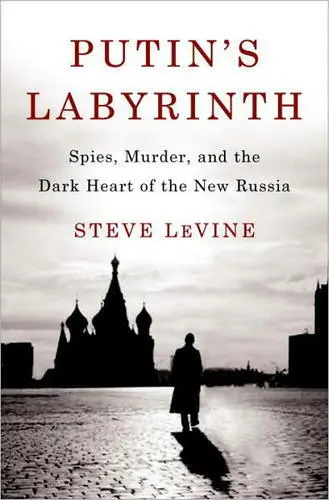
- Название:Putin's Labyrinth
- Автор:
- Издательство:Random House
- Жанр:
- Год:2008
- Город:New York
- ISBN:978-1-58836-815-7
- Рейтинг книги:3 / 5. Голосов: 1
-
Избранное:Добавить в избранное
- Отзывы:
-
Ваша оценка:
Putin's Labyrinth: краткое содержание, описание и аннотация
Предлагаем к чтению аннотацию, описание, краткое содержание или предисловие (зависит от того, что написал сам автор книги «Putin's Labyrinth»). Если вы не нашли необходимую информацию о книге — напишите в комментариях, мы постараемся отыскать её.
Drawing on new interviews with eyewitnesses and the families of victims, LeVine documents the bloodshed that has stained Putin’s two terms as president. Among the incidents chronicled in these pages: The 2002 terrorist takeover of a crowded Moscow theater—which led to the government gassing the building, and the deaths of more than a hundred terrified hostages–seen here from new angles, through the riveting words of those who survived; and the murder of courageous investigative reporter Anna Politkovskaya, shot in the elevator of her apartment building on Putin’s birthday, purportedly as a malicious “gift” for the president from supporters. Finally, a shocking story that made international headlines–the 2006 death of defector Alexander Litvinenko in London—is dramatized as never before. LeVine traces the steps of this KGB-spy-turned-dissident on his way to being poisoned with polonium-210, a radioactive isotope. And in doing so, LeVine is granted a rare series of interviews with a KGB defector who was nearly killed in strangely similar circumstances fifty years earlier. Through LeVine’s exhaustive research, we come to know the victims as real people, not just names in brief news accounts of how they died.
Putin’s Labyrinth
Putin's Labyrinth — читать онлайн бесплатно полную книгу (весь текст) целиком
Ниже представлен текст книги, разбитый по страницам. Система сохранения места последней прочитанной страницы, позволяет с удобством читать онлайн бесплатно книгу «Putin's Labyrinth», без необходимости каждый раз заново искать на чём Вы остановились. Поставьте закладку, и сможете в любой момент перейти на страницу, на которой закончили чтение.
Интервал:
Закладка:
But Berezovsky didn’t regard himself as a philanthropist. He was a businessman who always demanded something in return for his investments. And Litvinenko, despite his obvious gifts as an investigator, seemed unable to come up with new projects that were worthwhile, nothing like Blowing Up Russia, which Berezovsky had been willing to support because he thought it could wound the reviled Vladimir Putin. Berezovsky began to avoid meetings with him, no longer willing to listen to Litvinenko’s highly emotional and long-winded presentations. As Berezovsky put it, his fellow exile “demanded considerable attention,” while the oligarch had more pressing matters to attend to. On top of that, Litvinenko seemed obsessed with matters he regarded as absolutely vital but others thought were inconsequential at best. He seemed consumed by his conspiracy theories. At least that was how Berezovsky saw it.
Yuri Felshtinsky knew firsthand what it meant to be sought-after by Litvinenko. Phone calls came at all hours, and the voice at the other end usually was filled with urgency. But Litvinenko seldom had anything pressing to say. More often, it was “something that could wait two months, [much] less until the next day,” Felshtinsky told me. “I’d say, ‘You’re waking everyone up. Next time, please wait before you call.’ He’d say, ‘I don’t care. What’s the problem? So I woke them up.’”
In Litvinenko’s mind, his behavior was perfectly reasonable—for an oper, that is. This is FSB jargon for a special kind of intelligence agent, the operations man who tracks criminals in anticipation that they will commit illegal acts. Litvinenko had been trained as an oper, a word he used so often that Berezovsky soon picked it up. Now Litvinenko’s prey was the FSB; he was in constant battle with its shadowy operatives, always attempting “to provoke, to see how they react to him,” Felshtinsky said.
He sometimes struggled to decipher Litvinenko’s assertions. “When he is saying he has a tape that Putin is a pedophile, there are several possibilities of what that means,” Felshtinsky offered as an example. “There is the possibility he has a tape; another possibility is that he knows someone who has the tape; a third is that he is trying to provoke a reaction, such as that Putin may think he has a tape, or that someone who has the tape will understand he wants the tape, or that someone might make such a tape.”
In addition to being exhausting, the process of trying to understand Litvinenko tended to discourage friendship. In fact, Felshtinsky recalled his colleague saying that intelligence agents “don’t have friends.” People were either sources of information or they were targets of investigations. His wife and son were the only exceptions to this rule, Litvinenko said. “After that was when I stopped calling him a friend,” Felshtinsky said.
Litvinenko’s estrangement from Berezovsky worsened. Marina recalled her husband saying, with emotion, that their billionaire patron no longer seemed to require his services. Finally, toward the end of 2005, Berezovsky carved out time for a chat. It ended with Litvinenko informing the oligarch that he would seek work elsewhere—he was doing little in return for the money that Berezovsky was providing, and it was time to move on. Litvinenko had hoped to hear some mention of regret from the billionaire, even a suggestion that he reconsider. His old anxiety about being unwanted seemed to be in play, the unsettled sensation that went back to his boyhood. But Berezovsky expressed no misgivings. It was a good idea and Litvinenko was free to go, the billionaire said. But he promised not to abandon the Litvinenko family; they could remain in the home that he subsidized, he would still pay a salary to the ex–KGB man—though reduced to £1,500 a month—and he would continue to cover the cost of son Anatoly’s tuition.
Berezovsky’s pledge to continue his patronage after severing their business relationship might seem utterly contradictory. But the oligarch still felt indebted to Litvinenko for favors carried out before the two had separately fled Russia. Most prominent of these was Litvinenko’s courageous stand in 1994 to prevent Moscow police from taking Berezovsky into custody for closed-door questioning in a murder investigation. Their intentions seemed threatening, and the billionaire thought that Litvinenko’s action had probably saved his life. He also was fulfilling his old promise to Marina—made as she agonized over joining her husband in exile—that she and her son would be kept financially secure. I regarded Berezovsky as an ambitious conniver, but had to respect him for adhering to a certain code of honor, at least where the Litvinenkos were concerned.
On January 23, 2006, Berezovsky observed his sixtieth birthday in lavish style. He hosted a black-tie celebration at Blenheim Palace, the famous birthplace of Winston Churchill. It was always that way with the oligarch’s milestone birthdays—he had thrown a similar affair five years earlier in Nice, near his seaside villa on the Côte d’Azur.
Alexander and Marina Litvinenko were among the guests, invited as a nod to old times. So too was a snappy dresser named Andrei Lugovoi, former security chief for Berezovsky at ORT, the Russian television station that was once a valuable part of the oligarch’s empire. He was also a former KGB bodyguard for senior government officials.
Litvinenko was an FSB officer when the two last had contact, in the mid-1990s. At the time, he suspected Lugovoi of attempting to limit his access to Berezovsky, and their relationship was frosty as a result. But on this night, over dinner, the two veterans of Russian intelligence found that their interests might coincide. Lugovoi, now the multi-millionaire proprietor of Moscow security and soft drink companies, was thinking about expanding into the British market. Litvinenko had developed contacts with U.K. businessmen, thanks to his work at Titon and other Mayfair investigative agencies. Perhaps both men could profit from an informal partnership.
During the next several months, they tried to make the idea a reality. Progress was slow. Lugovoi provided a background report for a shared project at Titon, but the company’s managers were not impressed by his work. They also were uncomfortable in his presence; there was something vaguely disturbing about his look and his manner. No one said anything to Litvinenko—he surely would have shrugged off their concerns. Instead, the managers found excuses to absent themselves if Litvinenko called to say he was dropping by with Lugovoi.
In July, Vladimir Putin signed a law that caused a ripple of nervousness among Russian exiles in London. It granted the Kremlin’s intelligence agencies the right—if Putin gave his approval—to assassinate Russia’s enemies outside the nation’s borders, including “those slandering the individual occupying the post of president of the Russian Federation.” In other words, making a defamatory statement about Putin could be punishable by death. The new law lifted a quasi-moratorium that Moscow had observed on overseas assassinations for almost a half century, since the disastrous defection of Nikolai Khokhlov and two other Soviet killers who spilled secrets to the West in the 1950s.
I didn’t think that Putin necessarily had any specific slanderers in mind. Rather, he seemed to be reminding his countrymen—and other nations, especially in the West—of his new persona as the chisel-faced, muscular leader of Russia reborn. His we-won’t-be-pushed-around attitude certainly played well at home. It meshed with a new sense of nationalism that he encouraged, a Russia-first policy verging on xenophobia.
For example, the Kremlin formed a youth movement with a paramilitary bent, called Nashi. Literally the group’s name meant “Ours,” but its sense was “Our People.” The proximate trigger for its creation was the Orange Revolution of 2004 in neighboring Ukraine that overthrew the pro-Moscow president. Putin was determined that what he regarded as a Western-inspired movement would not spill into Russia and threaten his own government. Viewed that way, Nashi existed to defend Russian territory against dangerous foreign influences. Its loyalists famously pursued Estonia’s ambassador on foot when the Balkan country had the temerity to shift a Soviet war memorial from the center of the capital, Tallinn, to the city outskirts. Nashi followers demonstrated for a week in front of the Estonian embassy while the normally proactive police stood by. Concurrently, the Putin government expelled natives of the Caucasus and Central Asia from Moscow—people whom Russians call “the blacks.” In the nation’s capital, it became understood that the government would tolerate open racism; non-Russians, particularly dark-complected ones, were subject to street attacks by toughs.
Читать дальшеИнтервал:
Закладка:
Похожие книги на «Putin's Labyrinth»
Представляем Вашему вниманию похожие книги на «Putin's Labyrinth» списком для выбора. Мы отобрали схожую по названию и смыслу литературу в надежде предоставить читателям больше вариантов отыскать новые, интересные, ещё непрочитанные произведения.









Обсуждение, отзывы о книге «Putin's Labyrinth» и просто собственные мнения читателей. Оставьте ваши комментарии, напишите, что Вы думаете о произведении, его смысле или главных героях. Укажите что конкретно понравилось, а что нет, и почему Вы так считаете.