Steve LeVine - Putin's Labyrinth
Здесь есть возможность читать онлайн «Steve LeVine - Putin's Labyrinth» весь текст электронной книги совершенно бесплатно (целиком полную версию без сокращений). В некоторых случаях можно слушать аудио, скачать через торрент в формате fb2 и присутствует краткое содержание. Город: New York, Год выпуска: 2008, ISBN: 2008, Издательство: Random House, Жанр: Публицистика, на английском языке. Описание произведения, (предисловие) а так же отзывы посетителей доступны на портале библиотеки ЛибКат.
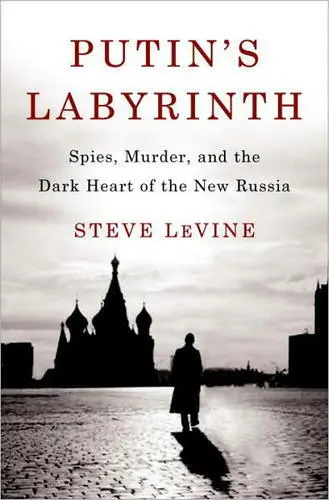
- Название:Putin's Labyrinth
- Автор:
- Издательство:Random House
- Жанр:
- Год:2008
- Город:New York
- ISBN:978-1-58836-815-7
- Рейтинг книги:3 / 5. Голосов: 1
-
Избранное:Добавить в избранное
- Отзывы:
-
Ваша оценка:
Putin's Labyrinth: краткое содержание, описание и аннотация
Предлагаем к чтению аннотацию, описание, краткое содержание или предисловие (зависит от того, что написал сам автор книги «Putin's Labyrinth»). Если вы не нашли необходимую информацию о книге — напишите в комментариях, мы постараемся отыскать её.
Drawing on new interviews with eyewitnesses and the families of victims, LeVine documents the bloodshed that has stained Putin’s two terms as president. Among the incidents chronicled in these pages: The 2002 terrorist takeover of a crowded Moscow theater—which led to the government gassing the building, and the deaths of more than a hundred terrified hostages–seen here from new angles, through the riveting words of those who survived; and the murder of courageous investigative reporter Anna Politkovskaya, shot in the elevator of her apartment building on Putin’s birthday, purportedly as a malicious “gift” for the president from supporters. Finally, a shocking story that made international headlines–the 2006 death of defector Alexander Litvinenko in London—is dramatized as never before. LeVine traces the steps of this KGB-spy-turned-dissident on his way to being poisoned with polonium-210, a radioactive isotope. And in doing so, LeVine is granted a rare series of interviews with a KGB defector who was nearly killed in strangely similar circumstances fifty years earlier. Through LeVine’s exhaustive research, we come to know the victims as real people, not just names in brief news accounts of how they died.
Putin’s Labyrinth
Putin's Labyrinth — читать онлайн бесплатно полную книгу (весь текст) целиком
Ниже представлен текст книги, разбитый по страницам. Система сохранения места последней прочитанной страницы, позволяет с удобством читать онлайн бесплатно книгу «Putin's Labyrinth», без необходимости каждый раз заново искать на чём Вы остановились. Поставьте закладку, и сможете в любой момент перейти на страницу, на которой закончили чтение.
Интервал:
Закладка:
Some of the exiles in London felt personally threatened by Putin’s legitimizing of assassination abroad. They remarked on how neatly the new law seemed to fit Litvinenko, who had been labeled a “traitor” by some former colleagues. Litvinenko himself observed that he, his neighbor Akhmed Zakayev, and Boris Berezovsky must be among the “terrorists” the Russian leader had in mind. His friends worried anew for his safety.
“I was there with him a few times when he got a call from Moscow,” said Vladimir Bukovsky, a fellow Russian exile.
“What, do you think it’s safe in London?” a caller once asked Litvinenko. “Remember Trotsky.”
In an interview, Marina said her husband believed he could outwit any potential assassin. “He believed that he would be able to sense something first,” she told the Russian newspaper Kommersant. “He said, ‘Marina, you can’t imagine how keen my nose is. I’m like a blood-hound—I sense danger, my hair stands on end, and I take care of everything immediately.’”
He did confess to “a feeling of danger,” she said, “but nothing concrete. He was very earnestly concerned about the law that was passed in Russia concerning the possibility of special operations being carried out abroad. He believed they would do such a thing.”
By October, Litvinenko had acquired what could be considered a layer of protection. He saw Felshtinsky and filmmaker Andrei Nekrasov at the Westminster Abbey memorial service for Anna Politkovskaya and whispered that he had finally received a British passport. “I’m British,” he said elatedly. “I’m an Englishman.”
When his father, Valter, a retired psychiatrist still living in Russia, expressed concern about Litvinenko’s safety, the son said not to worry. His new citizenship made him untouchable—his enemies in Russia would never risk attacking a Briton. Did Litvinenko, the oper, truly believe that? Not if one overheard what he told a confidant, Yevgeni Limarev, a France-based former KGB officer. More than once, Litvinenko raised the possibility that he would be killed, as though “expecting an attack, an assassination attempt or a murder.” Perhaps Litvinenko was genuinely conflicted about the dangers he faced. Still, he seemed to take few security precautions. Unlike Zakayev, his Chechen neighbor, he rather freely gave out his phone number and home address.
October also was a time when some of the central characters in Litvinenko’s life crossed paths in London. Yuri Felshtinsky flew from his suburban Boston home in search of more ivory for his private collection. He had been promised a ride on Boris Berezovsky’s jet to Israel, where carved mammoth tusks might be purchased. Best of all, he would not be subject to global export controls on the return trip because no one would check the billionaire’s private plane. On an evening stroll toward Piccadilly Circus, he encountered Andrei Lugovoi, Litvinenko’s putative business partner. The two hadn’t seen each other since Berezovsky’s birthday party ten months earlier. “Are you in town to see Boris?” Felshtinsky asked. No, said the wealthy Russian, and after a few more words they parted. Minutes later, Felshtinsky encountered Alex Goldfarb, the onetime Soviet dissident who had run George Soros’s Moscow human rights office and then went to work for Berezovsky. He had just seen the oligarch; they had dined and gone on to see a performance of King Lear, but Goldfarb had left early “because all the men were naked.”
Litvinenko and Lugovoi met often in October, sometimes with prospective clients, attempting to build some momentum for their budding partnership. On October 16, for instance, the multimillionaire flew in from Moscow and brought along an old school buddy, Dmitri Kovtun. The pair dined on sushi with Litvinenko at a restaurant called Itsu on Piccadilly. But not much is known about what transpired at their meetings. Kovtun said that Litvinenko excessively talked politics. Lugovoi said that he pushed would-be clients clumsily about money, describing one meeting at which Litvinenko pestered potential partners to “transfer 100,000 pounds to us.” Marina, who appears to have been uninvolved in her husband’s business affairs, could shed no light on the conversations.
I was more intrigued by the almost nonchalant manner that characterized Lugovoi’s dealings in London. In Moscow, he was the rich proprietor of a successful security company. A business such as that relies on operatives within Kremlin intelligence agencies to provide the information and skills that are critical to its success. Such a business cannot operate without the assent of the Kremlin. So why was Lugovoi willing and able to go into business with Litvinenko, a self-exiled FSB defector who had been convicted of a crime in Russia? And how was it that he could openly consort with Boris Berezovsky, himself a wanted man in Russia and the blood enemy of Putin? It didn’t add up.
On the morning of November 1, Litvinenko called his friend and neighbor Akhmed Zakayev. “I’m about to get information. A list of people who might be responsible for killing Anna Politkovskaya,” he said. The list was being offered by Mario Scaramella, a dubious figure on the margins of Italian politics who would later be arrested in a criminal investigation in Italy. Litvinenko had served as a source of sorts for the Italian’s attempts to undermine Romano Prodi, the country’s prime minister. Scaramella several times had paid him to fly to Italy and help build the case that Prodi was a stooge of the KGB; once he even videotaped Litvinenko saying so.
The two met that afternoon at Itsu, the sushi bar. Scaramella handed over a four-page e-mail—a purported hit list from Dignity and Honor, an association of former KGB agents with a history of issuing threats against supposed traitors. Among the names on the death list were those of Scaramella, Litvinenko, Berezovsky, and Anna. Litvinenko didn’t think it stood up to scrutiny. Nevertheless, he went by Berezovsky’s office to make photocopies, and gave one to the billionaire. Then he headed for a meeting with Lugovoi, who just the night before had shared a bottle of red wine with Berezovsky, his old boss.
By most accounts, Litvinenko was in good spirits. That night, he and Marina were planning to celebrate the sixth anniversary of their escape to England. They would have a quiet dinner together—Marina was planning to prepare chicken, a favorite dish.
He was also buoyed by the potential profits from a Lugovoi partnership. The two had agreed that Litvinenko would receive a 20 percent cut of any business he brought to the multi-millionaire’s security company. If things went well, Litvinenko told his friend Oleg Gordievsky, he could earn a half million pounds. Among other things, that would allow him to end his financial reliance on Boris Berezovsky.
Sometime after four p.m., Litvinenko made his way down the street to the Millennium Hotel, to look for Lugovoi in the Pine Bar. It would be their last business meeting.
CHAPTER 10

Polonium
The World Is Witness to an Assassination
THE NOBLE MILLENNIUM HOTEL, BUILT AS AN ELEGANT MANSION in the eighteenth century, is situated on Grosvenor Square, in London’s Mayfair district. The neighborhood around the square has several historical ties with the United States. General Dwight Eisenhower established his headquarters there during World War II, and the north side of the square is dominated by a monument to FDR. On the west side, the concrete-and-glass behemoth that is the American embassy clashes with the prevailing Georgian architecture.
This identification with America explained why, after the 9/11 terrorist attacks on the United States, the British feared an assault on the embassy. Authorities beefed up patrols and installed concrete blast barriers around the complex. But some nervous Mayfair residents thought that was not enough. A Swedish financier named Peter Castenfelt organized a neighborhood revolt, demanding that police seal access roads. As long as they were open, Castenfelt said, any attacker could drive up, detonate a bomb, and injure or kill nearby residents. I have known the soft-spoken Castenfelt for several years; well connected in capitals from Washington to Moscow, he has a habit of turning up in the middle of high-profile situations. “This is the No. 1 security issue in London that has not been resolved,” he said, and led the group in buying double-page protest ads in The Washington Post and The Times of London.
Читать дальшеИнтервал:
Закладка:
Похожие книги на «Putin's Labyrinth»
Представляем Вашему вниманию похожие книги на «Putin's Labyrinth» списком для выбора. Мы отобрали схожую по названию и смыслу литературу в надежде предоставить читателям больше вариантов отыскать новые, интересные, ещё непрочитанные произведения.









Обсуждение, отзывы о книге «Putin's Labyrinth» и просто собственные мнения читателей. Оставьте ваши комментарии, напишите, что Вы думаете о произведении, его смысле или главных героях. Укажите что конкретно понравилось, а что нет, и почему Вы так считаете.