Steve LeVine - Putin's Labyrinth
Здесь есть возможность читать онлайн «Steve LeVine - Putin's Labyrinth» весь текст электронной книги совершенно бесплатно (целиком полную версию без сокращений). В некоторых случаях можно слушать аудио, скачать через торрент в формате fb2 и присутствует краткое содержание. Город: New York, Год выпуска: 2008, ISBN: 2008, Издательство: Random House, Жанр: Публицистика, на английском языке. Описание произведения, (предисловие) а так же отзывы посетителей доступны на портале библиотеки ЛибКат.
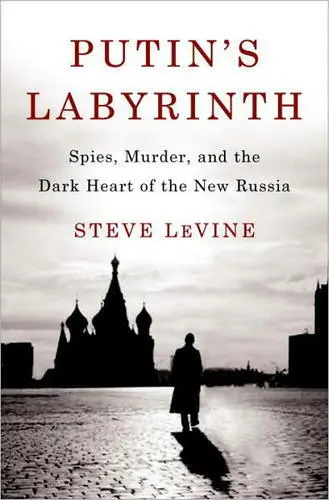
- Название:Putin's Labyrinth
- Автор:
- Издательство:Random House
- Жанр:
- Год:2008
- Город:New York
- ISBN:978-1-58836-815-7
- Рейтинг книги:3 / 5. Голосов: 1
-
Избранное:Добавить в избранное
- Отзывы:
-
Ваша оценка:
Putin's Labyrinth: краткое содержание, описание и аннотация
Предлагаем к чтению аннотацию, описание, краткое содержание или предисловие (зависит от того, что написал сам автор книги «Putin's Labyrinth»). Если вы не нашли необходимую информацию о книге — напишите в комментариях, мы постараемся отыскать её.
Drawing on new interviews with eyewitnesses and the families of victims, LeVine documents the bloodshed that has stained Putin’s two terms as president. Among the incidents chronicled in these pages: The 2002 terrorist takeover of a crowded Moscow theater—which led to the government gassing the building, and the deaths of more than a hundred terrified hostages–seen here from new angles, through the riveting words of those who survived; and the murder of courageous investigative reporter Anna Politkovskaya, shot in the elevator of her apartment building on Putin’s birthday, purportedly as a malicious “gift” for the president from supporters. Finally, a shocking story that made international headlines–the 2006 death of defector Alexander Litvinenko in London—is dramatized as never before. LeVine traces the steps of this KGB-spy-turned-dissident on his way to being poisoned with polonium-210, a radioactive isotope. And in doing so, LeVine is granted a rare series of interviews with a KGB defector who was nearly killed in strangely similar circumstances fifty years earlier. Through LeVine’s exhaustive research, we come to know the victims as real people, not just names in brief news accounts of how they died.
Putin’s Labyrinth
Putin's Labyrinth — читать онлайн бесплатно полную книгу (весь текст) целиком
Ниже представлен текст книги, разбитый по страницам. Система сохранения места последней прочитанной страницы, позволяет с удобством читать онлайн бесплатно книгу «Putin's Labyrinth», без необходимости каждый раз заново искать на чём Вы остановились. Поставьте закладку, и сможете в любой момент перейти на страницу, на которой закончили чтение.
Интервал:
Закладка:
The exiled billionaire spent generously to promote his creation. He launched the book with a London party worthy of royalty and flew some four dozen journalists in from Moscow to attend a press conference. Novaya Gazeta, Anna’s newspaper, published excerpts in a special issue. Berezovsky also bankrolled a fifty-two-minute documentary, entitled Assassination of Russia, which was based on the book. The French-produced film had its premiere in London but was also shown to a select audience in Moscow.
Putin’s regime labored to defend itself against the book and other attacks by Litvinenko and his billionaire ally. Boris Labusov, spokesman for the foreign arm of the FSB, scorned the defector’s claim that Russia’s secret services had escalated their activities in North America and Europe. “There is no need to analyze Litvinenko’s fabrications. You can say at once that he is fulfilling another social order by his superiors,” Labusov said, seeming to refer to Berezovsky. Early one morning in 2004, someone lobbed Molotov cocktails at the north London homes of Litvinenko and Akhmed Zakayev, the exiled Chechen leader. Litvinenko blamed Russia, and Labusov responded with scorn. “Discussing our involvement is really a laugh,” he said, suggesting instead that the exiles might have torched their own homes. “History knows a lot of cases when some individuals imitated attempts on their lives, trying to attract the public’s attention to themselves for various purposes.”
But there was no denying that Litvinenko had struck a nerve in Moscow. FSB marksmen used large portraits of their former colleague for target practice—all the better, it seemed, to motivate their accuracy. The Russian embassy left a summons at his London home to appear in Moscow and be tried on charges of beating a suspect and stealing explosives when he was an FSB agent (he had been cleared of similar allegations in 1999). Litvinenko, naturally, had no desire to return to Moscow under the threat of a prison sentence, and ignored the summons. He was convicted in absentia a month later, and a three-and-a-half-year suspended sentence was entered against him. Putin’s priorities seemed misdirected—pursuing an empty conviction with the likely intent to vilify a political exile, while exerting little energy to solve the country’s biggest murder cases.
Later in the year, word reached Litvinenko that the FSB apparently had hatched a plot to kill him. The tip came from Mikhail Trepashkin, who said he had been threatened with murder by the boss of Litvinenko’s FSB anti-crime unit and sat with him at the famous whistle-blower press conference in Moscow in 1998. In the end, the FSB turned against both of them, but he and Litvinenko became close friends.
A former FSB colleague of theirs had proposed that Trepashkin, still in Russia, go to London and be the point man in a surveillance operation targeting Litvinenko. In Trepashkin’s telling, the former colleague defined the purpose of the mission as sorting out “all matters linked to Litvinenko and Berezovsky once and for all.”
Apparently, the agency expected that Trepashkin’s loyalty to FSB tradition and his Russian patriotism would overcome whatever misgivings he might have at violating an important friendship. But Trepashkin quickly concluded that the agency was trying to draw him into a scheme to murder Litvinenko, and friendship prevailed.
Trepashkin told an interviewer how he responded to the ex-colleague: “‘Are you out of your mind?’ I said to him. ‘Are you trying to recruit me to help carry out an assassination? Forget it.’”
Episodes such as the surveillance plot did nothing to calm the paranoia and sense of drama that seemed to overwhelm Litvinenko at times. A Russian-born doctoral student named Julia Svetlichnaja, writing in a British newspaper, provided a vivid account of grandiose-to-eccentric behavior on his part. She had spent time with Litvinenko while doing research on Chechnya, and her article depicted him as a somewhat pathetic figure. Acting the superspy, he made abrupt turns in his car to lose a “tail” and insisted on standing and walking while being interviewed, supposedly to foil any attempts by unseen persons to record him. He posed in front of a British flag, belligerently brandishing a Chechen sword, and said of the Kremlin, “Every time I publish something on the ChechenPress website, I piss them off. One day they will understand who I am!” She said Litvinenko described plans to blackmail one or more Russian oligarchs with evidence he had of their corruption. He even invited Svetlichnaja to partner with him on the project, she said.
Felshtinsky, his writing partner, doubted that the latter invitation was genuine. Litvinenko, he said, would have been suspicious of a Russian woman he did not know claiming she was in London conducting research on Chechens. “He was probably thinking she worked for the KGB; all of it was his checking if she worked for the Russians or not,” Felshtinsky said. That rang true. Always, it seemed, Litvinenko was on the lookout for another plot.
By 2005, Litvinenko began to feel as if he were living on the dole. He had been in England for almost five years, but was still entirely dependent on Berezovsky’s goodwill and monthly stipends. He had exhausted all the evidence that he and Felshtinsky had gathered to portray the FSB and Putin as complicit in the apartment house bombings. Their investigations had resulted in a book and a film, and Litvinenko had written a second anti-FSB screed called Lubyanka Criminal Group. Now what would he do? He knew he was no businessman, but he excelled at intelligence work. That, he told Marina, “I can really do well.” Everyone was for sale in Russia and “everything has its price,” he said confidently.
Litvinenko was familiar with the detective agencies that had blossomed in London’s Mayfair district, especially their hunger for the kind of information he could provide. Their clientele included Western businessmen exploring joint ventures in Russia and elsewhere in the former Soviet Union, who were anxious to know more about their potential partners before taking the plunge. The detective agencies were happy to supply the needed intelligence in exchange for handsome fees.
And so Litvinenko, drawing on his sources inside and outside of Russia, began selling information to the Mayfair operatives. His initial experiences were not encouraging. The agencies were relative tight-wads when it came to paying their investigators. Sometimes they refused to pay anything for the information that he submitted, scoffing, “We ourselves could have discovered this.” Litvinenko was awkward in the art of wheeling and dealing, and accepted these financial slights.
But over time, he developed good relationships with a few select companies, especially one called Titon International Security Services. Titon was a boutique operation known for in-the-trenches investigations that larger rivals were reluctant to undertake—just the type that were Litvinenko’s forte. One of his notable successes at Titon was a probing report on Viktor Ivanov, a longtime Putin intimate and former KGB officer. After Putin appointed Ivanov chairman of Aeroflot, Litvinenko profiled Ivanov for a British firm thinking of doing business with the state airline.
At the same time Litvinenko was feeling his way as a private investigator, his relationship with Berezovsky was becoming strained. Given their long history together, this seemed a surprising development. The billionaire Russian had been his mentor and a willing provider for the Litvinenko family. Back in 2000, it was Berezovsky who had made possible Litvinenko’s cloak-and-dagger flight from Russia and had overcome Marina’s doubts about uprooting herself and her son from their native country. Berezovsky’s pledge to take care of them financially had persuaded Marina to go along with the plan to flee, she told me. In London, the exiled oligarch had installed them in an apartment in the desirable Kensington district, paid for their son’s schooling, and provided Litvinenko with a generous salary of £5,000 a month. (Litvinenko chronically griped that he had no cash. A skeptical colleague who knew his habits when it came to managing money once remarked to him, “Sasha, if I deposited my entire salary in the bank, I also would have no money in my pocket.”)
Читать дальшеИнтервал:
Закладка:
Похожие книги на «Putin's Labyrinth»
Представляем Вашему вниманию похожие книги на «Putin's Labyrinth» списком для выбора. Мы отобрали схожую по названию и смыслу литературу в надежде предоставить читателям больше вариантов отыскать новые, интересные, ещё непрочитанные произведения.








Обсуждение, отзывы о книге «Putin's Labyrinth» и просто собственные мнения читателей. Оставьте ваши комментарии, напишите, что Вы думаете о произведении, его смысле или главных героях. Укажите что конкретно понравилось, а что нет, и почему Вы так считаете.