Steve LeVine - Putin's Labyrinth
Здесь есть возможность читать онлайн «Steve LeVine - Putin's Labyrinth» весь текст электронной книги совершенно бесплатно (целиком полную версию без сокращений). В некоторых случаях можно слушать аудио, скачать через торрент в формате fb2 и присутствует краткое содержание. Город: New York, Год выпуска: 2008, ISBN: 2008, Издательство: Random House, Жанр: Публицистика, на английском языке. Описание произведения, (предисловие) а так же отзывы посетителей доступны на портале библиотеки ЛибКат.
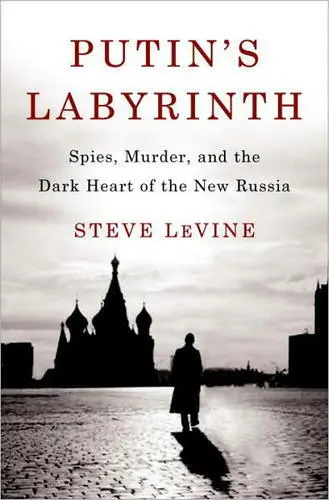
- Название:Putin's Labyrinth
- Автор:
- Издательство:Random House
- Жанр:
- Год:2008
- Город:New York
- ISBN:978-1-58836-815-7
- Рейтинг книги:3 / 5. Голосов: 1
-
Избранное:Добавить в избранное
- Отзывы:
-
Ваша оценка:
Putin's Labyrinth: краткое содержание, описание и аннотация
Предлагаем к чтению аннотацию, описание, краткое содержание или предисловие (зависит от того, что написал сам автор книги «Putin's Labyrinth»). Если вы не нашли необходимую информацию о книге — напишите в комментариях, мы постараемся отыскать её.
Drawing on new interviews with eyewitnesses and the families of victims, LeVine documents the bloodshed that has stained Putin’s two terms as president. Among the incidents chronicled in these pages: The 2002 terrorist takeover of a crowded Moscow theater—which led to the government gassing the building, and the deaths of more than a hundred terrified hostages–seen here from new angles, through the riveting words of those who survived; and the murder of courageous investigative reporter Anna Politkovskaya, shot in the elevator of her apartment building on Putin’s birthday, purportedly as a malicious “gift” for the president from supporters. Finally, a shocking story that made international headlines–the 2006 death of defector Alexander Litvinenko in London—is dramatized as never before. LeVine traces the steps of this KGB-spy-turned-dissident on his way to being poisoned with polonium-210, a radioactive isotope. And in doing so, LeVine is granted a rare series of interviews with a KGB defector who was nearly killed in strangely similar circumstances fifty years earlier. Through LeVine’s exhaustive research, we come to know the victims as real people, not just names in brief news accounts of how they died.
Putin’s Labyrinth
Putin's Labyrinth — читать онлайн бесплатно полную книгу (весь текст) целиком
Ниже представлен текст книги, разбитый по страницам. Система сохранения места последней прочитанной страницы, позволяет с удобством читать онлайн бесплатно книгу «Putin's Labyrinth», без необходимости каждый раз заново искать на чём Вы остановились. Поставьте закладку, и сможете в любой момент перейти на страницу, на которой закончили чтение.
Интервал:
Закладка:
Senior Kremlin officials, while welcoming the opportunity to cast the exiled Berezovsky in a bad light, cautioned that no one could say with certainty who killed Litvinenko. Lots of people in lots of countries could be responsible, they said, and it was reckless to point the finger at Russia, as many abroad were doing.
At a news conference in Helsinki a day after Litvinenko’s death, Putin went on the offensive. He falsely asserted that authorities in Britain “offer no indication that this was a violent death.” He questioned whether Litvinenko in fact dictated the memo that accused him of murder. “If such a note really did appear before Mr. Litvinenko’s death, then this raises the issue of why it was not made public during his life,” Putin said.
Finally, the Russian president chalked up all the fuss to politics. “The people that have done this are not God and Mr. Litvinenko is, unfortunately, not Lazarus,” he said. “And it is very much a pity that even such tragic events like a person’s death can be used for political provocations.”
I wondered why Litvinenko’s assassins didn’t simply shoot him or run him over. Novelist Martin Cruz Smith, for instance, thought a more “perfect” criminal would have simply pushed him off a subway platform.
If the purpose was to warn others who might have been tempted to follow in Litvinenko’s defiant footsteps, then any of these methods would have sufficed. But simply rendering him dead probably was the least challenging part of the mission. The question of how to carry out the killing in the most unobtrusive manner seems to have been uppermost in the minds of the assassins. Shoving the former KGB agent in front of a moving car or planting a knife in his back could cause an ugly scene in public and make it difficult for the assassins to escape unseen. Worse yet, if they were captured, the identity of whoever organized the murder might become known.
Hence the decision to use poison. Thallium must have been immediately rejected because any half-aware doctor would respond by immediately treating Litvinenko with Prussian blue, and the plot would likely fail. Biological poisons and other radioactive substances probably were rejected because of the risks entailed in handling and administering them.
Perhaps an old-timer among the conspirators would have recalled the existence of polonium-210. Its advantages would be immediately apparent. Litvinenko’s killers could carry a tiny amount of the substance to London wrapped in an ordinary piece of paper and pass undetected through airport security. Their personal health would not be at risk unless some of it got into their mouths or lungs. Once taken into Litvinenko’s body via food or drink, the polonium would likely defy discovery. And even if its presence were detected after a day or so, their victim would be beyond saving because of the horrible damage to his organs. Meanwhile, the assassins would be long gone from the scene of the crime. Polonium-210 had an additional appeal: If the killers were thirsting for revenge after his harsh attacks on Putin and the Russian security agencies, they could take pleasure in knowing that Litvinenko would suffer maximum pain while dying. And that it would all occur on the anniversary of his defection to Britain might have added satisfying symbolism to the affair.
I was curious to know what other Russian exiles in London were thinking about the means and methods of Litvinenko’s assassins. Boris Volodarsky, a former military intelligence officer, especially interested me. He claimed to have documented some twenty murders by poisoning that the Russian government had carried out since the 1920s—all of them employing substances that had left no trace.
It was easy to be put off by Volodarsky’s manner. He had adopted the persona of a high-born Briton, sporting a neatly trimmed beard, speaking with a cultivated English accent, and wearing a beautifully tailored suit with purple tie and matching silk handkerchief. The extent of his service in Russian intelligence was somewhat murky; as best I could tell, he was operating in the West when the Soviet Union collapsed, and simply never went back to Russia. He portrayed himself as a defector and was a critic of the Russian government, but there was no sign that Kremlin leaders ranked him high among exiles who irritated them. Still, I respected his knowledge of the ways of Russian intelligence.
He suggested we meet in the Cigar Room of the Connaught Hotel near Berkeley Square, an upper-crust Mayfair establishment. He flashed a pleasant, smallish smile, the wrinkles at the edges of his eyes curving upward, and exhaled the smoke of a small cigar. When I invited Volodarsky to join me in the dining room for lunch, he brought me up short: “Let’s get one thing straight. You have to pay. This is a consultation and it’s not free. I’ll give you ten minutes’ free consultation, then you pay.”
It was not possible, ethically speaking, for me to pay for the interview, although I felt a twinge of sympathy. The man did have to earn a living, and I had no idea how I would support myself if I were a former spy. Still, all I could do was buy lunch. He asked me to explain the difference between paying his accustomed fee and forking over £150 for a meal. I had no answer.
He declined lunch, but lingered for a while to talk about his business ventures. He had participated in British television programs about the Litvinenko case, and was now contributing to the making of two films. One was based on a 2005 article he wrote for The Wall Street Journal under the headline “The KGB Poison Factory,” recounting nearly nine decades of attacks on Kremlin enemies, including Nikolai Khokhlov and Ukraine’s president, Viktor Yushchenko. (After Litvinenko’s death, he updated the title to read “The KGB Poison Factory, Lenin to Litvinenko.”) “We are talking to several important studios,” Volodarsky said.
He described thirty-five minutes he spent in an Italian prison speaking with Mario Scaramella, who famously shared sushi with Litvinenko the day he was poisoned and was first thought—mistakenly—to be a suspect. No one else had gotten to Scaramella yet, Volodarsky boasted; he had left the prison with video footage and documents that might earn him some cash from curious U.K. journalists.
His theory about the Litvinenko case ran something like this: Several small teams in several countries would have come together on November 1, 2006, to carry out the mission and then disappear. He agreed with those who doubted that Lugovoi was a key player. The wealthy Russian may have known there was to be a poisoning, but didn’t actually do it himself, Volodarsky believed. The person who actually dropped the poison into Litvinenko’s tea probably has yet to be identified, at least not publicly, he said. He didn’t think that person would have accompanied Lugovoi or Kovtun to London because “that wouldn’t be professional.” On balance, he judged the Litvinenko killing to be the most momentous such exploit in three decades, “a model assassination” that seemed perfectly executed.
He recited this narrative with studied bravado, though he complained that, unlike superspy Oleg Gordievsky, he was vulnerable to a revenge attack. “I don’t have security, and neither did Litvinenko,” Volodarsky said. “I’m not easy to find, although if they want they can find me.”
Gordievsky had a different view of the need for security. The former KGB spymaster had been a high-value defector when he sought asylum in the United Kingdom two decades ago. His home outside London had been well protected before Litvinenko’s killing, and the security was stepped up afterward.
Gordievsky was most interested in the role of Andrei Lugovoi, Litvinenko’s companion at the Pine Bar. He had two opposing theories: that Lugovoi was the team leader in “a typical KGB operation,” or had been used as bait to befriend Litvinenko and finally lure him to the bar, where the actual assassins could do their work. In support of the latter scenario, Gordievsky cited Lugovoi’s “slow approach, the cultivation of Litvinenko for ten months, inducing him, promising him deals.” Once Lugovoi had cemented his relationship with Litvinenko, the trap was sprung, he surmised.
Читать дальшеИнтервал:
Закладка:
Похожие книги на «Putin's Labyrinth»
Представляем Вашему вниманию похожие книги на «Putin's Labyrinth» списком для выбора. Мы отобрали схожую по названию и смыслу литературу в надежде предоставить читателям больше вариантов отыскать новые, интересные, ещё непрочитанные произведения.









Обсуждение, отзывы о книге «Putin's Labyrinth» и просто собственные мнения читателей. Оставьте ваши комментарии, напишите, что Вы думаете о произведении, его смысле или главных героях. Укажите что конкретно понравилось, а что нет, и почему Вы так считаете.