Steve LeVine - Putin's Labyrinth
Здесь есть возможность читать онлайн «Steve LeVine - Putin's Labyrinth» весь текст электронной книги совершенно бесплатно (целиком полную версию без сокращений). В некоторых случаях можно слушать аудио, скачать через торрент в формате fb2 и присутствует краткое содержание. Город: New York, Год выпуска: 2008, ISBN: 2008, Издательство: Random House, Жанр: Публицистика, на английском языке. Описание произведения, (предисловие) а так же отзывы посетителей доступны на портале библиотеки ЛибКат.
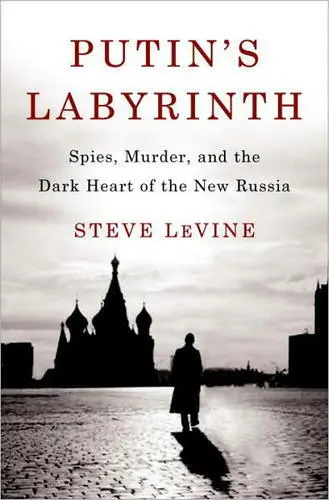
- Название:Putin's Labyrinth
- Автор:
- Издательство:Random House
- Жанр:
- Год:2008
- Город:New York
- ISBN:978-1-58836-815-7
- Рейтинг книги:3 / 5. Голосов: 1
-
Избранное:Добавить в избранное
- Отзывы:
-
Ваша оценка:
Putin's Labyrinth: краткое содержание, описание и аннотация
Предлагаем к чтению аннотацию, описание, краткое содержание или предисловие (зависит от того, что написал сам автор книги «Putin's Labyrinth»). Если вы не нашли необходимую информацию о книге — напишите в комментариях, мы постараемся отыскать её.
Drawing on new interviews with eyewitnesses and the families of victims, LeVine documents the bloodshed that has stained Putin’s two terms as president. Among the incidents chronicled in these pages: The 2002 terrorist takeover of a crowded Moscow theater—which led to the government gassing the building, and the deaths of more than a hundred terrified hostages–seen here from new angles, through the riveting words of those who survived; and the murder of courageous investigative reporter Anna Politkovskaya, shot in the elevator of her apartment building on Putin’s birthday, purportedly as a malicious “gift” for the president from supporters. Finally, a shocking story that made international headlines–the 2006 death of defector Alexander Litvinenko in London—is dramatized as never before. LeVine traces the steps of this KGB-spy-turned-dissident on his way to being poisoned with polonium-210, a radioactive isotope. And in doing so, LeVine is granted a rare series of interviews with a KGB defector who was nearly killed in strangely similar circumstances fifty years earlier. Through LeVine’s exhaustive research, we come to know the victims as real people, not just names in brief news accounts of how they died.
Putin’s Labyrinth
Putin's Labyrinth — читать онлайн бесплатно полную книгу (весь текст) целиком
Ниже представлен текст книги, разбитый по страницам. Система сохранения места последней прочитанной страницы, позволяет с удобством читать онлайн бесплатно книгу «Putin's Labyrinth», без необходимости каждый раз заново искать на чём Вы остановились. Поставьте закладку, и сможете в любой момент перейти на страницу, на которой закончили чтение.
Интервал:
Закладка:
Nick Priest was not a Russian exile, but he had some intriguing ideas as to how the poisoning might have taken place. The affable Priest, one of the world’s few polonium experts, was a little-known professor of environmental toxicology at London’s Middlesex University. When the role of polonium-210 in Litvinenko’s death became known, he was deluged with phone calls from journalists, other scientists, and security experts from around the world. Through it all, he remained a patient gentleman.
I asked the bespectacled Priest to conjure up a probable chronology, starting with the poison being transported into the United Kingdom.
Unlike others, Priest thought airport security might have been a problem. Even though polonium-210 is an alpha emitter, it throws out a tiny bit of gamma radiation, which could have been detected during airport screening, he said. Priest speculated that before it was taken to London the polonium would have been divided between four people, to lessen the risk of detection. “It’s quite possible each guy came with one-fourth of the total” dose intended for Litvinenko, he said. The deadly substance probably would have been carried in vials, perhaps mixed with an acid solution to keep it from sticking to the sides or bottoms of the vials, but not so acidic as to be detectable by taste. “Then they recombined it in a hotel room,” Priest said. That’s when the trouble would have begun—the first release of minute traces of polonium that eventually would be found throughout London. “The moment the seal [on the vials] was broken, you started the contamination,” he said.
“It’s entirely possible,” Priest continued, “that they didn’t know what they were handling or [else] they would have taken precautions. It’s possible they were only told it was poison. Otherwise they might have been frightened. Also, if you had known the properties of polonium, you would have changed your clothes [after lacing the tea], then thrown them away. You’d have used gloves. You’d have to be an idiot to leave a contamination trail behind.”
That didn’t necessarily explain why Lugovoi left polonium on the seat of the airliner on which he arrived in London from Moscow on October 31; perhaps he was also involved in the original mixing or pouring of the polonium solution in Moscow. Still, Priest’s explanation made sense. Lugovoi and Kovtun seem not to have known that they were leaving a radioactive trail. Priest’s conclusion roughly tracked with Oleg Gordievsky’s second scenario—that Lugovoi had been used as bait by other, unseen hands who actually dropped the polonium-210 into Litvinenko’s tea.
It seems safe to say that the assassination was not a seat-of-the-pants, rogue operation. After all, polonium-210 was not easy to procure, and it was pricey—one needed some $2 million to $3 million in cash, the commercial cost of the probable dose that experts say killed Litvinenko.
Organized crime experts considered whether Litvinenko was killed by professional Russian criminals, hired by someone whom Litvinenko had angered. But they rapidly dismissed this possibility because even the most hardened thugs would not risk Putin’s wrath by murdering such a high-level target on their own. They would have participated in such a killing only if they understood that it was acceptable to the senior ranks of Russian government.
Many thought the ruthless, calculated, and convoluted method of Litvinenko’s assassination clearly implicated Russia’s spy agencies.
“That’s Russian,” said a pin-striped British private eye who formerly served as a Soviet specialist for MI6, the country’s overseas espionage agency. During his spying days, he and his colleagues would marvel at the elegance of Soviet missions, finding that “an overcomplicated intelligence operation is their signature. You either admire its complexity, or decide it’s all out of proportion to what you want.”
Would the Kremlin dare to carry out, or bless, such an audacious scheme—murder by nuclear isotope, in a major Western capital, against a British citizen? An indignant Kremlin said no. Yet the notion of Russian state responsibility could not be easily put to rest. There was the law that Putin had approved just four months before Litvinenko’s death, granting the president authority to sanction the assassination of an enemy outside the nation’s borders. And there was the matter of Russia’s unrivaled access to polonium-210. Ninety-seven percent of the world’s commercial supply came from a single state-controlled nuclear reactor 450 miles southeast of Moscow, in a shipbuilding town called Avangard. The reactor complex was well secured, but it could not be ruled out as the source of the radiation that killed Litvinenko.
Britain sent investigators to Moscow and asked to interview Lugovoi, Kovtun, and other Russians. In response, the Kremlin said it was conducting its own investigation and asked to question one hundred people in London, including exiled oligarch Boris Berezovsky and other Russian dissidents. It was a transparent effort to turn the tables on Britain. Critics said Putin seemed to regard the murder as a public relations problem rather than a matter of criminal justice, and they appeared to be right. If, as Moscow suggested, London exiles were truly culpable, why did Russia not aggressively cooperate with Scotland Yard? It was an opportunity to prove once and for all that the West was providing safe haven to unsavory characters who did not deserve anyone’s protection. But Putin’s statements and actions made it appear he had little real interest in absolving Russia of outside suspicion.
Britain was in a predicament. The evidence plainly implicated both Lugovoi and Kovtun. But would the British request the pair’s extradition from Russia, triggering a judicial process that could lead to courtroom accusations against senior Kremlin officials? Putin himself, the sovereign president of a much-valued country, might become entangled in the drama. Were the British prepared for this to balloon into an international incident? I had my doubts. The British conducted much business with Russia—BP, the United Kingdom’s biggest company, was heavily invested there—and had a less-than-vigorous history of taking diplomatic risks. It was more of a go-along, get-along country.
Yet I was proved wrong. Six months after Litvinenko’s death, the United Kingdom said it would charge Lugovoi with murder, and it officially requested his extradition. Putin refused, saying that the Russian constitution prevented sending citizens abroad for trial. He said that the Britons should present their evidence to Moscow prosecutors and allow the Russian judicial system to decide the case. Britain regarded his offer as an effort to thwart justice, which seemed a correct assumption to me.
The case went nowhere. Rather, it turned into a diplomatic fracas: Britain expelled four Russian diplomats, and Moscow responded by ordering the closure of two British cultural offices in Russia, and expelling British diplomats.
Meanwhile, Lugovoi was treated as a Russian hero. In December 2007, he won election to the Russian parliament, and he was often cheered as he traveled around the country.
The foreigner who gained the closest access to Lugovoi was Mark Franchetti, the British journalist who seemed always to end up at the center of the news. After a series of interviews with Lugovoi, Franchetti aligned himself with Oleg Gordievsky and Nick Priest’s relatively benign view of the accused multi-millionaire’s culpability.
“Lugovoi has often asked me if I think he killed Litvinenko,” Franchetti wrote. “I confronted him with the theory, which I support, that he did murder but is not a cold-blooded killer. I told him I think he was recruited by Russia’s secret service but was tricked and used without his full knowledge. He did not flinch. He again voiced his innocence, and agreed he was framed, but by MI5,” meaning the domestic British intelligence service.
Читать дальшеИнтервал:
Закладка:
Похожие книги на «Putin's Labyrinth»
Представляем Вашему вниманию похожие книги на «Putin's Labyrinth» списком для выбора. Мы отобрали схожую по названию и смыслу литературу в надежде предоставить читателям больше вариантов отыскать новые, интересные, ещё непрочитанные произведения.







Обсуждение, отзывы о книге «Putin's Labyrinth» и просто собственные мнения читателей. Оставьте ваши комментарии, напишите, что Вы думаете о произведении, его смысле или главных героях. Укажите что конкретно понравилось, а что нет, и почему Вы так считаете.