Steve LeVine - Putin's Labyrinth
Здесь есть возможность читать онлайн «Steve LeVine - Putin's Labyrinth» весь текст электронной книги совершенно бесплатно (целиком полную версию без сокращений). В некоторых случаях можно слушать аудио, скачать через торрент в формате fb2 и присутствует краткое содержание. Город: New York, Год выпуска: 2008, ISBN: 2008, Издательство: Random House, Жанр: Публицистика, на английском языке. Описание произведения, (предисловие) а так же отзывы посетителей доступны на портале библиотеки ЛибКат.
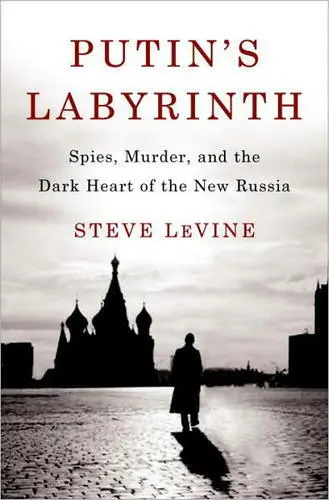
- Название:Putin's Labyrinth
- Автор:
- Издательство:Random House
- Жанр:
- Год:2008
- Город:New York
- ISBN:978-1-58836-815-7
- Рейтинг книги:3 / 5. Голосов: 1
-
Избранное:Добавить в избранное
- Отзывы:
-
Ваша оценка:
Putin's Labyrinth: краткое содержание, описание и аннотация
Предлагаем к чтению аннотацию, описание, краткое содержание или предисловие (зависит от того, что написал сам автор книги «Putin's Labyrinth»). Если вы не нашли необходимую информацию о книге — напишите в комментариях, мы постараемся отыскать её.
Drawing on new interviews with eyewitnesses and the families of victims, LeVine documents the bloodshed that has stained Putin’s two terms as president. Among the incidents chronicled in these pages: The 2002 terrorist takeover of a crowded Moscow theater—which led to the government gassing the building, and the deaths of more than a hundred terrified hostages–seen here from new angles, through the riveting words of those who survived; and the murder of courageous investigative reporter Anna Politkovskaya, shot in the elevator of her apartment building on Putin’s birthday, purportedly as a malicious “gift” for the president from supporters. Finally, a shocking story that made international headlines–the 2006 death of defector Alexander Litvinenko in London—is dramatized as never before. LeVine traces the steps of this KGB-spy-turned-dissident on his way to being poisoned with polonium-210, a radioactive isotope. And in doing so, LeVine is granted a rare series of interviews with a KGB defector who was nearly killed in strangely similar circumstances fifty years earlier. Through LeVine’s exhaustive research, we come to know the victims as real people, not just names in brief news accounts of how they died.
Putin’s Labyrinth
Putin's Labyrinth — читать онлайн бесплатно полную книгу (весь текст) целиком
Ниже представлен текст книги, разбитый по страницам. Система сохранения места последней прочитанной страницы, позволяет с удобством читать онлайн бесплатно книгу «Putin's Labyrinth», без необходимости каждый раз заново искать на чём Вы остановились. Поставьте закладку, и сможете в любой момент перейти на страницу, на которой закончили чтение.
Интервал:
Закладка:
The latter appointment was an important demonstration of confidence, since Gazprom is Russia’s strategically most important company, accounting for a quarter of all government revenue, according to 2006 tax figures. It also served as the main lever of Putin’s foreign policy. When he decided to seize oligarch Vladimir Gusinsky’s television station, it was Gazprom, with Medvedev at the helm, who actually took over NTV. When Putin ordered that the natural gas pipeline to Ukraine be shut down, incurring the wrath of European customers who depended on the same line for their supply, it was Medvedev’s Gazprom that actually carried out the order.
The same alliance went into action in 2007 when Putin moved to reassert Moscow’s power on the Caspian Sea, a longtime Russian preserve where the United States had been laboring for a decade to establish a strong Western presence.
There was nothing Putin could do on the western side of the sea—Washington had already cemented Azerbaijan’s and Georgia’s links to the West by successfully championing the construction of a non-Russian oil pipeline to the Mediterranean that made the region somewhat independent of Moscow. But the Americans had not yet brought the eastern side of the sea into its fold, and that’s where—through Medvedev—Putin acted.
Washington was loosely championing a set of two new natural gas pipelines that would link the energy-rich eastern Caspian countries of Turkmenistan and Kazakhstan with Europe. The crowning glory would be Nabucco, a two-thousand-mile line that would reach into the heart of Europe.
Putin countered by proposing that Gazprom ship the same natural gas—from Turkmenistan and Kazakhstan—straight north into Russia, and from there on to Europe. The scheme would renew Moscow’s bond with the two western Caspian states, both traditional Russian dominions, and would confound the West’s attempt to deepen its penetration of the former Russian empire. Medvedev and Putin personally courted the Turkmen and the Kazakhs, and by the spring of 2008 it was clear that the Russian strategy had all but won; the two Caspian states had signed over much of their natural gas to Russia, and the transit countries in Europe had agreed as well. It appeared to be a signal Russian triumph.
How far Putin—and $100-a-barrel oil—had brought his country was demonstrated even more starkly at the annual NATO gathering in April 2008. On the agenda were applications by Ukraine and Georgia to join the Western military alliance. Many Russians felt that the West had already violated an unofficial pledge to Soviet leader Mikhail Gorbachev during the late 1980s. At that time, Moscow voluntarily withdrew its army from Eastern European states, and senior Russian officials have said they were under the impression that Poland, Hungary, and the rest would not be absorbed into NATO, which, after all, was an anti-Soviet alliance. When the West did so anyway, taking in eleven former Soviet and Eastern Bloc countries, many Russians felt betrayed and humiliated. Now President Bush was strongly backing the inclusion of two more former Soviet states, an act that would push the NATO alliance smack against Russia’s western and southern territories. As Medvedev put it, “no state can be pleased about having representatives of a military bloc to which it does not belong coming close to its borders.”
But this time it didn’t go so smoothly. Lobbied heavily by the outgoing Russian president, Germany and France both suggested that, as a sign of respect, the alliance should delay consideration of the Ukrainian and Georgian applications until the end of the year, after Putin left office. Bush offered one of his trademark speeches about the march of freedom and the cause of liberty, but Germany, France, Italy, and others vetoed his proposal—solely because Putin objected.
That could not—and did not—happen during the time of Yeltsin, whose wishes NATO routinely ignored. Putin had not only made Europe listen; he had compelled it to act.
Russia’s ascendance to a new level of influence was reflected in the difficulty encountered by a second Bush proposal at the NATO meeting—the construction of a missile-defense system in Poland and the Czech Republic. It was approved unanimously by the twenty-six members of the alliance. Yet, possibly for the first time in his presidency, Bush elected to give ground on what he had identified as a primary strategic objective. He agreed to freeze the actual deployment of the missile shield until Moscow could be brought on board, something that clearly could not be achieved before his presidency ended.
Bush then turned his dual defeats into something resembling obsequiousness by flying to Putin’s vacation home in Sochi. He went there without any sign of a face-saving concession from Russia on any issue, and in violation of his own definition of when a U.S. president should put his prestige on the line by deigning to visit another country. He said only that he wanted to pave the way to a more cooperative relationship between the two countries. One would be foolish to carry this too far, but it did not seem excessive to say that, as far as Bush was concerned, Russia had finally earned equal ranking with the world’s most powerful nations; its wishes had to be respected. It was quite a turnaround for both leaders—a shot of hard-fought-for respect for Putin, and a step down for the customarily uncompromising Bush.
Some observers in the West searched for signs that Medvedev would be his own man, and his soft speaking style—along with an open fondness for the 1970s band Deep Purple—fed optimism that he would be more conciliatory toward the outside world. But Putin remarked publicly that if the West thought that Medvedev would be easier than he to deal with on foreign policy issues, it was wrong. And Medvedev agreed.
Indeed, the signs were that the long Russian continuum stretching from the time of the czars to the present would go on. There was no indication that Medvedev would inherit Putin’s influence over the siloviki, nor that, even if Putin did relegate true control over the military and spy agencies to his successor, Medvedev would change their operating style. Medvedev expressed no misgivings about unsolved murders, the indifference of the system, or the impunity enjoyed by killers. In Medvedev’s public appearances, it was difficult to find any opinions distinguishing him from Putin. Asked by Financial Times reporters what he had learned from Putin, Medvedev replied, among other things, that “Russia needs the maximum consolidation of power, consolidation of the Russian elite and consolidation of society. Only in this case we can attain the goals we have set in front of us.”
Marina Litvinenko Carries On
Late in 2007, I dined in London with Mariane Pearl, the French widow of Danny Pearl, my Wall Street Journal colleague who was gruesomely murdered in Pakistan five years earlier. Mariane was writing a popular series of articles for Glamour magazine on women leaders around the world, and told me that she was coincidentally in town to see Marina Litvinenko. Mariane—not an easy person to impress—was obviously taken with Marina, and pushed me hard not to judge her and those close to her too harshly. I had been dismayed by some of the self-promoters who had attached themselves to Marina Litvinenko after the assassination of her husband, but I said I would take a second look.
The next day, I met with Marina for lunch. Mariane’s sentiments were obviously mutual. Marina had seen photographs of Mariane with the actress Angelina Jolie and had wondered how she managed to handle Danny’s murder. “It was completely incredible,” Marina said. “We discovered we had very much in common. Not only in what happened to us, but in our lives in general. That we gave birth at the same age. That she used to love dancing, and that I do, too. Some of the complexities in our families. Incredible. I hope it will lay the foundation for a long-term friendship. I just hope.” Who could genuinely understand what Marina Litvinenko was feeling? Perhaps only another widow, such as Mariane.
Читать дальшеИнтервал:
Закладка:
Похожие книги на «Putin's Labyrinth»
Представляем Вашему вниманию похожие книги на «Putin's Labyrinth» списком для выбора. Мы отобрали схожую по названию и смыслу литературу в надежде предоставить читателям больше вариантов отыскать новые, интересные, ещё непрочитанные произведения.







Обсуждение, отзывы о книге «Putin's Labyrinth» и просто собственные мнения читателей. Оставьте ваши комментарии, напишите, что Вы думаете о произведении, его смысле или главных героях. Укажите что конкретно понравилось, а что нет, и почему Вы так считаете.