Steve LeVine - Putin's Labyrinth
Здесь есть возможность читать онлайн «Steve LeVine - Putin's Labyrinth» весь текст электронной книги совершенно бесплатно (целиком полную версию без сокращений). В некоторых случаях можно слушать аудио, скачать через торрент в формате fb2 и присутствует краткое содержание. Город: New York, Год выпуска: 2008, ISBN: 2008, Издательство: Random House, Жанр: Публицистика, на английском языке. Описание произведения, (предисловие) а так же отзывы посетителей доступны на портале библиотеки ЛибКат.
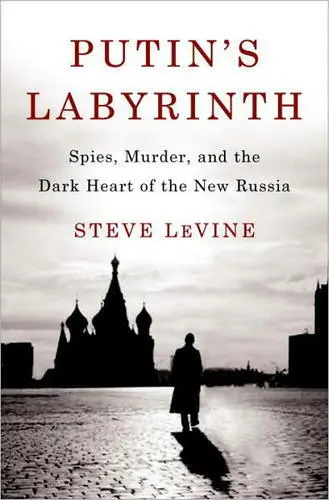
- Название:Putin's Labyrinth
- Автор:
- Издательство:Random House
- Жанр:
- Год:2008
- Город:New York
- ISBN:978-1-58836-815-7
- Рейтинг книги:3 / 5. Голосов: 1
-
Избранное:Добавить в избранное
- Отзывы:
-
Ваша оценка:
Putin's Labyrinth: краткое содержание, описание и аннотация
Предлагаем к чтению аннотацию, описание, краткое содержание или предисловие (зависит от того, что написал сам автор книги «Putin's Labyrinth»). Если вы не нашли необходимую информацию о книге — напишите в комментариях, мы постараемся отыскать её.
Drawing on new interviews with eyewitnesses and the families of victims, LeVine documents the bloodshed that has stained Putin’s two terms as president. Among the incidents chronicled in these pages: The 2002 terrorist takeover of a crowded Moscow theater—which led to the government gassing the building, and the deaths of more than a hundred terrified hostages–seen here from new angles, through the riveting words of those who survived; and the murder of courageous investigative reporter Anna Politkovskaya, shot in the elevator of her apartment building on Putin’s birthday, purportedly as a malicious “gift” for the president from supporters. Finally, a shocking story that made international headlines–the 2006 death of defector Alexander Litvinenko in London—is dramatized as never before. LeVine traces the steps of this KGB-spy-turned-dissident on his way to being poisoned with polonium-210, a radioactive isotope. And in doing so, LeVine is granted a rare series of interviews with a KGB defector who was nearly killed in strangely similar circumstances fifty years earlier. Through LeVine’s exhaustive research, we come to know the victims as real people, not just names in brief news accounts of how they died.
Putin’s Labyrinth
Putin's Labyrinth — читать онлайн бесплатно полную книгу (весь текст) целиком
Ниже представлен текст книги, разбитый по страницам. Система сохранения места последней прочитанной страницы, позволяет с удобством читать онлайн бесплатно книгу «Putin's Labyrinth», без необходимости каждый раз заново искать на чём Вы остановились. Поставьте закладку, и сможете в любой момент перейти на страницу, на которой закончили чтение.
Интервал:
Закладка:
Litvinenko was raised by his paternal grandfather in the northern Caucasus city of Nalchik, left there by parents who divorced when he was a young boy. His first wife thought his upbringing in this relatively wild region of southern Russia contributed to his being a bit of an odd character. Natalia Litvinenko, who had met the blond, blue-eyed Alexander in the suburbs of Moscow when he was fourteen and she a year younger, told me that he glorified his boyhood. As they fell in love, wed, and had two children, Litvinenko would abruptly turn cold and intimidating, and defend himself by saying that Caucasus people “have hotter blood so are capable of more cruelty,” Natalia said. But ultimately Litvinenko was a self-pitying sort, “like an abandoned puppy,” she said, troubled by an indifferent mother who refused to cook for him, an abusive stepfather who once forced him to jump on and off a couch one hundred times as punishment, and the general feeling that no one at all loved him.
In later years, Litvinenko would regard the period spanning his boyhood and first marriage as something of a lost time before he found his bearings. But he seemed to appreciate Natalia’s main point, according to Death of a Dissident, a memoir cowritten by his second wife, Marina, and his colleague and spokesman Alex Goldfarb. Rather than loved, he “felt sidelined” while growing up, the authors write. Absent an autobiography, I treated Death of a Dissident as a primary source for Litvinenko’s mind-set. Unsurprisingly, it differs from Natalia’s description of some events, especially Litvinenko’s abandonment of his family after eleven years of marriage. Natalia said that his departure was sudden, coming on a tempestuous 1993 night when he returned home smelling of perfume. She accused Marina of stealing him from her. Death of a Dissident, however, describes the first marriage as an unhappy one that collapsed of its own accord.
I found both wives attractive. Marina, a ballroom dance teacher, has more city sophistication and flair, and is less prone to paranoid and eyebrow-raising remarks. (For example, Natalia told my assistant that Litvinenko is still alive, and that his funeral was faked.) Yet I also felt sympathy for Natalia and the two children she had with Litvinenko; twenty-two-year-old Alexander and sixteen-year-old Sonya were both bitter and clearly hurt over growing up without their father for long periods.
Meeting Marina clearly was an important personal turn for Litvinenko. Death of a Dissident says that their relationship enabled him to finally shed his feelings of alienation. But far more dramatic in terms of Litvinenko’s ultimate fate was his crossing paths the next year with Boris Berezovsky, the wealthy Russian oligarch.
Moscow was bursting with swaggering billionaires in the 1990s, but few matched the outsized figure of Berezovsky. Made rich by his media empire, he presumed to influence all matters within the Kremlin, where he was part of President Boris Yeltsin’s inner circle. Litvinenko at the time was a major in an anti-terrorism and organized crime unit of the former KGB.
The two met when Litvinenko was investigating a reported assassination threat against Berezovsky, and they spoke again a few times after that. Then, eight months later, Litvinenko received an urgent message on his pager. Berezovsky said he was in trouble—Moscow police had shown up at the club he owned with the intention of taking him in for questioning in the investigation of a sensational murder. Vlad Listyev, general director of the Berezovsky-controlled television station ORT, had been shot dead. Litvinenko rushed to the club and held off the police until more members of his own unit arrived, and the altercation was defused. Berezovsky underwent police questioning, but at the club rather than some remote location.
The event quickly cemented the relationship between Berezovsky and Litvinenko. Both felt that, short of the latter’s intercession, the oligarch might have been taken away, only to disappear and later be reported as accidentally killed. Such things happened in Moscow with disturbing regularity. “[T]hey developed a bond shared only by people who have faced mortal danger together—not friendship or attachment, but a special kind of loyalty that no other can surpass,” Marina Litvinenko and Goldfarb wrote in Death of a Dissident.
In other words, Berezovsky more or less owed Litvinenko a blood debt.
In 1997, Litvinenko took command of a four-member team that was part of a shadowy anti–organized crime unit. A superior officer summoned the team and told the men that Berezovsky had to be killed. Speaking directly to Litvinenko, he said, “You will be the one to take him out.” The officer did not say who was ordering the assassination, but implied that the decision had been reached within the leadership of the anti-crime unit itself.
The events that followed reminded me of the old KGB agent Nikolai Khokhlov and his life-changing knock on the door of an anti-Soviet émigré—“I can’t let this murder happen.” Like Nikolai forty-four years earlier, Litvinenko did not perceive his assigned target as a “grave threat to our country”—the words of the superior officer that day. Extreme measures were warranted in wartime Chechnya, but not in peacetime Moscow. The order to kill the oligarch made Litvinenko and his men uneasy; he balked at it inwardly, but was careful to guard his feelings.
During the following three months, Litvinenko’s squad did nothing to carry out the order, and the superior officer never brought it up again. It was a curious situation, to say the least. Litvinenko and his men were dismayed that, whatever criminality had crept into their profession, someone was trying to reinvent them as a moneymaking political hit squad. That was not what they had signed up to be. At the same time, they suspected the threat wasn’t necessarily serious, and they might be able to outwait the officer who had issued the assassination order. So they dragged their feet, and heard nothing more from the officer.
Litvinenko did not immediately make Berezovsky aware of the order to assassinate him. When he later briefed the oligarch on the odd situation, Berezovsky thought the whole business sounded outlandish, but went straight to the director of the FSB. Was it true, what Litvinenko and his men said?
The FSB boss, Nikolai Kovalev, seemed to know nothing about the assassination order. But the accusations were explosive, and he assured the oligarch and Litvinenko that he would investigate. Soon they received word that whatever order had been issued—serious or not—was no longer in effect. Berezovsky would not be killed. However, the officer whose directive had set off the entire brouhaha went unpunished.
Litvinenko would not be soothed, and for good reason. Other troubling propositions were put before him: One superior asked if he was willing to help kill a former FSB man named Mikhail Trepashkin, who had accused the agency of corruption. Another sought his assistance in kidnapping a Chechen hotel owner. It seemed to Litvinenko that he and his men were still being pressured to act as an outlaw force.
Over subsequent months, Berezovsky arranged for Litvinenko’s men to air their complaints outside the FSB—to a Kremlin security official, who passed them on to the federal prosecutor’s office, which took formal depositions. It seemed they were being taken seriously, particularly when Kovalev was fired as FSB chief and replaced by someone whom Berezovsky recommended—Vladimir Putin.
Litvinenko and the other whistle-blowers were now on temporary suspension pending an investigation, but they thought the momentum was going their way. Their testimony could well lead to the reform of the FSB and promotions for all. Litvinenko in particular thought he might be in line for a senior position in the agency, given Berezovsky’s influence. The powerful oligarch had become a Putin zealot and was championing the new FSB boss as a presidential candidate to succeed Yeltsin. Within a relatively short time, he would emerge as one of Putin’s most important political strategists.
Читать дальшеИнтервал:
Закладка:
Похожие книги на «Putin's Labyrinth»
Представляем Вашему вниманию похожие книги на «Putin's Labyrinth» списком для выбора. Мы отобрали схожую по названию и смыслу литературу в надежде предоставить читателям больше вариантов отыскать новые, интересные, ещё непрочитанные произведения.










Обсуждение, отзывы о книге «Putin's Labyrinth» и просто собственные мнения читателей. Оставьте ваши комментарии, напишите, что Вы думаете о произведении, его смысле или главных героях. Укажите что конкретно понравилось, а что нет, и почему Вы так считаете.