Steve LeVine - Putin's Labyrinth
Здесь есть возможность читать онлайн «Steve LeVine - Putin's Labyrinth» весь текст электронной книги совершенно бесплатно (целиком полную версию без сокращений). В некоторых случаях можно слушать аудио, скачать через торрент в формате fb2 и присутствует краткое содержание. Город: New York, Год выпуска: 2008, ISBN: 2008, Издательство: Random House, Жанр: Публицистика, на английском языке. Описание произведения, (предисловие) а так же отзывы посетителей доступны на портале библиотеки ЛибКат.
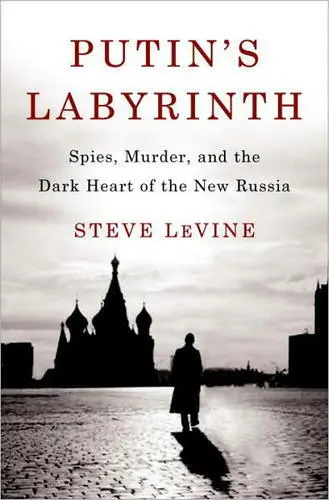
- Название:Putin's Labyrinth
- Автор:
- Издательство:Random House
- Жанр:
- Год:2008
- Город:New York
- ISBN:978-1-58836-815-7
- Рейтинг книги:3 / 5. Голосов: 1
-
Избранное:Добавить в избранное
- Отзывы:
-
Ваша оценка:
Putin's Labyrinth: краткое содержание, описание и аннотация
Предлагаем к чтению аннотацию, описание, краткое содержание или предисловие (зависит от того, что написал сам автор книги «Putin's Labyrinth»). Если вы не нашли необходимую информацию о книге — напишите в комментариях, мы постараемся отыскать её.
Drawing on new interviews with eyewitnesses and the families of victims, LeVine documents the bloodshed that has stained Putin’s two terms as president. Among the incidents chronicled in these pages: The 2002 terrorist takeover of a crowded Moscow theater—which led to the government gassing the building, and the deaths of more than a hundred terrified hostages–seen here from new angles, through the riveting words of those who survived; and the murder of courageous investigative reporter Anna Politkovskaya, shot in the elevator of her apartment building on Putin’s birthday, purportedly as a malicious “gift” for the president from supporters. Finally, a shocking story that made international headlines–the 2006 death of defector Alexander Litvinenko in London—is dramatized as never before. LeVine traces the steps of this KGB-spy-turned-dissident on his way to being poisoned with polonium-210, a radioactive isotope. And in doing so, LeVine is granted a rare series of interviews with a KGB defector who was nearly killed in strangely similar circumstances fifty years earlier. Through LeVine’s exhaustive research, we come to know the victims as real people, not just names in brief news accounts of how they died.
Putin’s Labyrinth
Putin's Labyrinth — читать онлайн бесплатно полную книгу (весь текст) целиком
Ниже представлен текст книги, разбитый по страницам. Система сохранения места последней прочитанной страницы, позволяет с удобством читать онлайн бесплатно книгу «Putin's Labyrinth», без необходимости каждый раз заново искать на чём Вы остановились. Поставьте закладку, и сможете в любой момент перейти на страницу, на которой закончили чтение.
Интервал:
Закладка:
Those killed by the gas had gone into hypoventilation, slow and shallow breathing that leads to a dangerous buildup of carbon dioxide in the blood. It is the way that heroin addicts often die. The appropriate treatment is an injection of naloxone, a medication that counters the effects of opiate overdose, especially from heroin or morphine. But it must be administered immediately.
In fact, some rescuers carried syringes of naloxone. Judging by the welt on his upper arm, Ilya reckoned that he received a shot from the commando who shook him awake. But there were not enough doses, or not enough people delivering them, to make much of a difference. Ilya said that no other musician appeared to have gotten a shot; he had simply been lucky.
Outside the theater, medical personnel were either absent or disorganized. The commandos themselves, rather than a waiting crew of paramedics, carried the liberated hostages from the building. Witnesses said there were no waiting stretchers and virtually no medical supervision; the commandos simply laid the hostages on the sidewalk, sometimes in the snow. Proper medical procedure called for the victims to be laid on the side, arms down at their sides, and heads back and aligned with their bodies, so as to keep their air passages open and tongues safely away from their throats. But that care was not taken.
Even those who made it to hospitals alive could not expect to receive appropriate treatment. Government secretiveness left doctors and nurses uncertain for hours as to how to proceed. In the emergency room where Irina was treated, it was apparent that few medical workers had been told anything about the nature of the gas that had been used, not even what it was.
And so the doctors tried improvising. Irina recalled that one prescribed milk for all the survivors. Another doctor ordered the milk exchanged for mineral water. Then a third ordered the mineral water withdrawn. “It’s no good in this case,” he said.
Some doctors did receive word to inject naloxone, which they reasonably interpreted to mean that the gas was an opiate. But no one could be sure what sort of opiate, a crucial bit of information. Under pressure, the Kremlin finally began to characterize the gas as a fentanyl derivative, but even that was too inexact. Was it an analogue of fentanyl called carfentanil, ten thousand times more powerful than morphine and used to sedate large animals? Was it sufentanil, an anesthetic for heart surgery that is a mere ten times more powerful than fentanyl? Or simple fentanyl? Doctors were left wondering how much naloxone to administer.
Five years later, authorities whom I interviewed responded to their critics in pretty much the same way. The government had certainly not intended that the hostages should die. Therefore it was blameless.
A former Kremlin official who had been involved in the planning, and who asked for anonymity, said no one was sure how much gas to pump in. Nor, he added, did anyone anticipate that a large supply of antidote would be needed. It was assumed that everyone would simply wake up. “In my opinion, the operation was successful,” he said.
As for the bitter complaints of survivors, he turned philosophical. “When there are victims, they will always seek answers,” he said. “They say we could have continued negotiations. They will do so until the end of their lives. People live in a certain myth in which some things were done well, and some things bad. But I’m absolutely certain that there was no evil plot to kill people.”
The Kremlin political adviser Vyacheslav Nikonov replied similarly. “The gas was rather harmless. The only thing they needed was a breath of fresh air—oxygen. A mask on their mouths,” he said. “Most of them died because of their tongues going down their throats. When they started bringing people out, there was a long line of medical cars. They concentrated on bringing people to the cars rather than on giving them oxygen.”
The government’s review of what precisely happened was lack-adaisical at best. Yuri Sinelshchikov, a former deputy prosecutor of the city of Moscow who supervised part of the investigation, believed it was not a serious effort. Written findings by his own investigator were altered to be in agreement with the conclusions of the FSB and the federal prosecutor, he said.
Sinelshchikov did not elaborate, but in other remarks he indicated there could be no conclusive investigation because the crime scene was politicized and corrupted. “I would leave the scene sick because of the mistakes, criminal mistakes,” he said. “Important witnesses were not immediately interviewed, not until two or three weeks later. There was missing evidence. In the beginning someone didn’t think something was important, and when he went back it was gone. People were not detained for interrogation. If someone was under suspicion and needed to be followed secretly, they were not doing it well at all, and it was obvious. For the first ten days there was chaos, and there were too many people from the top involved.”
Anna Politkovskaya had her suspicions about the events—she believed there had to be complicity of some kind within Russia’s intelligence agencies. How else did so many fully armed terrorists reach the center of Moscow? she asked. Six months afterward, she backed up her case by publishing an interview with a man who identified himself as a surviving member of the Nord-Ost terrorist band. The man, named Khanpasha Terkibayev, was working for Russian intelligence, Politkovskaya alleged. After the interview, Terkibayev denied telling Politkovskaya that he was at Nord-Ost. He was killed in a car crash a few months later.
Like the allegations regarding the 1999 apartment blasts, the suggestion of FSB involvement at Nord-Ost seemed fantastic. Even though I trusted Anna’s work, I had trouble taking such notions seriously. What I could say was that something worse than simple incompetence had led to the outcome at Nord-Ost. From the moment the hostage crisis began, the Kremlin and its security forces were focused only on killing the Chechens, on demonstrating the resolve of the state not to be pushed around. It never occurred to any of them to make the survival of the captives a priority.
An outsider could only wonder: If terrorists seized a theater in a major Western city, would the New York police or the FBI or the London, Paris, or Tokyo police use gas to subdue the hostage takers? Possibly. But would they neglect the need to have massive and well-organized medical care waiting outside the theater? The Hurricane Katrina debacle in 2005 notwithstanding, it is hard to imagine that fully equipped rescue trucks and ambulances would not have been lined up on Broadway by the dozens. I think it would be the same in the United Kingdom, in France, in Germany, and so on.
The most dangerous place in the industrialized world to be a rescued hostage is Russia.
The Nord-Ost survivors tried to get on with their lives, some more successfully than others. Two months after the hostage episode, Anna Politkovskaya’s phone rang. It was the police.
“We’ve got Ilya Lysak down here. He is asking for you,” a voice said. Ilya had been disorderly again; since his brush with terrorism, the young musician had gotten into a bar fight, inexplicably erupted at passersby on the street, and thrown a chair at someone.
“What’s wrong with me?” he asked Anna, after she signed him out of jail. That night, he dozed off on the Politkovskaya couch next to the family’s pet Doberman.
A few months later, a car jumped a curb near Ilya’s apartment and ran him down. He suffered multiple broken bones and spent eleven months in the hospital. Anna arranged for his treatment, cashing in a favor owed her by a wealthy acquaintance, who paid the bills.
Читать дальшеИнтервал:
Закладка:
Похожие книги на «Putin's Labyrinth»
Представляем Вашему вниманию похожие книги на «Putin's Labyrinth» списком для выбора. Мы отобрали схожую по названию и смыслу литературу в надежде предоставить читателям больше вариантов отыскать новые, интересные, ещё непрочитанные произведения.









Обсуждение, отзывы о книге «Putin's Labyrinth» и просто собственные мнения читателей. Оставьте ваши комментарии, напишите, что Вы думаете о произведении, его смысле или главных героях. Укажите что конкретно понравилось, а что нет, и почему Вы так считаете.