Steve LeVine - Putin's Labyrinth
Здесь есть возможность читать онлайн «Steve LeVine - Putin's Labyrinth» весь текст электронной книги совершенно бесплатно (целиком полную версию без сокращений). В некоторых случаях можно слушать аудио, скачать через торрент в формате fb2 и присутствует краткое содержание. Город: New York, Год выпуска: 2008, ISBN: 2008, Издательство: Random House, Жанр: Публицистика, на английском языке. Описание произведения, (предисловие) а так же отзывы посетителей доступны на портале библиотеки ЛибКат.
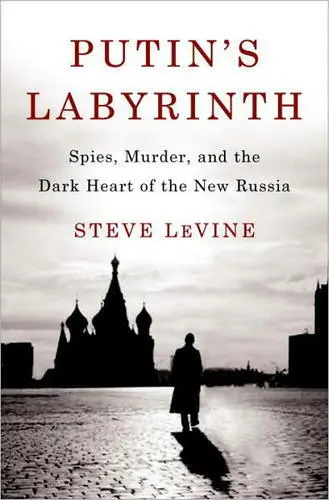
- Название:Putin's Labyrinth
- Автор:
- Издательство:Random House
- Жанр:
- Год:2008
- Город:New York
- ISBN:978-1-58836-815-7
- Рейтинг книги:3 / 5. Голосов: 1
-
Избранное:Добавить в избранное
- Отзывы:
-
Ваша оценка:
Putin's Labyrinth: краткое содержание, описание и аннотация
Предлагаем к чтению аннотацию, описание, краткое содержание или предисловие (зависит от того, что написал сам автор книги «Putin's Labyrinth»). Если вы не нашли необходимую информацию о книге — напишите в комментариях, мы постараемся отыскать её.
Drawing on new interviews with eyewitnesses and the families of victims, LeVine documents the bloodshed that has stained Putin’s two terms as president. Among the incidents chronicled in these pages: The 2002 terrorist takeover of a crowded Moscow theater—which led to the government gassing the building, and the deaths of more than a hundred terrified hostages–seen here from new angles, through the riveting words of those who survived; and the murder of courageous investigative reporter Anna Politkovskaya, shot in the elevator of her apartment building on Putin’s birthday, purportedly as a malicious “gift” for the president from supporters. Finally, a shocking story that made international headlines–the 2006 death of defector Alexander Litvinenko in London—is dramatized as never before. LeVine traces the steps of this KGB-spy-turned-dissident on his way to being poisoned with polonium-210, a radioactive isotope. And in doing so, LeVine is granted a rare series of interviews with a KGB defector who was nearly killed in strangely similar circumstances fifty years earlier. Through LeVine’s exhaustive research, we come to know the victims as real people, not just names in brief news accounts of how they died.
Putin’s Labyrinth
Putin's Labyrinth — читать онлайн бесплатно полную книгу (весь текст) целиком
Ниже представлен текст книги, разбитый по страницам. Система сохранения места последней прочитанной страницы, позволяет с удобством читать онлайн бесплатно книгу «Putin's Labyrinth», без необходимости каждый раз заново искать на чём Вы остановились. Поставьте закладку, и сможете в любой момент перейти на страницу, на которой закончили чтение.
Интервал:
Закладка:
Kazhegeldin had availed himself of such services, and sometimes reciprocated with information that enabled the agencies to plumb the vicious Russian business and political rivalries that their clients were keen to understand. With his help, I was able to contact agency detectives who were happy to talk, but not for attribution. While their openness might seem surprising, such professionals often trade information with journalists, particularly foreign correspondents with experience in opaque parts of the world.
One of these operatives, call him Andrew, said his usual clients were lawyers for British companies anxious to vet potential partners before signing a contract. But he also was profiting from a stream of new clients with business interests that involved the former Soviet Union. Some were tycoons in Russia and other newly independent republics who had built thriving enterprises from the wreckage of the Soviet states. They were willing to pay tens of thousands of dollars for compromising material on their enemies, a defense against rivals doing the same. Others were businessmen in the West, mainly Americans and Europeans, who were wondering if they should deal with such people. They routinely ordered $20,000 to $40,000 background checks on Russian, Kazakh, Uzbek, Georgian, or Chechen entrepreneurs who were offering what seemed like attractive deals.
The Mayfair detectives reckoned that most of the Western businessmen were just going through the motions; they fully intended to get in bed with these possibly nefarious fellows, if only to demonstrate their executive boldness. But, while they wanted to play near the edge, they hired the detective agencies to show shareholders that they were not doing so recklessly.
The agencies cared little about what motivated their clients. Their main concern was how to check out businessmen with murky pasts in Moscow, St. Petersburg, and elsewhere. Their staffs were thin on Russian expertise, and so their first reports were based on simple data searches on LexisNexis. Clients figured out that racket soon, however, and demanded more. So it was that the Mayfair agencies began to employ active-duty FSB men, reminiscent of the way that 1930s gangsters and Chicago policemen entered into mutually beneficial relationships. The agencies also hired former Russian intelligence agents, based on the assumption that, as with the mafia, no Russian spy ever truly left the service. It seemed that any Russian with an intelligence background who passed through London could pick up work.
The stock-in-trade for these gentlemen became known as the “KGB report.” Once given an assignment, an agent would visit the FSB’s file cabinets, pull records on whoever was of interest to the client, and pass them on. The level of detail delivered—property ownership, salary, marriage status, arrests—was astonishing compared with what was available publicly in the West.
There was no telling how much was accurate, but that didn’t seem to matter. The KGB reports, at $2,000 or so each, would be gussied up and delivered to clients who mainly accepted them at face value and didn’t question their provenance.
Andrew and the other detectives depicted their Western clients as strange combinations of voyeurs and cowboys, wanting to peek inside the strip show and boast to their friends about what they saw, but terrified to enter. Company lawyers ordered up the KGB reports, one detective said, but forbade his agency to conduct live interviews or hunt down revealing documents outside the KGB files. Such investigative methods could “violate little-understood laws,” the lawyers said. I could not fathom what laws they were talking about. Most likely, they themselves didn’t know and were simply trying to insulate themselves from whatever legal troubles might arise later.
William was the operations director of an agency that specialized in particularly gritty investigations. When he examined a Russian company, his aim was to provide a reality-based judgment on whether or not a client should do a deal, and if the answer was the former, how to do so prudently. He offered this theoretical example: If a client came to him with a Moscow property deal, it was not necessary to collect the voluminous detail that would appear in a KGB report. The sole relevant question was whether the deal included Yelena Baturina. She was Russia’s only woman billionaire, the wife of Mayor Yuri Luzhkov, and the queen of Moscow property development. If she was a participant, well, that would be fantastic, full steam ahead. But if not, it might be best to pass; a reasonably successful deal was probably unlikely. While such a calculation might seem rather crude, in fact it reflected some sophisticated sleuthing—it reflected how deals really got done in Russia.
The detective industry had its turbocharged side as well. I learned this from Dmitri, once an officer of GRU, an intelligence arm of the Russian military that deploys more spies abroad than any of the nation’s other espionage agencies. Dmitri worked now on contract for the Mayfair detective agencies, and a British friend recently retired from MI6 provided me the necessary introduction. Dmitri described his specialty as public relations— pee-yar’ in its Russian adaptation of the English acronym, except that in Russia it was more often than not essentially a black art. Its objective was the destruction of a client’s opponent through defamation. “We gather information for businesses that have problems,” Dmitri explained. “We can find out what are your rivals’ strong points, and can suggest how to damage the rival’s strategy. Everyone has skeletons.”
Unsolicited, Dmitri offered up Putin critic Anna Politkovskaya, the investigative reporter, as an example. He argued that her fundamental honesty could be challenged because she was in violation of Russian law by holding dual citizenships (she was born in New York when her father was a diplomat at the United Nations). Thus, he said, she should be regarded not as a crusading truth teller, but a questionable reporter who framed innocent Chechens and Russian soldiers.
It is best in such company to hold one’s breath and focus on blinking normally so as not to betray any particular opinion. Dmitri occupied a ruthless world.
Yet I was sure that Dmitri himself had skeletons, so I ventured a question: Given his inclinations, why was he living in London and not in Russia? His reply: That’s where he had found employment once he decided in the mid-1990s to leave the GRU, whose central tenet—discreet penetration of foreign militaries and businesses—had been watered down to a naïve belief that “Russians have nothing to be afraid of. Everybody is our friend.”
“It was like a kindergarten” during the 1990s, Dmitri said, echoing Putin’s realpolitik disdain for that period in Russia. In fact, in dealings with other states, “interests are eternal and friendships transitory.”
Dmitri was a bag of hot air—a spinmaster with a huge mouth, an annoying attitude, and a bucket of money from his employment by the U.K. detective agencies.
I liked him. He was wholly transparent.
One reason such individuals sound like mafiosi is that the two camps regularly associate, said Mark Galeotti, a bearded professor at Keele University. He is an expert on the intersection of Russian organized crime and intelligence services, and was introduced to Russian gangs while working on a doctoral degree in the 1980s. Russian-based detective agencies are often partners with criminal gangs, said Galeotti. The gangs, in turn, are tolerated by Putin as long as they respect the Kremlin’s domination of politics and business. Putin “doesn’t go out to cleanse the stables,” Galeotti said. “He just wants [the regions] to run efficiently.”
Alexander Litvinenko’s road to political exile in London began with a similar observation—that Putin was inexplicably tolerating criminality within the Russian state. His accusations would become more incendiary over the years, sometimes crossing into the fantastic. Galeotti, who once attended a speech by Litvinenko, found him to be earnest and committed, a decent person who was simply out of his depth. That was a perceptive observation. For all of Litvinenko’s precautions as a KGB-trained officer accustomed to attack and betrayal, he was ultimately unprepared for the precarious course his life took.
Читать дальшеИнтервал:
Закладка:
Похожие книги на «Putin's Labyrinth»
Представляем Вашему вниманию похожие книги на «Putin's Labyrinth» списком для выбора. Мы отобрали схожую по названию и смыслу литературу в надежде предоставить читателям больше вариантов отыскать новые, интересные, ещё непрочитанные произведения.









Обсуждение, отзывы о книге «Putin's Labyrinth» и просто собственные мнения читателей. Оставьте ваши комментарии, напишите, что Вы думаете о произведении, его смысле или главных героях. Укажите что конкретно понравилось, а что нет, и почему Вы так считаете.