Steve LeVine - Putin's Labyrinth
Здесь есть возможность читать онлайн «Steve LeVine - Putin's Labyrinth» весь текст электронной книги совершенно бесплатно (целиком полную версию без сокращений). В некоторых случаях можно слушать аудио, скачать через торрент в формате fb2 и присутствует краткое содержание. Город: New York, Год выпуска: 2008, ISBN: 2008, Издательство: Random House, Жанр: Публицистика, на английском языке. Описание произведения, (предисловие) а так же отзывы посетителей доступны на портале библиотеки ЛибКат.
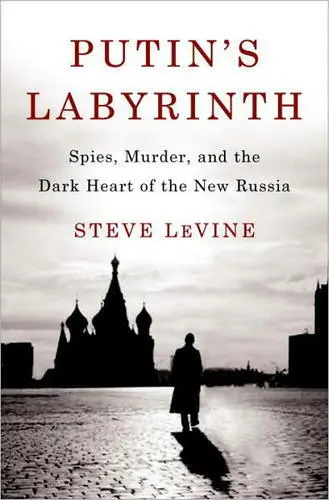
- Название:Putin's Labyrinth
- Автор:
- Издательство:Random House
- Жанр:
- Год:2008
- Город:New York
- ISBN:978-1-58836-815-7
- Рейтинг книги:3 / 5. Голосов: 1
-
Избранное:Добавить в избранное
- Отзывы:
-
Ваша оценка:
Putin's Labyrinth: краткое содержание, описание и аннотация
Предлагаем к чтению аннотацию, описание, краткое содержание или предисловие (зависит от того, что написал сам автор книги «Putin's Labyrinth»). Если вы не нашли необходимую информацию о книге — напишите в комментариях, мы постараемся отыскать её.
Drawing on new interviews with eyewitnesses and the families of victims, LeVine documents the bloodshed that has stained Putin’s two terms as president. Among the incidents chronicled in these pages: The 2002 terrorist takeover of a crowded Moscow theater—which led to the government gassing the building, and the deaths of more than a hundred terrified hostages–seen here from new angles, through the riveting words of those who survived; and the murder of courageous investigative reporter Anna Politkovskaya, shot in the elevator of her apartment building on Putin’s birthday, purportedly as a malicious “gift” for the president from supporters. Finally, a shocking story that made international headlines–the 2006 death of defector Alexander Litvinenko in London—is dramatized as never before. LeVine traces the steps of this KGB-spy-turned-dissident on his way to being poisoned with polonium-210, a radioactive isotope. And in doing so, LeVine is granted a rare series of interviews with a KGB defector who was nearly killed in strangely similar circumstances fifty years earlier. Through LeVine’s exhaustive research, we come to know the victims as real people, not just names in brief news accounts of how they died.
Putin’s Labyrinth
Putin's Labyrinth — читать онлайн бесплатно полную книгу (весь текст) целиком
Ниже представлен текст книги, разбитый по страницам. Система сохранения места последней прочитанной страницы, позволяет с удобством читать онлайн бесплатно книгу «Putin's Labyrinth», без необходимости каждый раз заново искать на чём Вы остановились. Поставьте закладку, и сможете в любой момент перейти на страницу, на которой закончили чтение.
Интервал:
Закладка:
Everyone—the hostages, the Chechens—was buoyed. The masked men tossed candies and juice into the audience.
About five a.m., Elena’s son told his mother that he smelled something sweet. Irina saw one of the Chechens on stage pull his mask up over his face and look about the theater in seeming puzzlement. Was there a fire? she wondered. Ilya glanced up and saw a faint, cloud-like mist floating down from ventilators in the ceiling.
Barayev shouted a sudden warning. “Now they are storming us!” he cried out. “Lay down!”
Ilya didn’t know what to think—did the Chechens intend to be their killers, or their rescuers?
“I’m afraid,” said Irina’s son. “Don’t be afraid,” she replied. “Whatever happens, we’ll be together. I’ll hold your hand.” She was startled to see the black widows begin to slump against walls where they had been standing at attention, then slide to the floor unconscious.
Something perilous was in the air. Irina wrapped her scarf around her son’s face and told her sister to cover her daughter’s face, too. Elena dampened three handkerchiefs with water she had saved. She handed one to her son, one to her husband, and placed the third over her face.
Ilya heard shouting, glass breaking, and shooting. The Chechen gunmen scattered in panic. But the gas had made him woozy and indifferent—who cared about the Chechens? He and a fellow musician lay side by side on the floor and covered their faces with a jacket they shared. Then Ilya blacked out.
Russian commandos waited at a command post about two hundred yards away as the gas was released into the theater’s air-conditioning system. It was a derivative of fentanyl, an opiate anesthetic many times more powerful than morphine. The Kremlin’s expectations were that everyone inside would fall safely asleep. Then security forces could storm the building and kill the Chechen invaders before any bombs were detonated.
The assault had been organized with the care of a watchmaker, according to Mark Franchetti, the British journalist. Commandos placed ultrasensitive sound devices beneath the floor of the auditorium, enabling them to track the movement of the Chechens inside. They also drilled a peephole and ran a tiny camera through it, allowing some limited viewing of the theater’s interior. After hours of such monitoring, the security forces were able to establish the approximate position of each terrorist. Commandos were then assigned specific Chechens to shoot when the assault began. They conducted practice raids in another theater a few miles away.
Still, after the fentanyl was released, signs of movement continued inside the auditorium. The gas apparently had not circulated as well as expected. Fentanyl was usually dispensed via an injection or pill; the aerosol had been tested and judged safe by scientists, but never in a space this large. Some parts of the theater seemed to be getting quite a bit of gas, other parts very little.
More fentanyl was pumped in, and then yet more. At last, all seemed quiet inside the theater and troops from the elite Alpha Unit poured into the building. Fifty-seven hours after the hostage crisis had begun, it was all over. The Russian commandos shot the black widows point blank where the women had collapsed. They pursued the Chechen men through the theater and executed them on the spot, including Barayev. (There were rumors later that one or more of the terrorists had escaped, but they were unsubstantiated.)
Ilya felt someone shaking him. A masked commando was shouting in his face, “Get up! Get up!” Although he could barely move his arms and legs, he managed to stumble out of the building to an ambulance, which whisked him to a hospital. When he was released four days later, four thousand rubles, the equivalent of $160, was missing from his trousers. Other hostages admitted to the hospital had the same story—all their cash, jewelry, and furs were stolen. Later, Ilya learned that ten of his fellow musicians were dead.
Elena awoke in a hospital bed about four hours after the gassing. “Where is my husband?” she pleaded. A few hours later, her mother and sister arrived with the answer. Her husband, Sergei, and her son, Andrei, had both perished.
Irina awoke in the crowded emergency room of another hospital. Her clothes, blood soaked, had been removed, and she was naked except for a blanket that someone had wrapped around her. She realized that her son was not with her and began to scream.
“Why are you shouting?” a doctor demanded. “Everyone is fine. No hostages died.” That, at least, was the official word—all the hostages were safe.
A friend retrieved clothes from Irina’s apartment while she used a borrowed cell phone to call other hospitals in search of her son. There was no trace of him, and she decided to go look for him herself. The first obstacle was getting out of the emergency room and off the hospital grounds, which were surrounded by soldiers with orders not to allow anyone to leave. Irina was stopped on her first attempt. But when in desperation she began to climb over a fence, she felt a hand under her—a kindly soldier provided the final boost.
Irina’s first stop was her apartment, to retrieve a photograph of her son in case it would be needed for identification purposes. The building’s lobby was already crowded with friends ready to join in the search. A television was turned to the news.
Suddenly, a friend brandishing a cell phone burst into tears. They killed him, she cried. On television, the bad news was confirmed. Some hostages in fact had died, and their names began scrolling across the screen. The first on the list was Yaroslav Fadeev—Irina’s son.
A stillness came over Irina. She felt nothing and showed no emotion.
“Where is he?” she asked simply. She found his body at a morgue, where she sat alone, gazing at his face and caressing his head. She felt a wound and realized he must have been hit in the fusillade directed at the Chechens. That explained why her clothes had been so bloodied—it was her son’s blood.
All she could think of were her final words to him—whatever happens, we’ll be together. She felt she had deceived her son. And she couldn’t live with that.
Irina ran out a back door, flagged a taxi, and directed the driver to a bridge over the Moscow River. She had no money so she paid the fare with her gold wedding band, and stepped out. She stood on the bridge where she and Yaroslav had often strolled, and gazed down at the icy water. The words kept going through her mind—whatever happens, we’ll be together.
Then she jumped.
Irina opened her eyes. She had briefly gone underwater, but then floated right back to the surface. There was too much ice in the river. It was impossible to drown.
“Are you crazy? Why are you swimming there?” a man shouted from the riverbank. He and a friend pulled Irina out. “Where are you from?” the man’s friend asked.
“I’m from the morgue,” she replied. The men looked at her as if she was crazy.
“Listen,” she said. “I’m from Nord-Ost. ”
The two men instantly understood. Anyone in Moscow would have. “Where do you want to go?”
Home, she said.
Irina did not even catch a cold.
The official death toll was 129. In a statement, Vladimir Putin congratulated the commandos for rescuing more than seven hundred hostages. “We could not save everyone,” he said. “Forgive us.”
A chorus of criticism arose among survivors and their relatives. Why had the Kremlin not given negotiations more of a chance? What happened to Viktor Kazantsev, the Russian general who supposedly was on his way to attempt a negotiated settlement? Had that been a ploy to gain time for the commandos to prepare their assault? And what about the reckless use of the aerosol?
Читать дальшеИнтервал:
Закладка:
Похожие книги на «Putin's Labyrinth»
Представляем Вашему вниманию похожие книги на «Putin's Labyrinth» списком для выбора. Мы отобрали схожую по названию и смыслу литературу в надежде предоставить читателям больше вариантов отыскать новые, интересные, ещё непрочитанные произведения.







Обсуждение, отзывы о книге «Putin's Labyrinth» и просто собственные мнения читателей. Оставьте ваши комментарии, напишите, что Вы думаете о произведении, его смысле или главных героях. Укажите что конкретно понравилось, а что нет, и почему Вы так считаете.