Steve LeVine - Putin's Labyrinth
Здесь есть возможность читать онлайн «Steve LeVine - Putin's Labyrinth» весь текст электронной книги совершенно бесплатно (целиком полную версию без сокращений). В некоторых случаях можно слушать аудио, скачать через торрент в формате fb2 и присутствует краткое содержание. Город: New York, Год выпуска: 2008, ISBN: 2008, Издательство: Random House, Жанр: Публицистика, на английском языке. Описание произведения, (предисловие) а так же отзывы посетителей доступны на портале библиотеки ЛибКат.
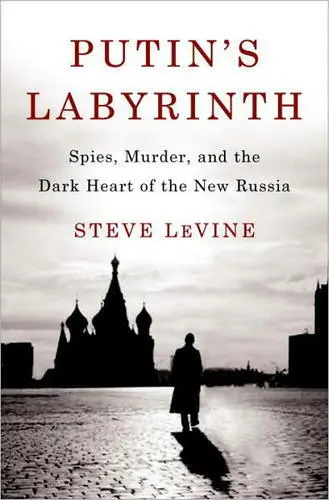
- Название:Putin's Labyrinth
- Автор:
- Издательство:Random House
- Жанр:
- Год:2008
- Город:New York
- ISBN:978-1-58836-815-7
- Рейтинг книги:3 / 5. Голосов: 1
-
Избранное:Добавить в избранное
- Отзывы:
-
Ваша оценка:
Putin's Labyrinth: краткое содержание, описание и аннотация
Предлагаем к чтению аннотацию, описание, краткое содержание или предисловие (зависит от того, что написал сам автор книги «Putin's Labyrinth»). Если вы не нашли необходимую информацию о книге — напишите в комментариях, мы постараемся отыскать её.
Drawing on new interviews with eyewitnesses and the families of victims, LeVine documents the bloodshed that has stained Putin’s two terms as president. Among the incidents chronicled in these pages: The 2002 terrorist takeover of a crowded Moscow theater—which led to the government gassing the building, and the deaths of more than a hundred terrified hostages–seen here from new angles, through the riveting words of those who survived; and the murder of courageous investigative reporter Anna Politkovskaya, shot in the elevator of her apartment building on Putin’s birthday, purportedly as a malicious “gift” for the president from supporters. Finally, a shocking story that made international headlines–the 2006 death of defector Alexander Litvinenko in London—is dramatized as never before. LeVine traces the steps of this KGB-spy-turned-dissident on his way to being poisoned with polonium-210, a radioactive isotope. And in doing so, LeVine is granted a rare series of interviews with a KGB defector who was nearly killed in strangely similar circumstances fifty years earlier. Through LeVine’s exhaustive research, we come to know the victims as real people, not just names in brief news accounts of how they died.
Putin’s Labyrinth
Putin's Labyrinth — читать онлайн бесплатно полную книгу (весь текст) целиком
Ниже представлен текст книги, разбитый по страницам. Система сохранения места последней прочитанной страницы, позволяет с удобством читать онлайн бесплатно книгу «Putin's Labyrinth», без необходимости каждый раз заново искать на чём Вы остановились. Поставьте закладку, и сможете в любой момент перейти на страницу, на которой закончили чтение.
Интервал:
Закладка:
In the years that followed, Nikolai became “disgusted” with what he regarded as an ineffectual anticommunist movement and decided to move on. Now a U.S. citizen, it took him just three years to earn both master’s and doctoral degrees in psychology at Duke University. Then he began his teaching career, at California State University, San Bernardino. Two decades later, in Russia, Boris Yeltsin pardoned Nikolai for turning against the Soviet intelligence service. Nikolai attributed Yeltsin’s act to blind luck—he had asked for permission to visit Moscow at a moment when, for one reason or another, the Russian president saw political advantage in welcoming such a visitor.
Nikolai and Yana spoke frequently by telephone in the time leading up to the Moscow visit, his first since defecting. In the Russian capital, they spent an emotional evening together. He would not share the details of their visit, other than to say that she told him he had “done everything right.” They were divorced by now; he had since married Tatjana, who was a sister-in-law of Giorgy Okolovich’s chief lieutenant. He remained in contact with son Alik, now a biologist at Moscow State University.
Nikolai’s years as a spy never left his soul, and in a very real way he was still living them when I knew him. He thrived on the past. His voice turned childlike whenever our discussions turned to his World War II exploits, and the descriptions of those adventures are the best parts of his memoir. He remained bitter at the CIA’s failure to rescue Yana and Alik; it was a betrayal, proof that the agency cared nothing about human beings. His friend Nick Andonov told me Nikolai was desperate to find someone who would portray him in film or print as a man who was not a traitor. When he failed, he was certain that the CIA simply didn’t want his story to be told and had pressured media executives into shunning him. I chalked that up to paranoia.
Until the very end, Nikolai insisted he was never an assassin and spoke contemptuously of those who portrayed him as having been one. Everyone got him wrong. I thought it was an absurd position to take. Did he ever kill anyone with his bare hands? Not that I could find out. But he was obviously capable of directing murder plots when he so chose. He was making a distinction between assassinations that he thought were justified—during wartime as a Russian partisan—and those he found distasteful after the war. One type was patriotic, the other mechanical and ideological.
I came to believe that stagecraft was a large part of Nikolai’s psyche. The Okolovich affair seemed to be a prime example. If Nikolai had simply wanted to stop the murder of the émigré leader, he only had to warn Okolovich to get out of town and no one would have been the wiser. He extended what should have been a temporary intersection with Okolovich’s life into an elongated drama, quite possibly because of the very theater of it—he couldn’t help himself.
Now I wanted to understand something about the nature of the current regime in Moscow. I decided to take a look at the events of October 2002 in a popular theater in the Russian capital.
CHAPTER 5

Nord-Ost
Once Again, Mother Russia Fails Her People
ILYA LYSAK, A BOYISHLY CHARMING TWENTY-FOUR-YEAR-OLD bass player with a confident manner, seated himself in the orchestra pit and began tuning up. It was October 23, 2002, and he and thirty-one other musicians were about to perform in the hit musical Nord-Ost, or “Northeast,” a World War II love story. He knew the score by heart, having already played it some three hundred times for theater audiences. But he was ever mindful of the need to stay sharp—it was a coup that he had landed this job in Moscow, one of the world’s most musically talented cities, and he knew it.
Irina Fadeeva, a thirty-seven-year-old blond woman with striking blue eyes, took her seat in row 11 of the theater. She was accompanied by her equally lovely older sister, Victoria; her fifteen-year-old son, Yaroslav; and her eighteen-year-old niece, Anastasia. The foursome ended up here entirely by chance. Irina had bought tickets for another show at a different theater, only to discover at the last minute that the tickets were for the previous night’s performance. But she was determined that the evening would not be wasted. She hurried everyone to another theater just down the street. Nord-Ost was playing, and she managed to buy four of the few remaining tickets.
Elena Baranovskaya, a well-spoken, elegantly turned-out woman, sat seven rows away with her husband, Sergei, a retired military officer, and her nineteen-year-old son, Andrei. They were marking a new life together—she and Sergei had been married just over a year, and only the day before had moved into a large new apartment. Elena had bought the Nord-Ost tickets to celebrate their good fortune; a bottle of wine and late dinner awaited them at home after the play was over.
Five years later, in separate conversations, the young bass player and the two women would guide me through the nightmare that soon unfolded inside the theater. Here are the stories of Ilya, Irina, and Elena, three who somehow survived while more than one hundred were dying.
It was during the second act that events on stage began to seem out of the ordinary. Ilya looked up from the orchestra pit to see armed strangers, dressed in masks and fatigues, suddenly appear. His initial reaction was bemusement: Two years into the musical’s run, its eccentric director must be still fiddling with the cast, introducing new characters without warning. Ilya watched as one of the masked men ordered a principal actor to leave the stage, then a second and a third.
Some in the audience, including Irina and Elena, laughed at the seemingly impromptu staging. But not Elena’s husband, a war-hardened former colonel in military intelligence. His intuition told him that these new “actors” were about to take hostages. “Everyone relax. We will be here awhile,” Sergei cautioned those around him. Images flashed through his mind of the 118-man crew that had perished in the submarine Kursk two years earlier, absent any Russian rescue attempt. Putin “will not save us,” he said.
Now something was going wrong in the orchestra pit. The conductor continued to wave his baton, but the music began to trail off. One by one, the confused members of the orchestra were putting down their instruments, in such perfect order that it appeared the surreal scene had been choreographed. Finally, there was only silence in the pit.
Videos captured some of the drama. A sequence from the theater’s in-house recording system opens with four men walking on stage in camouflage jackets. One barks orders to a comrade. Another is identifying himself and the other invaders as Chechens from the republic in southern Russia where President Vladimir Putin is conducting a savage war of conquest. Their leader, twenty-two-year-old Movsar Barayev, appears in a separate video shot during the siege with British newsman Mark Franchetti. The only one not wearing a mask, he is a nephew of a famously fierce Chechen commander. “We want an end to the war,” he tells the intrepid reporter.
From his vantage point in the pit, Ilya estimated that there were four dozen Chechens scattered about the theater. He wasn’t far off. There were forty-one. Many of them were women; they were known as “black widows” because they were the wives or sisters of slain Chechen men and had volunteered to be suicide bombers in this assault. Each one kept a hand at all times on a belt around her waist; each belt was said to be loaded with explosives and shrapnel. Ilya could see what appeared to be detonators—small buttons atop some belts; two wires extending from others, as if waiting to be touched together.
Читать дальшеИнтервал:
Закладка:
Похожие книги на «Putin's Labyrinth»
Представляем Вашему вниманию похожие книги на «Putin's Labyrinth» списком для выбора. Мы отобрали схожую по названию и смыслу литературу в надежде предоставить читателям больше вариантов отыскать новые, интересные, ещё непрочитанные произведения.









Обсуждение, отзывы о книге «Putin's Labyrinth» и просто собственные мнения читателей. Оставьте ваши комментарии, напишите, что Вы думаете о произведении, его смысле или главных героях. Укажите что конкретно понравилось, а что нет, и почему Вы так считаете.