Steve LeVine - Putin's Labyrinth
Здесь есть возможность читать онлайн «Steve LeVine - Putin's Labyrinth» весь текст электронной книги совершенно бесплатно (целиком полную версию без сокращений). В некоторых случаях можно слушать аудио, скачать через торрент в формате fb2 и присутствует краткое содержание. Город: New York, Год выпуска: 2008, ISBN: 2008, Издательство: Random House, Жанр: Публицистика, на английском языке. Описание произведения, (предисловие) а так же отзывы посетителей доступны на портале библиотеки ЛибКат.
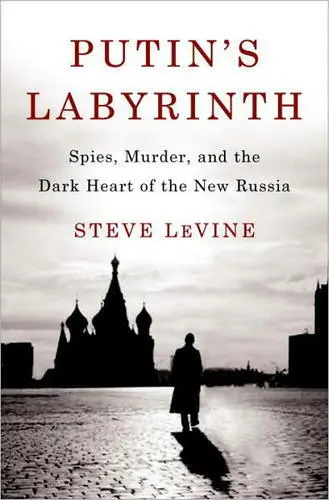
- Название:Putin's Labyrinth
- Автор:
- Издательство:Random House
- Жанр:
- Год:2008
- Город:New York
- ISBN:978-1-58836-815-7
- Рейтинг книги:3 / 5. Голосов: 1
-
Избранное:Добавить в избранное
- Отзывы:
-
Ваша оценка:
Putin's Labyrinth: краткое содержание, описание и аннотация
Предлагаем к чтению аннотацию, описание, краткое содержание или предисловие (зависит от того, что написал сам автор книги «Putin's Labyrinth»). Если вы не нашли необходимую информацию о книге — напишите в комментариях, мы постараемся отыскать её.
Drawing on new interviews with eyewitnesses and the families of victims, LeVine documents the bloodshed that has stained Putin’s two terms as president. Among the incidents chronicled in these pages: The 2002 terrorist takeover of a crowded Moscow theater—which led to the government gassing the building, and the deaths of more than a hundred terrified hostages–seen here from new angles, through the riveting words of those who survived; and the murder of courageous investigative reporter Anna Politkovskaya, shot in the elevator of her apartment building on Putin’s birthday, purportedly as a malicious “gift” for the president from supporters. Finally, a shocking story that made international headlines–the 2006 death of defector Alexander Litvinenko in London—is dramatized as never before. LeVine traces the steps of this KGB-spy-turned-dissident on his way to being poisoned with polonium-210, a radioactive isotope. And in doing so, LeVine is granted a rare series of interviews with a KGB defector who was nearly killed in strangely similar circumstances fifty years earlier. Through LeVine’s exhaustive research, we come to know the victims as real people, not just names in brief news accounts of how they died.
Putin’s Labyrinth
Putin's Labyrinth — читать онлайн бесплатно полную книгу (весь текст) целиком
Ниже представлен текст книги, разбитый по страницам. Система сохранения места последней прочитанной страницы, позволяет с удобством читать онлайн бесплатно книгу «Putin's Labyrinth», без необходимости каждый раз заново искать на чём Вы остановились. Поставьте закладку, и сможете в любой момент перейти на страницу, на которой закончили чтение.
Интервал:
Закладка:
When I met him five years later, he spoke as though the hours he spent as a hostage weren’t entirely frightening for him. Indeed, I had the sense that he was feeling fairly full of himself some of the time. At one point, he said, he decided that the Chechen leader, Barayev, was not that imposing, and that he, Ilya, could “take him one-on-one” if the two had ever been alone together. But there also was something affecting about Ilya. He described himself as a big, muscular man prior to the auto accident; now, at age twenty-nine, he was skinny, almost wiry, and, while a captivating speaker, he was more boy than man. When I saw him, Ilya was working two jobs—sound director at the country’s main television station and, on the side, composing music for a film.
Elena noticed that people acted strangely once they learned of her connection to Nord-Ost, and so she stopped mentioning it. For the previous eighteen years, she had taught chemistry. But she could not see herself returning to the classroom. Instead, she began attending classes on the tourism industry, and there she met an elderly woman named Diana who was already a success in the business. As their relationship warmed, Elena revealed that she had been a hostage.
Diana responded instantly. “I’m going to give you my firm,” she said. Elena was floored by her classmate’s extreme kindness. “She was seventy-five and decided to do something else. She could see my circumstances,” said Elena. “She asked an absolutely symbolic amount” of money in exchange.
When Elena spoke to me over tea in spring 2007, she was about to fly to Paris to personally select a hotel for clients. This courageous woman was on her way.
Irina, anxious that her son not be forgotten, presented herself at Anna Politkovskaya’s newspaper office with a sheaf of photographs. Until then, the two had never met. But the sympathetic journalist made Irina and her dead son part of a feature article entitled “Nord-Ost. 11th Row,” and churned out other pieces on the survivors and the government’s plodding investigation. Irina read them all; Anna, she said, had “taken me by a finger and pulled me out from drowning….”
But the Novaya Gazeta story offended the city prosecutor’s office. An investigator summoned Irina for an interview and demanded that she retract the claim that her son had been shot by commandos. The official version was that firearms had been used only against the Chechens. Irina refused to back down; the prosecutor’s office kept phoning, then began calling her parents.
Finally, Anna called the prosecutor’s office: “Leave this family alone,” she said, according to Irina. The calls stopped.
In America, the HBO network commissioned a documentary entitled Terror in Moscow, based on the work of Mark Franchetti, the British reporter who had interviewed the terrorist leader Barayev. Ilya, Elena, and Irina were brought together for the HBO program, and it in turn gave rise to the formation of Nord-Ostsi, or the “People of Nord-Ost ”—survivors and families of the dead, bound together by the shared tragedy. They met at Elena’s new apartment, and their common vow was to keep the memory of the theater massacre alive. Some joined in a suit against the Russian government, filed in international court in Strasbourg, France.
On the first anniversary of the gassing, a bronze plaque bearing the names of all 129 victims was installed outside the theater during a memorial service. Irina placed a photograph of her son amid the bouquets of flowers. Elena slipped in a photo of her husband and son at the seashore. No one from the Kremlin attended. President Putin sent a statement from abroad, calling the deaths “a severe wound in our heart that will take a long time to heal. But you and I know well that once you let terrorists raise their heads in one place they will immediately appear in another place using territories they are comfortable in as bases of rear support.”
I last saw Irina at a Nord-Ostsi dinner in September 2007, where she sat before the camera of Russian documentary filmmaker Marina Goldovskaya. She was in despair that her life had become, like the setting for the theater massacre, a sort of play. “Just turn on the camera, and we can perform,” she said of herself and the other survivors.
Her story fascinated the media—how she had found her son’s body in a morgue, how she had jumped from the bridge. She was entirely genuine each time her tears welled up, which is why journalists and filmmakers kept returning. She had dedicated herself to crusading on behalf of the victims of Nord-Ost, which guaranteed that she would be a constant object of attention.
And yet she was troubled by the freeze-frame in which she found herself. It seemed frightening at times. In the years after the massacre, she had married and given birth to two children. She was a mother again, and she did not want her children to pay a price for the life she had chosen to lead. But how could they not be affected?
Would it have helped if Irina had sensed that there was some understanding of her pain amid the highest levels of government? An understanding among the Kremlin leadership that defense of the state had to be tempered with compassion for the Russian people?
Probably.
CHAPTER 6

The Exiles
Boris Berezovsky and the Sanctuary of London
THANKS TO ITS LIBERAL ATTITUDE TOWARD POLITICAL ASYLUM, the United Kingdom is a haven for the outcasts of autocratic countries around the world. Expatriates from former Soviet nations once ruled by Moscow make up a significant portion of this community of political refugees. My introduction to their universe was provided by a genteel Kazakh man named Akezhan Kazhegeldin, a KGB-trained former prime minister who presumed to lead his homeland’s political opposition from London. Ten years earlier, he had stepped over the bounds of permitted ambition by aspiring to be president of his onetime Soviet country. Now he passed the time by dreaming of political plots against Kazakhstan’s president, Nursultan Nazarbayev. Some dismissed him as a self-promoter, but this ungenerous characterization never gained traction with me.
I had known the fifty-seven-year-old Kazhegeldin for a decade. He was an enduring survivor, an admirable but sad figure. Admirable for standing up as an often lone voice against the autocratic politics practiced back home. Sad because, even if he were able to return to his country some day, there was little chance he could ever make a political comeback. And he likely wouldn’t return, not with the discouraging example of Boris Shikhmuradov to consider. This somewhat vain political exile from former Soviet Turkmenistan sneaked back into his native country in 2002, thinking he would force the country’s dictator into retirement. Instead, he was rapidly captured, drugged, forced to give a televised “confession,” and imprisoned for life. Something similar certainly awaited Kazhegeldin were he to return to Kazakhstan. So that meant stewing abroad, forever planning unlikely conspiracies and hoping for a miracle.
Kazhegeldin supplied the number of a friend who could introduce me to the Mayfair district, a London haunt for the kind of people I was seeking: the political exiles, the denizens of the city’s underworld of spies and former spies, and the often shady businessmen who moved comfortably among all factions.
Mayfair enjoyed a certain James Bond mystique, a hangover from the time that MI6, the British spy agency, was based there. But it was also august London writ large, housing Savile Row, Christie’s and Sotheby’s, and the Ritz. When I visited in 2007, its office space was the most expensive in the world at $212 a square foot, far higher than mid-town Manhattan, Hong Kong, or Tokyo. You couldn’t know by merely walking Mayfair’s streets, but hedge funds had moved into the district alongside the luxury boutiques and exotic restaurants. The most intriguing businesses of all were the myriad detective agencies. These were run by clubby characters whose success seemed to hinge in part on how well they could create the impression that they knew the darkest secrets and kept company with the most dangerous characters.
Читать дальшеИнтервал:
Закладка:
Похожие книги на «Putin's Labyrinth»
Представляем Вашему вниманию похожие книги на «Putin's Labyrinth» списком для выбора. Мы отобрали схожую по названию и смыслу литературу в надежде предоставить читателям больше вариантов отыскать новые, интересные, ещё непрочитанные произведения.







Обсуждение, отзывы о книге «Putin's Labyrinth» и просто собственные мнения читателей. Оставьте ваши комментарии, напишите, что Вы думаете о произведении, его смысле или главных героях. Укажите что конкретно понравилось, а что нет, и почему Вы так считаете.