Steve LeVine - Putin's Labyrinth
Здесь есть возможность читать онлайн «Steve LeVine - Putin's Labyrinth» весь текст электронной книги совершенно бесплатно (целиком полную версию без сокращений). В некоторых случаях можно слушать аудио, скачать через торрент в формате fb2 и присутствует краткое содержание. Город: New York, Год выпуска: 2008, ISBN: 2008, Издательство: Random House, Жанр: Публицистика, на английском языке. Описание произведения, (предисловие) а так же отзывы посетителей доступны на портале библиотеки ЛибКат.
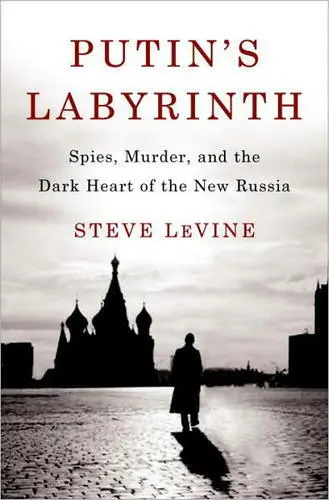
- Название:Putin's Labyrinth
- Автор:
- Издательство:Random House
- Жанр:
- Год:2008
- Город:New York
- ISBN:978-1-58836-815-7
- Рейтинг книги:3 / 5. Голосов: 1
-
Избранное:Добавить в избранное
- Отзывы:
-
Ваша оценка:
Putin's Labyrinth: краткое содержание, описание и аннотация
Предлагаем к чтению аннотацию, описание, краткое содержание или предисловие (зависит от того, что написал сам автор книги «Putin's Labyrinth»). Если вы не нашли необходимую информацию о книге — напишите в комментариях, мы постараемся отыскать её.
Drawing on new interviews with eyewitnesses and the families of victims, LeVine documents the bloodshed that has stained Putin’s two terms as president. Among the incidents chronicled in these pages: The 2002 terrorist takeover of a crowded Moscow theater—which led to the government gassing the building, and the deaths of more than a hundred terrified hostages–seen here from new angles, through the riveting words of those who survived; and the murder of courageous investigative reporter Anna Politkovskaya, shot in the elevator of her apartment building on Putin’s birthday, purportedly as a malicious “gift” for the president from supporters. Finally, a shocking story that made international headlines–the 2006 death of defector Alexander Litvinenko in London—is dramatized as never before. LeVine traces the steps of this KGB-spy-turned-dissident on his way to being poisoned with polonium-210, a radioactive isotope. And in doing so, LeVine is granted a rare series of interviews with a KGB defector who was nearly killed in strangely similar circumstances fifty years earlier. Through LeVine’s exhaustive research, we come to know the victims as real people, not just names in brief news accounts of how they died.
Putin’s Labyrinth
Putin's Labyrinth — читать онлайн бесплатно полную книгу (весь текст) целиком
Ниже представлен текст книги, разбитый по страницам. Система сохранения места последней прочитанной страницы, позволяет с удобством читать онлайн бесплатно книгу «Putin's Labyrinth», без необходимости каждый раз заново искать на чём Вы остановились. Поставьте закладку, и сможете в любой момент перейти на страницу, на которой закончили чтение.
Интервал:
Закладка:
That Litvinenko was no longer safe seemed obvious. He began planning his escape from Russia. Felshtinsky’s recollection is that the two of them met at Litvinenko’s dacha after his release from prison. Felshtinsky and Berezovsky had recently discussed Litvinenko’s safety in Russia, and both figured it was time for him to leave the country. Now at Litvinenko’s dacha, Felshtinsky related the conversation to him.
“What will I do? Where will I go?” Litvinenko asked. Felshtinsky said he could help. During the early 1980s, difficult years when the border was closed after the Soviet invasion of Afghanistan, he had run an illicit emigration scheme in which he charged Soviets $6,000 each to get out by marrying a Swede or a Finn. Given that he managed to settle people fairly easily during those years, he didn’t see much of a problem once Litvinenko got over the Russian border.
In the meantime, Felshtinsky said, give Marina some money, and tell her to depart separately and meet him—Felshtinsky—somewhere abroad. Berezovsky would help. Litvinenko agreed.
According to Death of a Dissident, Litvinenko had already decided to flee before his émigré friend suggested it. He had been doing his best to evade FSB surveillance, which he was certain was under way. But how would he get out of the country, since he had been refused a passport the last time he applied? He began studying a lengthy land route south.
Not too long after, Natalia Litvinenko—his first wife—had a rare visit from her former husband. He had some plans, he said. It had become too dangerous for him, and he was going to go live on an island somewhere, write a book, and live off the royalties. Did she think that was all right? If he no longer felt safe, she replied, he indeed should go.
A month after the meeting at Litvinenko’s dacha, Felshtinsky was back in Boston. His telephone rang. It was Berezovsky calling from London. “You know we have a common friend in Moscow?” the oligarch said in the vague way that former Soviets speak when they fear their phone is tapped. “Well, he’s no longer in Moscow.”
Felshtinsky understood instantly. Litvinenko had not taken long to act.
His first stop was the Russian Black Sea resort of Sochi, from which he took a steamer south to the neighboring republic of Georgia, a trip that didn’t require a passport. He traversed seaside towns before finally turning inland and reaching the Georgian capital, Tbilisi. He knew people there and could purchase a false passport.
Litvinenko needed to obtain asylum in a Western country if he was to be out of Russia’s reach. But where? One possibility was London. Another was Germany. Litvinenko had a sister there, and his father had other connections. The Berezovsky machine went into motion.
Berezovsky himself was in trouble with Putin at the moment. The strain had begun a half year earlier, soon after Putin won election as president. In Berezovsky’s estimation, Putin’s rise meant business as usual for him, meaning that he would maintain his profit-making enterprises and continue to exercise influence in the Kremlin.
And that’s how their relationship was initially. But quickly, Putin became offended by Berezovsky’s attitude, which smacked of entitlement. The billionaire argued forcefully against Putin’s plan to rein in much of the country’s power and transfer it to the Kremlin. Berezovsky’s television station, ORT, strongly criticized Putin’s performance during the 2000 Kursk submarine disaster. And, in an interview, Berezovsky had seemed to compare Putin to Chilean dictator Augusto Pinochet.
Berezovsky had stepped out of line. The punishment would be Kremlin seizure of ORT, Putin decided.
In their final Kremlin meeting, recorded in Death of a Dissident and confirmed by Berezovsky, each seemed to regard the other’s behavior as betrayal.
“Tell me Boris, I don’t understand,” Putin asked. “…Why are you attacking me? Have I done anything to hurt you?…You are supposed to be my friend.”
“…You forgot our conversation after the election, Volodya,” Berezovsky replied, using Putin’s nickname. “I told you that I never swore allegiance to you personally. You promised to continue the Yeltsin way. He would never even think of shutting up a journalist who attacked him. You are destroying Russia.”
That was about it.
“Good-bye, Boris Abramovich,” Putin said.
“Good-bye, Volodya,” said the oligarch.
The two never spoke again. By the time Litvinenko decided to flee, Berezovsky was already an exile living in Europe.
It was vindication for Felshtinsky. Berezovsky’s relationship with his political consultant had gone through a rocky period, mainly because the oligarch felt that Felshtinsky didn’t understand the changes that had transformed Russia in the last two decades. But now, Berezovsky wanted Felshtinsky to serve as his man on the ground, and get Litvinenko to safety. The oligarch instructed Felshtinsky to come meet him in London. Working as a team, they would spirit Litvinenko into Munich via commercial flights and even private planes if needed. Berezovsky provided $10,000 in cash to be funneled to Litvinenko.
At this point, Marina and her six-year-old son, Anatoly, learned for the first time what was going on. Her husband had left Moscow saying he was going to visit his father in the Caucasus. Later, he had called to suggest that she take a vacation in Spain. It was left to Felshtinsky to go to Marina and explain the escape plan.
He began to shuttle between the husband in Georgia and the wife in Spain. Arriving in Tbilisi, Felshtinsky found Litvinenko in a petulant state. He now had Berezovsky’s cash, along with an authentic-looking Georgian passport, and wanted to go straight to the U.S. embassy. He threw a tantrum when Felshtinsky refused to take him there. Berezovsky had ordered that they stay away from the Americans—the oligarch wanted no one to know of the pair’s presence in Georgia, worried in particular that the episode would be associated with one of his longtime business partners who had a reputation for criminal connections.
Litvinenko would have none of it. “If we don’t go to the American embassy, I’m going back to Moscow,” he said defiantly.
Finally, Felshtinsky relented. Okay, we will go, he said, but on one condition—that you never tell Berezovsky. Litvinenko agreed.
Felshtinsky held several meetings at the embassy. The American diplomats were mainly interested in gauging Litvinenko’s usefulness as an intelligence source. Did he know any Russian agents operating in the United States? Or Americans operating for the Russians? Beyond that, the diplomats seemed in no hurry to move things along.
Felshtinsky and Litvinenko became increasingly nervous. For security purposes, they carried several cell phones, including one with Felshtinsky’s Boston number. But only his Russian phone worked in Georgia—and it began to ring. Acquaintances in Moscow were calling, having noted the absence of the entire Litvinenko family and concerned that something was amiss. Felshtinsky worried that it had become too dangerous to remain in Georgia.
He and Litvinenko rushed to the airport and boarded a fourteen-seat luxury Fokker jet rented by Berezovsky in Paris. On the tarmac as the pilot prepared for takeoff, Felshtinsky heard his cell phone ring. It was the American embassy in Tbilisi.
“Call me in an hour,” Felshtinsky said, notwithstanding that they would be in the air at that moment. Then Berezovsky called. Felshtinsky briefed him. In line with the original plan, he said, they were headed for Munich.
“I think you should go to Turkey, not Munich,” Berezovsky replied.
That did not go over well with Litvinenko. Turkey was a nether-world that swallowed up all manner of people. It sounded like Berezovsky intended to abandon him, and he insisted that they head for a Western country—Germany, he said.
Читать дальшеИнтервал:
Закладка:
Похожие книги на «Putin's Labyrinth»
Представляем Вашему вниманию похожие книги на «Putin's Labyrinth» списком для выбора. Мы отобрали схожую по названию и смыслу литературу в надежде предоставить читателям больше вариантов отыскать новые, интересные, ещё непрочитанные произведения.










Обсуждение, отзывы о книге «Putin's Labyrinth» и просто собственные мнения читателей. Оставьте ваши комментарии, напишите, что Вы думаете о произведении, его смысле или главных героях. Укажите что конкретно понравилось, а что нет, и почему Вы так считаете.