Steve LeVine - Putin's Labyrinth
Здесь есть возможность читать онлайн «Steve LeVine - Putin's Labyrinth» весь текст электронной книги совершенно бесплатно (целиком полную версию без сокращений). В некоторых случаях можно слушать аудио, скачать через торрент в формате fb2 и присутствует краткое содержание. Город: New York, Год выпуска: 2008, ISBN: 2008, Издательство: Random House, Жанр: Публицистика, на английском языке. Описание произведения, (предисловие) а так же отзывы посетителей доступны на портале библиотеки ЛибКат.
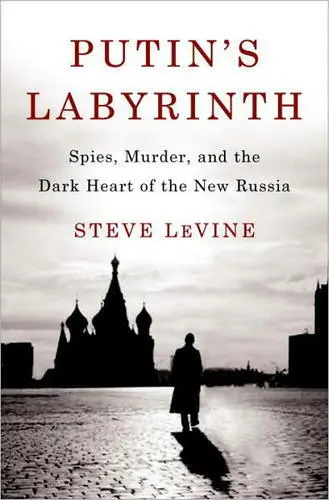
- Название:Putin's Labyrinth
- Автор:
- Издательство:Random House
- Жанр:
- Год:2008
- Город:New York
- ISBN:978-1-58836-815-7
- Рейтинг книги:3 / 5. Голосов: 1
-
Избранное:Добавить в избранное
- Отзывы:
-
Ваша оценка:
Putin's Labyrinth: краткое содержание, описание и аннотация
Предлагаем к чтению аннотацию, описание, краткое содержание или предисловие (зависит от того, что написал сам автор книги «Putin's Labyrinth»). Если вы не нашли необходимую информацию о книге — напишите в комментариях, мы постараемся отыскать её.
Drawing on new interviews with eyewitnesses and the families of victims, LeVine documents the bloodshed that has stained Putin’s two terms as president. Among the incidents chronicled in these pages: The 2002 terrorist takeover of a crowded Moscow theater—which led to the government gassing the building, and the deaths of more than a hundred terrified hostages–seen here from new angles, through the riveting words of those who survived; and the murder of courageous investigative reporter Anna Politkovskaya, shot in the elevator of her apartment building on Putin’s birthday, purportedly as a malicious “gift” for the president from supporters. Finally, a shocking story that made international headlines–the 2006 death of defector Alexander Litvinenko in London—is dramatized as never before. LeVine traces the steps of this KGB-spy-turned-dissident on his way to being poisoned with polonium-210, a radioactive isotope. And in doing so, LeVine is granted a rare series of interviews with a KGB defector who was nearly killed in strangely similar circumstances fifty years earlier. Through LeVine’s exhaustive research, we come to know the victims as real people, not just names in brief news accounts of how they died.
Putin’s Labyrinth
Putin's Labyrinth — читать онлайн бесплатно полную книгу (весь текст) целиком
Ниже представлен текст книги, разбитый по страницам. Система сохранения места последней прочитанной страницы, позволяет с удобством читать онлайн бесплатно книгу «Putin's Labyrinth», без необходимости каждый раз заново искать на чём Вы остановились. Поставьте закладку, и сможете в любой момент перейти на страницу, на которой закончили чтение.
Интервал:
Закладка:
Felshtinsky handed the phone to Litvinenko.
Berezovsky went to work on him: I’m not going to abandon you. We just need more time to figure this out.
Berezovsky had a commanding manner. It also mattered that he was financing the escape. Even Litvinenko, prone to argue with anyone, didn’t challenge him too vigorously. Finally he told the billionaire that he trusted him, and switched off the phone.
But then he resumed bargaining with Felshtinsky. Litvinenko would go to Antalya—the Turkish resort region that Berezovsky had in mind—only if Felshtinsky dropped him off, then flew at once to Spain to retrieve Marina and Anatoly.
By now Litvinenko was under tremendous stress, and the arrival of his family the next day with Felshtinsky didn’t ease him that much. He was suspicious of certain men he saw in the hotel lobby. “I know these people,” he insisted. “They are FSB. I know them from Chechnya.” He was sure they were preparing to kill them. Felshtinsky ignored him. He thought that was Litvinenko’s game—using staged nervousness to get what he wanted, which could range from checking into a new hotel, to going to a new city, or simply attracting attention.
Whichever was the case, Felshtinsky was losing confidence. A month earlier, he had thought it would be easy to arrange asylum for Litvinenko. The obvious route was the Americans, but so far that wasn’t working. In Tbilisi, the U.S. embassy had seemed more interested in bargaining for information than rescuing an FSB defector. Berezovsky’s camp had made Felshtinsky even more anxious by suggesting they rent a yacht and sail into international waters—they could wait at sea while asylum was arranged. But Felshtinsky thought that could leave them exposed to an attack, with no escape route should Putin learn their location.
Now Berezovsky dispatched an additional adviser, Alex Goldfarb, to the mission. Goldfarb had an unusual talent for public relations. While still a Soviet citizen in the 1970s, this microbiologist came to be known by Western journalists as a conduit to Moscow dissidents. After the Soviet breakup, he ran the Moscow office of the Open Society Institute, an organization established by hedge fund billionaire George Soros to promote democracy in formerly communist states. Berezovsky eventually hired him to run a foundation that financed anti-Putin political activities. With Goldfarb, it was often difficult to determine where the truth ended and the propaganda began. But if you wanted something to happen, he was your man.
Felshtinsky and Goldfarb began instantly to quarrel. Goldfarb’s first suggestion was that Litvinenko be brought to American diplomats in Turkey, accompanied by a lawyer to protect his interests. Felshtinsky thought this was a terrible idea after their Tbilisi experience, but couldn’t let slip that they had defied Berezovsky’s instructions and already gone to the Americans.
“It’s an idiotic idea,” Felshtinsky said.
Goldfarb said he would dispatch a lawyer.
“If you are going to send in a lawyer, you might as well go yourself, because I’m not going to go with a lawyer,” Felshtinsky replied. He announced that he was leaving, causing Litvinenko to become even more alarmed and his wife to sense betrayal. Felshtinsky had deliberately escalated the argument out of dread that this mission was going very wrong. But his departure would turn out to be a welcome development. While a nice guy, he was not an operator of Goldfarb’s caliber.
Within hours after Felshtinsky left, Goldfarb and the Litvinenko family were on the road to the capital, Ankara. There, they met with diplomats at the U.S. embassy—but again, no one seemed prepared to make a deal.
That night, Litvinenko went into his familiar routine. He called Goldfarb’s attention to a fellow in the hotel lobby. “They’re here already…. We have to get out of here,” he declared, identifying the manas an FSB agent. Goldfarb took Litvinenko seriously and hustled the family out of the hotel. They drove all night to presumed safety in Istanbul. Along the way, Litvinenko stepped up the drama. He directed Goldfarb to stop the car and wait ten minutes to see whether anyone was following them. “I won’t go alive,” Litvinenko said. “If the Turks turn me in, I’ll kill myself.”
Was there a genuine danger? One couldn’t tell, Felshtinsky had said of Litvinenko. And even if you knew he was bluffing, and kept saying to yourself, “He is bluffing, he is bluffing,” Litvinenko was a very good actor, and it was hard to be absolutely sure.
Felshtinsky, back in Boston, received a call from local CIA agents. Could they come meet with him? Before long, a man and a woman showed up at his door. “You left Tbilisi without talking to our friend who was expecting to meet with you,” one said.
“I was trying to check how quick you are,” Felshtinsky replied, remembering the snippet of phone conversation moments before taking off from the Tbilisi airport. He explained what was going on in Turkey. “We left Tbilisi because it’s dangerous, and it’s more dangerous in Turkey.” Could these agents help rescue his Russian friend? “It’s difficult,” the U.S. agents said simply. “It’s difficult.”
Goldfarb telephoned from Istanbul. If the Americans didn’t act quickly, he told Felshtinsky, he would hold a press conference and say that an American’s life was being put in danger, meaning his own. Felshtinsky should pass that message on to his CIA contacts. Felshtinsky advised against such an approach.
“It’s my life, not yours,” Goldfarb replied. “The FSB is already here. It’s our lives, and I ask you to do this on my behalf.”
So Felshtinsky called his contact at the CIA.
“We can’t be subject to blackmail and pressure,” the CIA contact replied. “You’re on your own.”
Goldfarb, left to his wilier instincts, improvised. He bought Turkey-to-Moscow tickets for everyone—with a transit stop in London. At Heathrow Airport, Goldfarb introduced Litvinenko to an immigration officer and requested asylum on behalf of him and his family.
Within hours, the Litvinenkos were under the protection of the British government. As for Goldfarb, the United Kingdom declared him persona non grata and sent him on his way.
Berezovsky put up Litvinenko and his family in an apartment in London’s upscale Kensington district and arranged a £5,000 monthly allowance, a handsome sum, considering that their housing expenses were already covered.
Litvinenko and Felshtinsky saw much of each other, laboring over Blowing Up Russia, their book about the 1999 apartment blasts. Berezovsky published the resulting work in Russian, but the Kremlin security services foiled his attempt to smuggle five thousand copies into Russia. The opposition newspaper Novaya Gazeta came to the rescue by printing several chapters in one hundred thousand copies of a special edition.
But the transition to life in London was hard for Litvinenko. Unlike Berezovsky, now in self-exile there, he did not speak English and was not very diligent about learning it. That left him isolated, glued to satellite television shows beamed in from Moscow, and unable to wander much beyond the Russian-speaking community.
He sought a meeting with Oleg Gordievsky, the ex–KGB station chief who was the hub and glue of all the U.K.-based spies and former spies. Gordievsky had become a cause célèbre in 1985 when he defected and was spirited out of the Soviet Union by British spies in the trunk of a car. He had traveled to the United States a dozen times, visited Ronald Reagan and George H.W. Bush in the White House, and by his own count had written some ten thousand intelligence reports for the West.
Newly arrived Russian exiles regularly made pilgrimages to Gordievsky’s home in Godalming, a village outside London. But the old spy at first refused to see Litvinenko. This new defector from the FSB was not the type of exile he was inclined to meet. This fellow was a mere operative for Boris Berezovsky, and not a genuine dissident.
Читать дальшеИнтервал:
Закладка:
Похожие книги на «Putin's Labyrinth»
Представляем Вашему вниманию похожие книги на «Putin's Labyrinth» списком для выбора. Мы отобрали схожую по названию и смыслу литературу в надежде предоставить читателям больше вариантов отыскать новые, интересные, ещё непрочитанные произведения.










Обсуждение, отзывы о книге «Putin's Labyrinth» и просто собственные мнения читателей. Оставьте ваши комментарии, напишите, что Вы думаете о произведении, его смысле или главных героях. Укажите что конкретно понравилось, а что нет, и почему Вы так считаете.