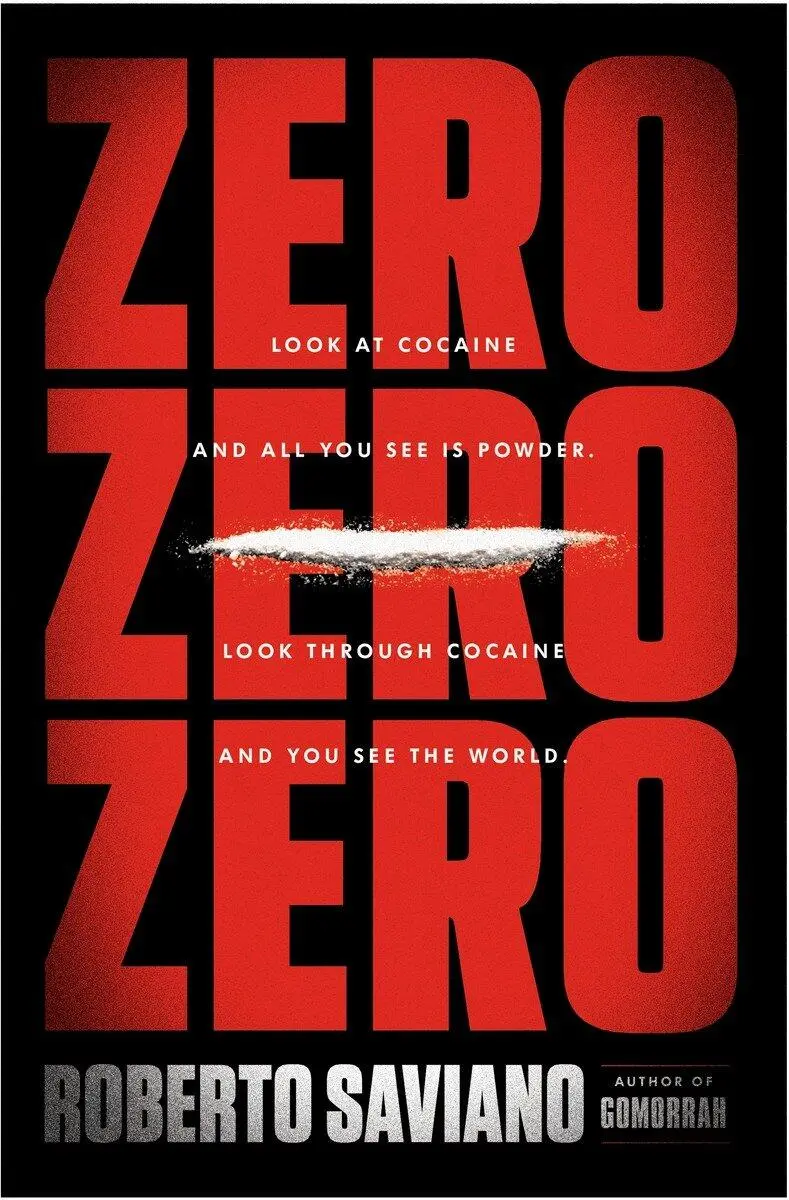
Roberto Saviano - ZeroZeroZero
Здесь есть возможность читать онлайн «Roberto Saviano - ZeroZeroZero» весь текст электронной книги совершенно бесплатно (целиком полную версию без сокращений). В некоторых случаях можно слушать аудио, скачать через торрент в формате fb2 и присутствует краткое содержание. Год выпуска: 2015, Издательство: Penguin Publishing Group, Жанр: Публицистика, Криминальный детектив, на английском языке. Описание произведения, (предисловие) а так же отзывы посетителей доступны на портале библиотеки ЛибКат.
- Название:ZeroZeroZero
- Автор:
- Издательство:Penguin Publishing Group
- Жанр:
- Год:2015
- ISBN:нет данных
- Рейтинг книги:5 / 5. Голосов: 1
-
Избранное:Добавить в избранное
- Отзывы:
-
Ваша оценка:
ZeroZeroZero: краткое содержание, описание и аннотация
Предлагаем к чтению аннотацию, описание, краткое содержание или предисловие (зависит от того, что написал сам автор книги «ZeroZeroZero»). Если вы не нашли необходимую информацию о книге — напишите в комментариях, мы постараемся отыскать её.
Saviano’s
, his explosive account of the Neapolitan mob, the Camorra, was a worldwide publishing sensation. It struck such a nerve with the Camorra that Saviano has lived with twenty-four hour police protection in the shadow of death threats for more than seven years. During this time he has become intimate with law enforcement agencies around the world. Saviano has broadened his perspective to take in the entire global corporate” entity that is the drug trade in cooperation with law enforcement officials, who have fed him information and sources and used him to guide their own thinking and tactics. Saviano has used this extraordinary access to feed his own groundbreaking reportage.
The result is a truly amazing and harrowing synthesis of intimate literary narrative and geopolitical analysis of one of the most powerful dark forces in the global economy. In
, Saviano tracks the shift in the cocaine trade’s axis of power, from Colombia to Mexico, and relates how the Latin American cartels and gangs have forged alliances, first with the Italian crime syndicates, then with the Russians, Africans, and others. On the one hand, he charts an astonishing increase in sophistication and diversification as these criminal entities diversify into many other products and markets. On the other, he reveals the threat of violence to protect and extend power and how the nature of the violence has grown steadily more appalling.
Saviano is a journalist of rare courage and a thinker of impressive intellectual depth and moral imagination, able to see the connections between far-flung phenomena and bind them into a single epic story. Most drug-war narratives feel safely removed from our own lives; Saviano offers no such comfort. As heart racing as it is heady,
is a fusion of a variety of disparate genres into a brilliant new form that can only be called
.
ZeroZeroZero — читать онлайн бесплатно полную книгу (весь текст) целиком
Ниже представлен текст книги, разбитый по страницам. Система сохранения места последней прочитанной страницы, позволяет с удобством читать онлайн бесплатно книгу «ZeroZeroZero», без необходимости каждый раз заново искать на чём Вы остановились. Поставьте закладку, и сможете в любой момент перейти на страницу, на которой закончили чтение.
Интервал:
Закладка:
Osiel met a girl at the maquiladora —smart, with pearls for eyes — but Osiel was ashamed whenever he asked her out, because he couldn’t afford a car to go pick her up, or dinner in even a modest restaurant. He started dealing. Quick, profitable, risky enough to provide an adrenaline high. For pushers just starting out, whoever is the most unscrupulous usually takes the lead. Cruelty is essential; without it you might appear weak, and your adversaries will take advantage of you. It’s like with dogs: Whichever one growls the loudest becomes the head of the pack.
He was arrested for the first time in 1989, when he was twenty-one, for homicide, but the charge didn’t stick. When he was twenty-five he was arrested in Brownsville, Texas, and accused of drug trafficking; he was in possession of 2 kilos of cocaine. Sentenced to five years in prison, he got lucky again; thanks to a prisoner exchange between Mexico and the United States, he was sent back to his own country. In 1995, after just one year behind bars, Osiel was free again.
Great criminal leaders often have in common the desire to create an aura for themselves, the desire to enchant, seduce. It matters little whether the objective is a woman to bed or a rival dealer to eliminate by convincing your accomplices that the bastard has it coming to him. Once you find the right opening, the way to a person’s will, you’ve won. Osiel knew he could cut off hands, threaten family members, or burn down warehouses, but he also knew that the fastest way to get what he wanted was to touch the right chord. Those who didn’t fear him adored him. Acting as a madrina , or informer, Osiel infiltrated the Federal Judicial Police, gradually acquiring the protection that allowed him to move about freely. Now he could control both fronts and network with the Gulf cartel men in the meantime. He knew Salvador Gómez Herrera, alias El Chava, who became the Gulf cartel leader after Juan García Ábrego was arrested. El Chava too told Osiel the story of El Padrino raising his glass to toast Ábrego’s receiving the Matamoros corridor.
In the second half of the 1990s the Gulf cartel faced a war of succession. Plenty of people were ready to write off the organization that only a few years earlier — after El Padrino’s arrest and after the Golden Age of García Ábrego as leader — had been one of Mexico’s most powerful cartels. But now it had the police on its back, as well as the FBI and rival cartels. Founded in the 1970s by a man with the high-sounding name of Juan Nepomuceno Guerra, who had smuggled alcohol into the United States during Prohibition, the cartel’s days now seemed numbered. The new leaders fell one by one. García Ábrego fell, arrested by the Mexican authorities and then extradited to the United States, where he is serving eleven life sentences. García Ábrego’s brother Humberto failed: too weak. Sergio “El Checo” Gómez fell, betrayed by a conspiracy orchestrated by his partners and his bodyguards. Óscar Malherbe de León fell, arrested immediately after he took command. Hugo Baldomero Medina Garza, the Lord of the Trailers, fell too: His arrest put a stop to the tons of cocaine he’d been shipping to the United States every month, hidden in crates of vegetables or bags of seafood. The police celebrated, but in the meantime, El Chava and Osiel became friends and accomplices. They seemed inseparable, helped each other out, and amassed power and money. Not enough, though, at least for Osiel. You can’t wield power as part of a pair, as he’d always say to whoever insisted on pulling out that El Padrino story: “If you can have the whole world, why be satisfied with just a piece?” And so, after they were arrested together, and after they bribed the prison guards to escape, Osiel killed El Chava. On that day in 1998 he obtained two things: absolute control of the Gulf cartel and a nickname, El Mata Amigos, or Friend Killer.
You’re someone who kills your friends. If you don’t have any ties, what is there to fear? If you’re bright, you have a radiant future ahead of you. El Mata Amigos restructured the organization and brought it into the twenty-first century. Protection was guaranteed through bribes. Even the Twenty-first Motorized Cavalry Regiment of Nuevo Laredo was in his pay. It was good theater: The authorities would receive a report that a shipment of cocaine was hidden in the warehouses of an abandoned factory on the edge of the desert. They’d rush to the site in force, followed by a host of obliging journalists: a rapid, bloodless raid, no one there, just some white powder. But never an arrest. Photos, handshakes, smiles. A good, clean job.
Meanwhile, the frontier between Mexico and the United States was being violated day after day, hour after hour. But other organizations also wanted the sinuous tongue of Tamaulipas, which licks America’s ass it is said, and they declared war on the Gulf cartel. The Valencia brothers, together with the Tijuana cartel, Vicente Carrillo Fuentes’s Juárez cartel, and even Los Negros, the death squad in the service of Sinaloa — they all challenged the Gulf cartel. A real war. Cities such as Nuevo Laredo, Reynosa, and Matamoros became battlegrounds. There wasn’t an hour day or night when executions and kidnappings weren’t taking place; it wasn’t unusual to find bodies on the street, hacked to pieces and stuffed into plastic bags.
The escalation of violence and deaths increased national and international pressure for the capture of Osiel Cárdenas Guillén. He was finally arrested and four years later was extradited to the United States. The cartel subsequently decentralized, with two drug lords sharing control: Osiel’s brother Antonio Ezequiel Cárdenas Guillén, alias Tony Tormenta (killed by the Mexican army in Matamoros on November 5, 2010), and Jorge Eduardo Costilla Sánchez, alias El Coss (arrested by the Mexican navy in Tampico on September 12, 2012), leaders who proved unable to put an end to the internal feuds devouring the cartel. And soon enough, once their suns had set, it was Mario Armando Ramírez Treviño’s turn. But Mario, known as El Pelón, Baldy, or X20, was arrested in Reynosa on August 17, 2013. So now who? The DEA bet on one of three men: Luis Alberto Trinidad Cerón, known as El Guicho, Juan Francisco Carrizales, known as El 98, and Juan Alberto de la Cruz Álvarez, known as El Juanillo. But there would also be room for another of Osiel’s brothers, Homero Cárdenas Guillén, known as El Majadero, or Stupid. Some say he sits atop the Gulf command structure; others say he died of a heart attack in March 2014.
Today the Gulf cartel continues to take advantage of its proximity to the U.S. border. It is an efficient money-making machine, using an unbelievable variety of means to transport cocaine north, including underground tunnels, which are also used for human trafficking. These humans are the new drug mailmen: In exchange for the mirage of a new life beyond the border, they carry up to half a million dollars of drugs on them. Or they use the buses on I-35, which goes from the border city of Laredo, Texas, all the way to Minnesota, or I-25, which you can pick up twenty-five miles from El Paso, Texas, and take all the way to Wyoming. Buses are the perfect mode of transport for narcos, because they’re not usually X-rayed. But the Gulf cartel doesn’t disdain more creative options either, such as trains or submarines: fast, safe, and capable of carrying astronomical quantities of cocaine.
• • •
“In the heart of every man is a desperate desire for a battle to fight, an adventure to live, and a beauty to rescue.” Nazario Moreno González, one of the most powerful bosses of The Michoacán Family, often quoted these words, by writer and Christian activist John Eldredge. Moreno González preached the divine right to eliminate his enemies and was never without his “bible” of teachings. “It is better to die fighting face to face than to live your whole life humiliated and on your knees,” Moreno wrote, taking his cue from the sayings of the Mexican revolutionary Emiliano Zapata.
Читать дальшеИнтервал:
Закладка:
Похожие книги на «ZeroZeroZero»
Представляем Вашему вниманию похожие книги на «ZeroZeroZero» списком для выбора. Мы отобрали схожую по названию и смыслу литературу в надежде предоставить читателям больше вариантов отыскать новые, интересные, ещё непрочитанные произведения.



Обсуждение, отзывы о книге «ZeroZeroZero» и просто собственные мнения читателей. Оставьте ваши комментарии, напишите, что Вы думаете о произведении, его смысле или главных героях. Укажите что конкретно понравилось, а что нет, и почему Вы так считаете.