Robert Leckie - Strong Men Armed
Здесь есть возможность читать онлайн «Robert Leckie - Strong Men Armed» весь текст электронной книги совершенно бесплатно (целиком полную версию без сокращений). В некоторых случаях можно слушать аудио, скачать через торрент в формате fb2 и присутствует краткое содержание. Город: Cambridge, Год выпуска: 2010, ISBN: 2010, Издательство: Da Capo Press, Жанр: nonf_military, на английском языке. Описание произведения, (предисловие) а так же отзывы посетителей доступны на портале библиотеки ЛибКат.
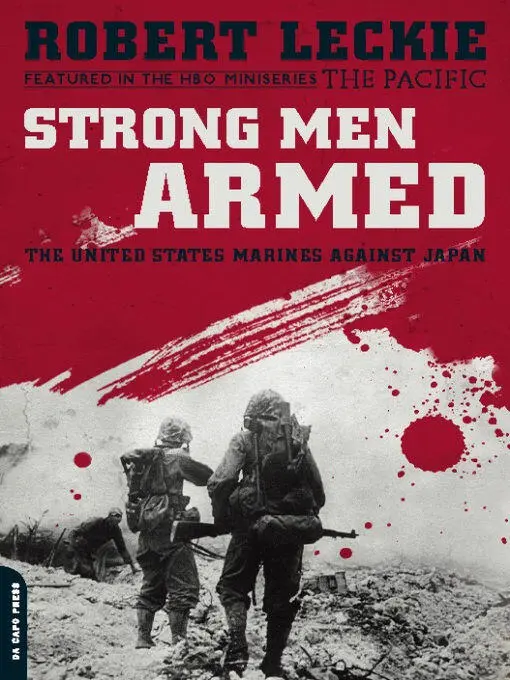
- Название:Strong Men Armed
- Автор:
- Издательство:Da Capo Press
- Жанр:
- Год:2010
- Город:Cambridge
- ISBN:978-0-786-74832-7
- Рейтинг книги:3 / 5. Голосов: 1
-
Избранное:Добавить в избранное
- Отзывы:
-
Ваша оценка:
Strong Men Armed: краткое содержание, описание и аннотация
Предлагаем к чтению аннотацию, описание, краткое содержание или предисловие (зависит от того, что написал сам автор книги «Strong Men Armed»). Если вы не нашли необходимую информацию о книге — напишите в комментариях, мы постараемся отыскать её.
Strong Men Armed — читать онлайн бесплатно полную книгу (весь текст) целиком
Ниже представлен текст книги, разбитый по страницам. Система сохранения места последней прочитанной страницы, позволяет с удобством читать онлайн бесплатно книгу «Strong Men Armed», без необходимости каждый раз заново искать на чём Вы остановились. Поставьте закладку, и сможете в любой момент перейти на страницу, на которой закончили чтение.
Интервал:
Закладка:
A submarine surfaced and it had a big red ball painted on it and in the dimness of dusk Boyington could see the conningtower hatch pop open and disgorge a dozen short men with odd flat hats. Boyington was brought aboard. His wounds were not treated, but he was offered tea and cookies and given cigarettes. A pharmacist’s mate who spoke English said to him: “You don’t have to worry about anything as long as you are on this boat.”
An hour later the sub docked at Rabaul and Boyington was led ashore tied and blindfolded.

It was dark on the Japanese side of Suicide Creek.
Corporal Caldwell and Pfc. Raschke found it hard to see as they crawled down the creek in search of Lieutenant Atkins. They had been given permission to return for their wounded platoon leader, and had brought two riflemen with them for fire cover. They came to the bank where they had last seen “Tommy Harvard” and crawled up it into the underbrush.
They could hear only the rushing of the river and the muttering of the Japanese. Should they go back or should they risk calling out? Caldwell and the riflemen lay in the bushes with covering rifles while Raschke slithered out on the edge of the bank and began calling softly:
“Tommy Harvard… Tommy Harvard…”
A voice came weakly: “I’m down here.”
Raschke stiffened. It could be a Japanese trick. He called out again.
“What’s your real name?”
The voice gasped, “Elisha Atkins.”
The Marines slid cautiously down the bank. They found Atkins shaking from hours of immersion in the water, weak from the loss of blood. They lifted him up gently and carried him back to their lines.
“God!” Lieutenant Atkins whispered hoarsely. “Am I glad to see you.”
22
Aogiri Ridge?
Could there be such a place? There wasn’t anything with that name on the map. Even the Melanesians now returning from their mountain hideouts had never heard of it. Nor could you trust them. They were so happy to see the Americans—for the Japanese had latterly treated them wretchedly—that they would smile and bob their heads and say “Yes” to any point fingered out on the map.
Obviously there was such a place, for the message taken from that dead Japanese warrant officer’s pocket mentioned it twice, emphasizing its importance, and the documents found in the pack of the deceased Lieutenant Abe indicated that there was at least a full regiment back there somewhere. Also, when the tanks rolled over Suicide Creek on the morning of January 4, they found that the enemy had retreated.
So there should be quite a hatful of Japanese to the southeast, probably around Hill 660.
Was Hill 660 Aogiri Ridge? No. Corporal Shigeto said Hill 660 was called Manju Yama, meaning Sweet Cookie Hill. Maybe it was Hill 150 just to the south of Target Hill. A rough sketch on the message made it look that way, and so the attacking Marine battalions were sent against Hill 150. They took it and found that it was probably not Aogiri Ridge at all.
The attack southeastward continued, with Brigadier General Shepherd still anxious to locate this Aogiri Ridge.
The terrain still favored the Japanese. As the Marine battalions swung like a gate southeastward to Borgen Bay, they plunged into another swamp. The Seventeenth Marines again built corduroy roads and knocked down riverbanks to get the tanks into bitterly-resisting Japanese pockets. At noon on January 7, as the right flank swung through an area 1,000 yards diagonally southwest of Target Hill, Lieutenant Colonel David McDougal of the Third Battalion, Fifth, was wounded. Five hours later his executive officer, Major Joseph Skoczylas, was also hit. Lieutenant Colonel Chesty Puller, still commanding the Third Battalion, Seventh, took over both outfits. Next morning Puller turned the other battalion over to a tall, brawny, square-faced lieutenant colonel with the fanciful name of Silent Lew Walt.
As Walt’s men pressed the attack that morning of January 8 they felt the ground rising gently beneath a tangle of vines and creepers. It seemed drier. Though the map insisted they were on level ground, they were in fact beginning to climb steep slopes. They were being swept by interlocking small-arms fire. They did not know it then, but they had found Aogiri Ridge. Nor did they know that there were 37 bunkers ahead, most of them connected by underground tunnels. If one bunker fell and the Marines moved on, it would suddenly erupt again behind them. Walt’s men took heavy casualties, and General Shepherd had to rush two reinforcing companies up to Aogiri Ridge. The Marines did not take Aogiri Ridge or even dent it that day. They fell back to their morning positions and dug in.
At dawn of January 9 Walt’s men struck out in straight frontal attack again. They couldn’t flank the position because its guns could rake either side. They couldn’t bypass it, for it would cut Marine communications. They had to strike straight ahead, staggering with fatigue, moving through jungle so thick they could not see 10 yards ahead of them, and all the while being struck by an invisible foe. They faltered, and Walt called for a 37-millimeter cannon.
The goo-pound gun was trundled forward.
“All right,” Walt shouted, as he and his runner put their stooping shoulders to one of the wheels. “Who’ll give me a hand?”
There was no response, but then Walt tore at the gun with such savage fury that his men leaped in beside him. They pushed the cannon up the steep slope, stopping to fire cannister shot, blasting apart the jungle and clearing a path through the bunkers. Men were killed or wounded but others rushed in to take their place. Up, up it went, bumping and volleying and at last it was atop the ridge, and the hail of its cannister was sweeping among the enemy like shotgun pellets.
The Marines had a hold on Aogiri Ridge.
The Japanese in Rabaul led Major Boyington by rope halter to a hut half a mile from the dock. There they questioned him for twenty-four hours. When he balked, they twisted the ropes around his wrists until he was about to lose consciousness; then they loosened the rope and continued. They did not treat his wounds for ten days. They preferred to punch him in the jaw and beat his legs with rifle butts. They beat him regularly during the six weeks in which they held him prisoner there, for they did not like the American major who had taunted them so derisively, nor did they like the terrible things his comrades were doing to their once-mighty base. Already there was a new light-bomber strip being completed on Bougainville, and Rabaul had only six more weeks to live.
Colonel Katayama had decided to use his last reserve battalion to knock the Americans off Aogiri. It was the 3rd Battalion, 141st, commanded by Major Asachichi Tatsumi. During the darkness succeeding the Marines’ conquest of the ridge-top, these men of Major Tatsumi had been gathering on Aogiri’s reverse slope. Around midnight of that January 9 they began to chant:
“Marines prepare to die, Marines prepare to die.”
At a quarter past one in the morning of January 10 they rushed up the slope screaming and howling, but were swiftly cut down by the Marines who had seized upon the chanting to get ready in the right place. The shattered waves flowed back down the slope and came up again. Once more they were hurled back.
In his foxhole Silent Lew Walt was calling 105-millimeter fire in closer and closer to his lines. He cut through the objections of the artillery officers in the fire-direction centers and called for shells as close as 50 yards to his own men, for the Japanese were obviously under orders to retake Aogiri or die.
A third wave came up and was stopped.
Читать дальшеИнтервал:
Закладка:
Похожие книги на «Strong Men Armed»
Представляем Вашему вниманию похожие книги на «Strong Men Armed» списком для выбора. Мы отобрали схожую по названию и смыслу литературу в надежде предоставить читателям больше вариантов отыскать новые, интересные, ещё непрочитанные произведения.










Обсуждение, отзывы о книге «Strong Men Armed» и просто собственные мнения читателей. Оставьте ваши комментарии, напишите, что Вы думаете о произведении, его смысле или главных героях. Укажите что конкретно понравилось, а что нет, и почему Вы так считаете.