Robert Leckie - Strong Men Armed
Здесь есть возможность читать онлайн «Robert Leckie - Strong Men Armed» весь текст электронной книги совершенно бесплатно (целиком полную версию без сокращений). В некоторых случаях можно слушать аудио, скачать через торрент в формате fb2 и присутствует краткое содержание. Город: Cambridge, Год выпуска: 2010, ISBN: 2010, Издательство: Da Capo Press, Жанр: nonf_military, на английском языке. Описание произведения, (предисловие) а так же отзывы посетителей доступны на портале библиотеки ЛибКат.
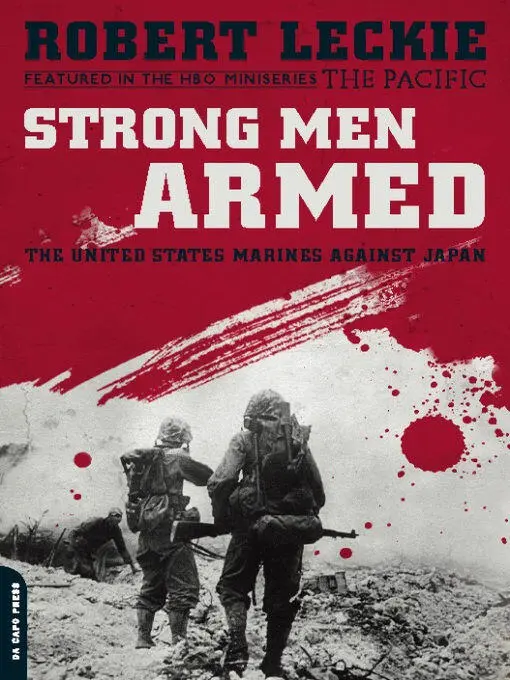
- Название:Strong Men Armed
- Автор:
- Издательство:Da Capo Press
- Жанр:
- Год:2010
- Город:Cambridge
- ISBN:978-0-786-74832-7
- Рейтинг книги:3 / 5. Голосов: 1
-
Избранное:Добавить в избранное
- Отзывы:
-
Ваша оценка:
Strong Men Armed: краткое содержание, описание и аннотация
Предлагаем к чтению аннотацию, описание, краткое содержание или предисловие (зависит от того, что написал сам автор книги «Strong Men Armed»). Если вы не нашли необходимую информацию о книге — напишите в комментариях, мы постараемся отыскать её.
Strong Men Armed — читать онлайн бесплатно полную книгу (весь текст) целиком
Ниже представлен текст книги, разбитый по страницам. Система сохранения места последней прочитанной страницы, позволяет с удобством читать онлайн бесплатно книгу «Strong Men Armed», без необходимости каждый раз заново искать на чём Вы остановились. Поставьте закладку, и сможете в любой момент перейти на страницу, на которой закончили чтение.
Интервал:
Закладка:
The next morning, January 14, Buse sent companies around to the right or west of Hill 660, to its inland side. He was probing for a soft spot. His men could never go up that front slope without terrible casualties. Almost to the rear of Hill 660, separated from Captain Buckley by a swamp, the Marines found their soft spot. It was lightly guarded because it was so steep. The Japanese did not think anyone could come up it.
Buse ordered his men up and they went up. They went up in a sudden burst of energy and valor as mystifying as it was marvelous. They clawed up that vertical face of gummy clay and came in on the startled enemy and put him to death among his guns. Those who fled down the hill ran the roaring gantlet of Captain Buckley’s men. Those who counterattacked a day later were torn apart in a march and countermarch of mortar shells. And those who survived this slaughter perished in sea or swamp to either side of Buckley’s guns, one whole group of them cut down in a daisy chain as they crossed a creek holding hands.
Hill 660 had fallen. Its price had not been high in blood but in hardship, in the ordeal written on the faces of the men who took it and were at last being relieved after twenty-three days in the swamp. They were all dripping hair and smeared red-brown with soil. Mud-stained ponchos or Japanese raincoats hooded their heads against the rain and they walked woodenly, staring straight ahead while mechanically spooning mouthfuls of cold beans from the little ration cans in their hands.
The last of Colonel Katayama’s forces in Borgen Bay had been shattered and the colonel had himself gone back to Nakarop-Egaroppu, where General Matsuda was already preparing his getaway. The fighting at Borgen Bay had been as decisive a victory for the First Marine Division as the battle for Cape Gloucester Airfield.
24
Conquest of the Gilbert Islands in November of 1943 had caused the first break in the outerworks of Fortress Nippon. Now, in February of 1944, seizure of the Marshall Islands would start the breakthrough.
The Marshalls sat athwart the Central Pacific about 400 miles north and 650 miles west of Tarawa in the Gilberts. They guarded all the routes to Tokyo. Directly west or behind them lay the Carolines with the monster air-sea base at Truk and the ocean fort of Peleliu. South and west of them lay General MacArthur’s Bismarcks-New Guinea route to the Philippines. North and west of them lay the Marianas with Guam and Saipan, the Volcanos with Iwo Jima, and the Bonins.
Japan by now had no real hope of holding the Marshalls. Even though Premier Tojo still expected to wear down the American will to fight, he planned to do it by delaying in the Marshalls while strengthening the inner ring of defenses—especially at Peleliu, the Marianas and the Bonins.
The Marshalls were admirably suited to delaying action because there were so many of them. There were 36 true atolls —with perhaps 2,000 islets and islands—in this enormous chain running 650 miles on a northwest-southeast diagonal. They had been in Japan’s possession since they were seized from Germany in World War One, when Japan was on the side of the Allies and also acquiring such easy German booty as the Marianas, but Japan had not bothered to fortify them in any strength until just before the attack on the Gilberts at Makin and Tarawa.
Now there were six atolls on which she had based airfields. These were Eniwetok, Kwajalein, Wotje, Maloelap, Jaluit and Mili. Of these Eniwetok was the farthest west, closest to Japan. Kwajalein was in the center. Wotje and Maloelap were east and north; Jaluit and Mili were east and south. Vice Admiral Musashi Kobayashi, who was in command of the Marshalls, first began fortifying Wotje and Maloelap, but then came Tarawa, and emphasis was shifted to Jaluit and Mili—closest by far to the new American bases south in the Gilberts. Admiral Kobayashi paid little attention to Kwajalein or Eniwetok. They were fortified, of course, but nothing like the eastern atolls, and nothing at all like Tarawa. Kobayashi expected the Americans to attack on the eastern atolls, more likely on Jaluit and Mili.
Admiral Nimitz chose Kwajalein.
He chose it because by knifing right into the heart of the Marshalls he would bypass all those Japanese outposts on the eastern atolls, and he would make Kobayashi’s work there useless. The neutralizing of the bulk of 28,000 troops stationed in the Marshalls could speed up the war by opening both the Central Pacific and Southwest Pacific fronts.
More, Kwajalein Atoll was lightly defended, it had airfields, and its lagoon was the largest in the world. It was 65 miles in length and 18 miles in width within an atoll chain forming a shape best described as a flattened pyramid canted on its right-hand base. Its terminals were Ebadon Islet on the west, the twin islets of Roi-Namur about 40 miles to the east, and then Kwajalein Islet about 45 miles south of Roi-Namur and a bit to the east.
Nimitz was concerned only with Kwajalein Islet in the south, where a bomber field was under construction, and Roi-Namur in the north, where there was an excellent air base.
But Nimitz’ commanders—Admirals Raymond Spruance and Kelly Turner, General Howlin’ Mad Smith—were concerned about the risks of an operation against Kwajalein.
It could be taken, but afterwards the vast Pacific Fleet which had brought the assault forces to Kwajalein was going to be turned over to Admiral Halsey to cover General MacArthur’s proposed landing on New Ireland in the Southwest Pacific. The fleet’s withdrawal would leave the men on Kwajalein alone and at the mercy of a ring of hostile airfields, especially Eniwetok with its lines running directly back to Japan. Neither Spruance nor Turner nor Smith wanted to take on Kwajalein without first nailing down some or all of those airfield atolls in the east.
It was then that Admiral Nimitz took a long look at Majuro Atoll nestling almost exactly in the center of that quartet of outer bastions. It was then that Captain Jim Jones took his Recon Boys up to Majuro by destroyer while the greatest invasion fleet yet assembled waited for word of what he found there.
25
Mr. Michael Madison said, “Perhaps you gentlemen would like a drink?” and the Recon Boys of Captain James Logan Jones blinked and wondered if they were back on Apamama.
Though they were not—though they were on Majuro Atoll in the Marshall Islands—it was certainly true that one of this tall half-caste’s daughters had just shinnied up a coconut tree and had slid back down grasping a blue saki bottle filled with palm toddy. Now she was going up again for more and it looked like Majuro might be better than Apamama.
It was not this for which Lieutenant Harvey Weeks had led a platoon ashore on Majuro’s Calalin Islet, for which Lieutenant Leo Shinn had led the point of the platoon in its reconnaissance across the islet. They had come as the scouts of the big invasion force which was to arrive nine hours later. They had left Captain Jones back aboard their destroyer, inflated their rubber boats and passed through the same ordeal of confusion, surf and wind which had nearly swamped them off Apamama. They had talked to the Micronesians and found that there was only a Japanese warrant officer left on the island. That had been on the night of January 30.
Now it was the dawn of January 31 and here was Mr. Michael Madison offering glasses and palm toddy. Actually it was a moment worthy of celebration. The landing on Calalin at eleven o’clock the preceding night represented the first American invasion of soil which Japan had held prior to World War Two, and that “invasion” was made a “conquest” a little later when a Warrant Officer Nagata was surprised and captured.
Nagata said that the 300 to 400 Japanese who once garrisoned the island had been evacuated long ago. This piece of good news was relayed to Captain Jones. After some delays, Jones was able to message Admiral Hill to call off the bombardment of Majuro which had already begun. Luckily only a few shells had fallen, and most of Majuro’s valuable installations were unharmed. The 2nd Battalion, 106th Infantry, of the Army’s 27th Division could now come ashore unopposed, the work on the first of several airstrips could commence, Majuro Lagoon could be made into an anchorage—and Admiral Chester Nimitz could go ahead with the Marshall Islands conquest which had depended so much on the seizure of Majuro.
Читать дальшеИнтервал:
Закладка:
Похожие книги на «Strong Men Armed»
Представляем Вашему вниманию похожие книги на «Strong Men Armed» списком для выбора. Мы отобрали схожую по названию и смыслу литературу в надежде предоставить читателям больше вариантов отыскать новые, интересные, ещё непрочитанные произведения.









Обсуждение, отзывы о книге «Strong Men Armed» и просто собственные мнения читателей. Оставьте ваши комментарии, напишите, что Вы думаете о произведении, его смысле или главных героях. Укажите что конкретно понравилось, а что нет, и почему Вы так считаете.