Robert Leckie - Strong Men Armed
Здесь есть возможность читать онлайн «Robert Leckie - Strong Men Armed» весь текст электронной книги совершенно бесплатно (целиком полную версию без сокращений). В некоторых случаях можно слушать аудио, скачать через торрент в формате fb2 и присутствует краткое содержание. Город: Cambridge, Год выпуска: 2010, ISBN: 2010, Издательство: Da Capo Press, Жанр: nonf_military, на английском языке. Описание произведения, (предисловие) а так же отзывы посетителей доступны на портале библиотеки ЛибКат.
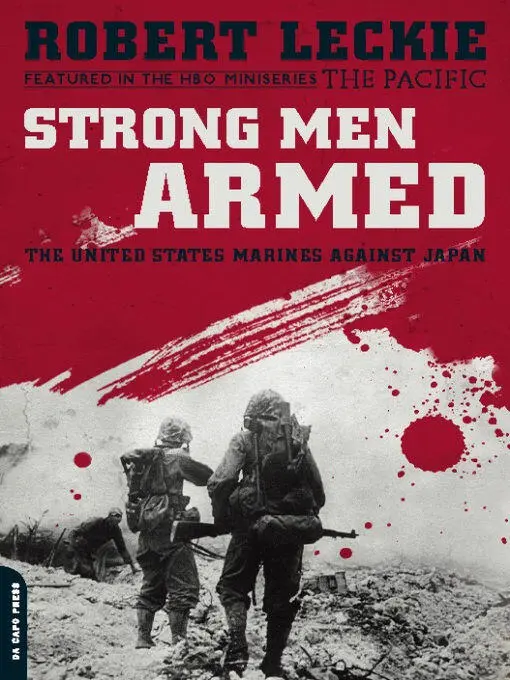
- Название:Strong Men Armed
- Автор:
- Издательство:Da Capo Press
- Жанр:
- Год:2010
- Город:Cambridge
- ISBN:978-0-786-74832-7
- Рейтинг книги:3 / 5. Голосов: 1
-
Избранное:Добавить в избранное
- Отзывы:
-
Ваша оценка:
Strong Men Armed: краткое содержание, описание и аннотация
Предлагаем к чтению аннотацию, описание, краткое содержание или предисловие (зависит от того, что написал сам автор книги «Strong Men Armed»). Если вы не нашли необходимую информацию о книге — напишите в комментариях, мы постараемся отыскать её.
Strong Men Armed — читать онлайн бесплатно полную книгу (весь текст) целиком
Ниже представлен текст книги, разбитый по страницам. Система сохранения места последней прочитанной страницы, позволяет с удобством читать онлайн бесплатно книгу «Strong Men Armed», без необходимости каждый раз заново искать на чём Вы остановились. Поставьте закладку, и сможете в любой момент перейти на страницу, на которой закончили чтение.
Интервал:
Закладка:
But even as intelligence officers arrived on the battlefield—angrily shooing the souvenir-hunters away—the clamor of battle had shifted back to Suicide Creek.

Dawn at Suicide Creek burst from the Japanese mortars. Before the Marines could leap erect to continue the attack on the morning of January 3, the shells were flashing and roaring among them. One young rifleman was decapitated by the direct blast of an exploding shell. Men going forward looked at that sitting headless figure with just the neck from which dog-tags dangled and wondered who it might have been.
They went across Suicide Creek, small unit by small unit, sometimes finding and knocking out an enemy gun, but always being thrown back again.
One Marine lay behind a log, firing. “It don’t do no good,” he muttered, his face ashen. “I got three of ‘em, but it don’t do no good.”
Platoon Sergeant Casimir Polakowski shouted at him angrily: “What the hell you bitchin’ about? You get paid for it, don’t you?”
The shocked Marine managed a weak grin and continued to fire. Polakowski arose to take his platoon across the creek to rescue another one trapped over there. He saw three of his men killed in rapid succession, returned, ran to rescue a wounded Marine being shot at by a sniper—and was shot in the back.
Lieutenant Elisha Atkins led his platoon of heavy machine-gunners across the water. The enemy gunners allowed half of them to cross, and then the converging fire of six automatic weapons made a screaming, bleeding hell of the others. Some men lay in the water, not daring to move, not even daring to rescue others who lay across trees in full view of the enemy, who called helplessly, over and over, whose blood flowed into the faces of those who dared not move to help them.
Across the bank Lieutenant Atkins lay in a tangle of vines. He had been hit three times and was losing blood fast. Pfc. Luther Raschke found him. He cut him free and tried to drag him back across the creek, but “Tommy Harvard,” as the men called Atkins, refused to go.
“Go on,” he gasped. “Keep the line moving. Get the men out.”
Raschke and Corporal Alexander Caldwell obeyed. They got back in time to hear that the engineers of the Seventeenth Marines had laid a corduroy road of logs through the swamp which Major Takabe considered impassable.
At last there were tanks coming up to Suicide Creek.
At last there were Corsairs coming up to Rabaul, coming up to one of those wild aerial battles the Marines called “a big hairy dogfight.”
Since the December 27 fighter-sweep in which Pappy Boyington had shot down his twenty-fifth plane, there had been no attacks on the dying Japanese base on eastern New Britain. It had rained constantly, while Boyington alternated between badgering others and being badgered. He had but a few days to go on his third and final tour in the Pacific. He hounded meteorological people for the latest word on the weather, and was hounded by war correspondents for the latest word on when he was going to break Foss’s record.
On the night of January 2 came reports of clearing weather at last. At dawn of the next day, while Japanese mortars scourged the Marines at Suicide Creek, Pappy Boyington fire-balled his splay-legged fighter down the Torokina strip and circled aloft while his Black Sheep climbed to join him. They pushed the stick forward and roared north.
Over Rabaul 40 to 60 fighters rose to meet them. When they had reached 12,000 feet, Boyington told his fighters to get set. He looked around him.
“Okay,” he shouted, “let’s get the bastards!”
They went nosing over.
Boyington went down. Captain George Ashmun followed on his tail. They pounced on a pair of Zeros flying at 15,000 feet. Boyington made an overhead run on one of them. From 400 yards away he fired a short burst. The Zero burst into flames.
“You got a flamer, Skipper!” Ashmun yelled, and Boyington grinned in his cockpit. He had shot down as many enemy planes as any other American.
Boyington climbed, Ashmun riding his wing. Again they saw Zeros below. Again they went over, thinking the rest of the Black Sheep were diving after them. They scissored over the Japanese, weaving back and forth over one another, firing short bursts.
Two of the slender, brown, red-balled sausages flamed and fell, but Boyington did not grin this time, for Ashmun’s plane was puffing smoke and his wingman was going down in a long graded dive. Behind him came a dozen Zeros converging for the kill.
“Dive, George!” Boyington screamed. “For God’s sake, dive!”
There was not so much as a waggled aileron in reply, and the Zeros were taking turns at tail passes.
Boyington slammed in behind them, kicking the rudder back and forth, triggering short bursts. Ashmun’s Corsair was now a fiery meteor and was dropping into the sea. But there was another Zero in flames too, Pappy Boyington’s twenty-eighth kill—and also his last.
For there was now a pack of Zeros growling on his tail. Boyington threw the stick forward and raced over the ocean at 400 knots. He could see the enemy bullets stitching patterns in his wings. His main gas tank blew up.
It was all over.
Boyington felt as though his body had been hurled into a blast furnace. With his remaining strength he released his safety belt with one hand, seized the rip-cord ring with the other, and kicked the stick hard forward with both feet. He had given his body centrifugal force, made it weigh a ton, and he went flying out the top of his plane. He was only a hundred feet above the water when his chute opened with a spine-snapping jerk, and though he slammed the water hard he was alive and treading water when he surfaced.
The Japanese tried to gun him to death. They played cat-and-mouse for half an hour, one Zero coming in low and pulling out just as another dove in from a different direction. Twenty-millimeter cannon exploded all around Boyington. He was gagging from the sea water he had swallowed as he had played duck-the-apple for the enemy pilots. After two hours of treading water he reached beneath him for the rubber life raft dangling between his legs. He pulled it out and found that it was intact. He inflated it. He climbed aboard and examined himself. His scalp was dangling down over his eyes. His left ear was half chewed off. His throat was cut and his left ankle torn up. There were shrapnel holes in his hands and his leg ached where it had struck the stabilizer when he was catapulted free. But he was not dismayed. He found himself humming something, and tried to puzzle it out. It was:
If the engine conks out now
We’ll come down from forty thou—
And wind up in a rowboat at Rabaul.
The Sherman tanks lumbering up to Suicide Creek were led by a tunnel-blasting bulldozer driven by Corporal John Capito. Capito began cutting down the 12-foot-high near bank, pushing the earth into the stream to form a causeway. A sniper peppered him and Capito was shot in the teeth. Then the Japanese began raking the bank with small-arms fire. Staff Sergeant Keary Lane crawled forward and jumped into the driver’s seat. He too was shot. Pfc. Randall Johnson crawled up to the bulldozer. He swung it around between him and the enemy. He began running alongside it, working the controls with a shovel and an axe handle as he cut the bank down. There was now a passage, but it was already getting dark and the crossing would have to be made in the morning.
In that fading light Pappy Boyington paddled his rubber boat toward Rabaul and hoped there was no truth to the line, “ ‘Cause they’ll never send a Dumbo way out here.” If there was no rescuing Catalina, there might at least be an American submarine.
Читать дальшеИнтервал:
Закладка:
Похожие книги на «Strong Men Armed»
Представляем Вашему вниманию похожие книги на «Strong Men Armed» списком для выбора. Мы отобрали схожую по названию и смыслу литературу в надежде предоставить читателям больше вариантов отыскать новые, интересные, ещё непрочитанные произведения.






Обсуждение, отзывы о книге «Strong Men Armed» и просто собственные мнения читателей. Оставьте ваши комментарии, напишите, что Вы думаете о произведении, его смысле или главных героях. Укажите что конкретно понравилось, а что нет, и почему Вы так считаете.