Robert Leckie - Strong Men Armed
Здесь есть возможность читать онлайн «Robert Leckie - Strong Men Armed» весь текст электронной книги совершенно бесплатно (целиком полную версию без сокращений). В некоторых случаях можно слушать аудио, скачать через торрент в формате fb2 и присутствует краткое содержание. Город: Cambridge, Год выпуска: 2010, ISBN: 2010, Издательство: Da Capo Press, Жанр: nonf_military, на английском языке. Описание произведения, (предисловие) а так же отзывы посетителей доступны на портале библиотеки ЛибКат.
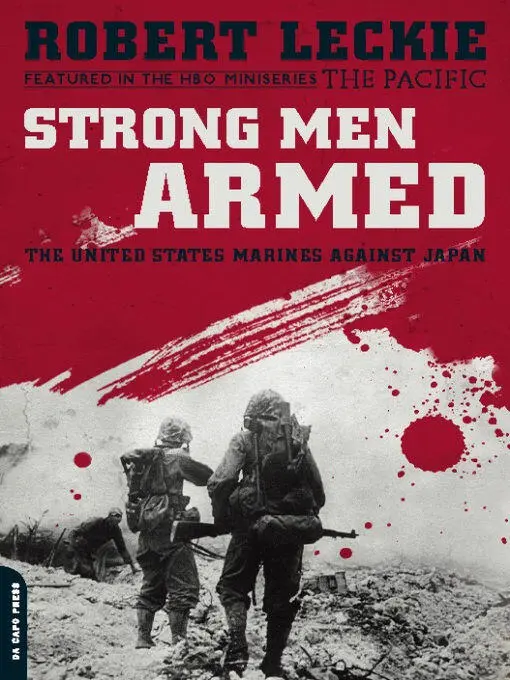
- Название:Strong Men Armed
- Автор:
- Издательство:Da Capo Press
- Жанр:
- Год:2010
- Город:Cambridge
- ISBN:978-0-786-74832-7
- Рейтинг книги:3 / 5. Голосов: 1
-
Избранное:Добавить в избранное
- Отзывы:
-
Ваша оценка:
Strong Men Armed: краткое содержание, описание и аннотация
Предлагаем к чтению аннотацию, описание, краткое содержание или предисловие (зависит от того, что написал сам автор книги «Strong Men Armed»). Если вы не нашли необходимую информацию о книге — напишите в комментариях, мы постараемся отыскать её.
Strong Men Armed — читать онлайн бесплатно полную книгу (весь текст) целиком
Ниже представлен текст книги, разбитый по страницам. Система сохранения места последней прочитанной страницы, позволяет с удобством читать онлайн бесплатно книгу «Strong Men Armed», без необходимости каждый раз заново искать на чём Вы остановились. Поставьте закладку, и сможете в любой момент перейти на страницу, на которой закончили чтение.
Интервал:
Закладка:
The Japanese gunner ran to his gun and pulled the lanyard. The gun roared and the shell struck the tank and exploded. It left a small dent. The astonished Japanese soldier fled, for the tank had lurched forward and was rolling toward him. Now the other tanks came up, flushing the Japanese out of the bunkers into the fire of following riflemen. One of these riflemen struck his foot on an object in the ground. Looking down, he gazed into the agonized eyes of Corporal Kashida Shigeto. The Marine hesitated. He did not know whether to shoot or to kick the Japanese, but he had plenty of time to decide, for Corporal Shigeto was buried up to his neck. His trench had caved in on him a few moments after he had received a painful wound in the shoulder.
Then to Corporal Shigeto’s amazement the Americans began to dig him out. An intelligence officer had arrived just in time to convince the puzzled rifleman that he should neither kill nor kick, that he should in fact be kind. The Marines had learned how kindness could open the lips of Japanese prisoners. Taught to expect torture, Corporal Shigeto was delighted to accept the offer of cheese from a K-ration and an American cigarette. He began to answer questions. His country had not signed the Geneva Convention under which all captured soldiers are to give their name and serial number—and nothing more—nor did Japan tell her soldiers how to act when captured, for surrender was the supreme disgrace. Cave-ins and other forms of accidental surrender were not anticipated, and so the suddenly amiable Corporal Shigeto began to answer his captor’s questions with great fervor and detail.
As a result of what he said, General Rupertus did not press his attack to the airfield. He decided to wait until the Fifth Marines arrived in the morning.
Colonel John Selden led the First and Second Battalions of the Fifth Marines into Cape Gloucester shortly after dawn of December 29, landing at the beach where the First Marines had come in. The Fifth’s men were brought uproad to the airfield by truck. They dismounted and were deployed wide to the left or south of the road. They were to advance on the airfield through the jungled ridges, while the First rolled up the road.
The assault began and quickly picked up momentum. The rain stopped. The sun was shining. The roadbound Marines burst from a wood onto the edge of a field of kunai grass. Beyond it was the airfield.
Artillery shells screeched overhead and crashed in front of them. The tanks rolled forward, their 75’s blasting and machine guns blazing. Riflemen clustered behind them and began moving at a trot. There was the happy barking of a dog. A German shepherd whose Japanese master had fallen at Hell’s Point was running out in front. He had taken the point. He was leading them in, and suddenly the troops were grinning with relief, for there was no one on the airfield to oppose them. Corporal Shigeto’s reports of thousands of men seemed proven false.
But the Japanese prisoner had actually not exaggerated. Colonel Sumiya and his men had abandoned the airfield. They had also withdrawn from a series of ridges directly south of it, and it was past these empty bunkers that the men of the Fifth Marines moved as they came in on the airfield from their jungle march.
During the darkness of that night the Japanese came back to these bunkers, reoccupied them—and turned the guns toward the airfield below.
It had been a dull damp war at Tauali where Masters’ Bastards still sat in roadblock. Patrols moving out from the perimeter ran into occasional brief skirmishes on narrow jungle trails, but then the enemy vanished. Throughout the day of December 29 patrols came in with reports of a silent jungle.
Lieutenant Colonel Masters was worried. That night the men holding his perimeter facing east to the jungle were on full alert. A fierce storm burst on their heads, and at two o’clock the following morning 116 Japanese came charging west down a natural causeway connecting the Marines’ ridges with their own.
They came yelling in what might have been a hurricane, and they came with such swift ferocity that they immediately overran one gunpit.
The Marines counterattacked. Gunnery Sergeant Joe Guiliano cradled a light machine gun in his arms and plunged into the dark melee firing from the hip. The Japanese were thrown out of the pit they had taken, but they came back. Guiliano fired again and led another charge. The fight raged on through the wind-whipped darkness, until, in the morning, it had come to the end usually foreordained when a hundred lightly armed men charge a thousand better-armed men holding the high ground. The Marines, whose losses were six killed and 17 wounded, never found out for sure why this detachment from the 53rd Regiment had launched that charge.
There were no officers among the five men taken prisoner, and everyone else was dead.
Up at the airfield a patrol from the Fifth Marines had run into heavy fire from the “deserted” bunkers in the southern ridges. The regiment prepared to return to the ridges, for the Japanese had to be driven from the high ground if capture of the airfield was to be completed. The Fifth began a series of small nasty actions in which the Marines slugged through muck and fire to clear the hills.
By one o’clock on the afternoon of December 30 Major General Rupertus was able to send this message to Lieutenant General Walter Krueger, the commander of ALAMO Force:
First Marine Division presents to you as an early New Year’s gift the complete airdrome of Cape Gloucester. Situation well in hand due to fighting spirit of troops, the usual Marine luck and the help of God—Rupertus grinning to Krueger.
Next day the American flag went up the pole at Cape Gloucester Airfield—and by the time it reached the top it was already limp and dripping. That same day, General Rupertus did what he could to assuage the grief of an American mother. He ordered Private Paul Hansen sent home never to be returned to combat again.
And back in Melbourne the newspapers celebrated the easy victory with the exulting headlines:
21
Major General William Rupertus began the New Year of 1944 by drawing a perimeter around the airfield and calling upon Brigadier General Lemuel Shepherd, the assistant division commander, to clear out the Japanese holding high ground in the Borgen Bay area.
Borgen Bay was the 10-mile indentation formed by Cape Gloucester on the west and the irregular northern coast jutting out to its east. Along its coast was a series of hills which the Marines wished to hold to guarantee their beachhead.
The eastern flank of this beachhead was represented by Target Hill about six miles southeast of the airfield and about a thousand yards west of the mouth of Borgen Bay. General Shepherd, long considered one of the Marine Corps’s foremost tacticians, sent a force into the jungle at Suicide Creek about a mile northwest of Target Hill. The Marines were to cross the stream and swing like a gate southeast through the Borgen Bay hills. Shepherd’s plan was simply to hold at Target Hill and hit at Suicide Creek.
While Shepherd’s battalions moved into position on the airfield side of Suicide Creek, the Japanese across the stream were building an intricate ambush in a morass. Colonel Kenshiro Katayama, who had arrived from the south coast to take command in Borgen Bay, had conferred with Matsuda at Nakarop, and the swamp fox—who never came within a half-dozen miles of the front—had given him complete control of the battle. It was Katayama who ordered Major Shinichi Takabe to dig in southeast of Suicide Creek with his 2nd Battalion, 53rd.
Katayama had also studied Suicide Creek and Target Hill. He had found that the creek area was impassable for the dreaded American tanks and decided to hold there. Target Hill, however, was open on its seaward side where the coastal road to the airfield ran around it. To recapture the airfield, Katayama decided to hold at Suicide Creek and hit at Target Hill. It was the exact opposite of Shepherd’s plan and the guarantor of battle at both points.
Читать дальшеИнтервал:
Закладка:
Похожие книги на «Strong Men Armed»
Представляем Вашему вниманию похожие книги на «Strong Men Armed» списком для выбора. Мы отобрали схожую по названию и смыслу литературу в надежде предоставить читателям больше вариантов отыскать новые, интересные, ещё непрочитанные произведения.












Обсуждение, отзывы о книге «Strong Men Armed» и просто собственные мнения читателей. Оставьте ваши комментарии, напишите, что Вы думаете о произведении, его смысле или главных героях. Укажите что конкретно понравилось, а что нет, и почему Вы так считаете.