Robert Leckie - Strong Men Armed
Здесь есть возможность читать онлайн «Robert Leckie - Strong Men Armed» весь текст электронной книги совершенно бесплатно (целиком полную версию без сокращений). В некоторых случаях можно слушать аудио, скачать через торрент в формате fb2 и присутствует краткое содержание. Город: Cambridge, Год выпуска: 2010, ISBN: 2010, Издательство: Da Capo Press, Жанр: nonf_military, на английском языке. Описание произведения, (предисловие) а так же отзывы посетителей доступны на портале библиотеки ЛибКат.
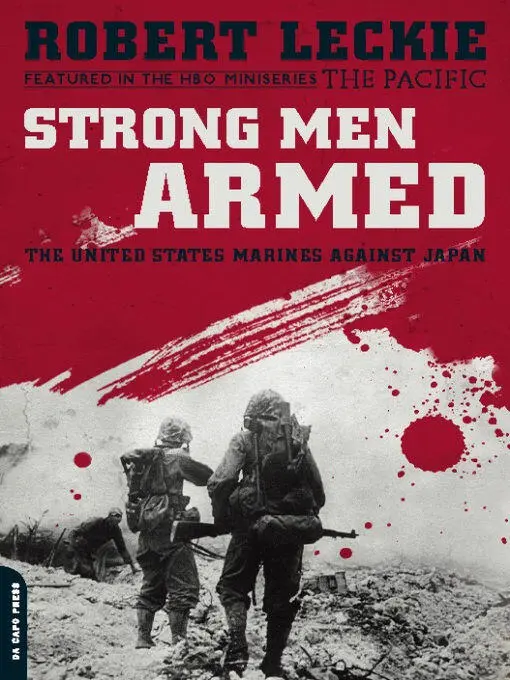
- Название:Strong Men Armed
- Автор:
- Издательство:Da Capo Press
- Жанр:
- Год:2010
- Город:Cambridge
- ISBN:978-0-786-74832-7
- Рейтинг книги:3 / 5. Голосов: 1
-
Избранное:Добавить в избранное
- Отзывы:
-
Ваша оценка:
Strong Men Armed: краткое содержание, описание и аннотация
Предлагаем к чтению аннотацию, описание, краткое содержание или предисловие (зависит от того, что написал сам автор книги «Strong Men Armed»). Если вы не нашли необходимую информацию о книге — напишите в комментариях, мы постараемся отыскать её.
Strong Men Armed — читать онлайн бесплатно полную книгу (весь текст) целиком
Ниже представлен текст книги, разбитый по страницам. Система сохранения места последней прочитанной страницы, позволяет с удобством читать онлайн бесплатно книгу «Strong Men Armed», без необходимости каждый раз заново искать на чём Вы остановились. Поставьте закладку, и сможете в любой момент перейти на страницу, на которой закончили чтение.
Интервал:
Закладка:
Again Boyington hurled his taunts, and again came that polite inquiry:
“Major Boyington, what is your position?”
“Right over your effing airport!” Boyington yelled. “Why don’t you yellow bastards come up and fight?”
“Why don’t you come down, sucker?” the Japanese taunted.
Boyington grinned and led his fighters in a circling, high-low weave designed to confuse the enemy antiaircraft. Still the Japanese refused combat. Boyington and Moe Casey nosed over in a dive. They came in spraying the parked aircraft, always keeping a safe distance from those Japanese machine guns which were so accurate at short range. They climbed back up to 20,000 feet, where the other fighters were stacked.
“All right, you bastards, I was down,” Boyington yelled. “How about you coming up?”
Silence.
Exasperated, his gasoline low, Boyington turned and flew back to Torokina.
There were, he told Major General Mitchell, too many Allied planes out that day. The Japanese liked the odds a bit more in their favor. Seventy-six planes of three different types were also too difficult to handle. If the general would let him take up 36 planes—or at least no more than 48—he’d show him some real results.
Mitchell agreed, but it could not be done until the air strikes had flown to Hellzapoppin’ Ridge.
Three air strikes flew off Torokina on December 18. The foot Marines marked their front lines with colored smoke grenades. They marked the enemy targets by firing white phosphorous mortar shells. And the pilots dropped their bombs. Hellzapoppin’ Ridge was wreathed in smoke. Gradually the gaunt outlines of the ridge became visible, for the bombardment was divesting it of its vegetation and unmasking its defenses.
The First and Third Battalions of the Twenty-first Marines attacked. They moved against the ridge from two sides, but the enemy had come out of his remaining holes once the bombardment was lifted and still held out.
Another air strike.
Six Avengers came roaring over the treetops. They dropped 48 100-pounders on targets within 75 yards of the Marine front. They circled and flew back to strafe at treetop level, and this time the attack was irresistible.
Hellzapoppin’ was the last fierce battle of the Third Marine Division on Bougainville. Hill 600A was taken on December 23 and Hill 600 fell on December 27. The following day Major General Turnage turned over his Bougainville lines to Major General John Hodge, commander of the Marines’ old friends from Guadalcanal—the Americal Division.
By the end of the year almost all of the Third Marine Division was back at Guadalcanal. They had seized an airfield in the heart of a blackwater jungle, had bought it at the cost of 423 killed and 1,418 wounded. They had counted well over 2,000 enemy bodies and there were probably at least that many more who died from their meeting with the Third Marine Division on Bougainville. Moreover, Torokina Airfield was already mounting the flights of planes that were roaring requiem for Rabaul.
Five days after the fall of Hellzapoppin’ Ridge, Major Boyington proved the wisdom of the smaller sweep. He took 48 fighters up to Rabaul and caught 40 enemy fighters in the air. Thirty of them were shot down—12 by the Black Sheep alone, of which Boyington himself got four. For the first time in a year Joe Foss’s 26-plane record was in jeopardy.
18
Within the swamp forests of western New Britain was a swamp fox named Iwao Matsuda. He was a major general in the Imperial Japanese Army, a shipping specialist who had come to the vicinity of Cape Gloucester to direct the movement of barges from Rabaul to New Guinea.
The barge movement had become important to Japan after the disaster of the Battle of the Bismarck Sea in March, 1943, when Allied aircraft sank eight transports and four destroyers bringing troops to New Guinea from Rabaul. Thereafter no big ships were risked within range of enemy air power. As had happened in the Solomons, New Guinea began to be supplied by barge.
The barges moved at night, hiding out by day in the numerous coves and creeks of New Britain’s irregular northern coast. They crept around Cape Gloucester at the western tip of the north coast and slipped over to Rooke Island (Umboi) still farther west. From there they made the nocturnal dash across the Dampier Strait to New Guinea.
Major General Iwao Matsuda made Cape Gloucester the midway point of this Rabaul-New Guinea barge movement, but as the thunder of the aerial assault upon Rabaul traveled westward to his own sector, Matsuda saw clearly it would soon be necessary for him to defend the Cape. To do this Matsuda had the 65th Brigade, a mixture of no less than 41 separate detachments and groups ranging in size from four men to 3,365. The war in the Solomons and New Guinea had thrown up many military waifs and orphans on the shores of New Britain and Iwao Matsuda had been made their guardian. He had only two battle-seasoned line regiments—the 53rd Infantry of Colonel Koki Sumiya and the 141st commanded by Colonel Kenshiro Katayama—plus artillery and machine cannon companies and a battalion-size combat outfit called the 51st Reconnaissance Regiment commanded by Colonel Jiro Sato. On December 1, Matsuda listed his strength as 15,018 men, although he actually had something closer to 10,000 to defend western New Britain.
About 3,000 of these under Colonel Katayama were strung out at outposts as much as 40 or 50 miles southeast of the airfield. Another 4,000 were in the Cape Gloucester Airfield vicinity under Colonel Sumiya. The airfield, incidentally, was an area only about two miles wide and a mile deep set in fields of kunai grass at the extreme northern tip of the Cape. Cape Gloucester itself formed the northern extremity of western New Britain. It was a nipple of land about 12 miles wide from west to east and rising roughly eight miles higher than the rest of the north coast stretching away east from it. In the indenture thus formed was Borgen Bay. The remainder of Matsuda’s men were in this Borgen Bay area or else were with him in his headquarters at Nakarop.
Here Matsuda had a personal residence built 10 feet off the sodden ground. He had a bedroom with a four-poster bed and adjoining bath. He had a fancy kitchen, well stocked with canned delicacies from America, Australia and England. He had cases of saki and beer. He had a living room with floors of inlaid wood and pink wicker furniture and he had a record-player. He had a prayer room with an altar window. He had an air raid shelter 30 feet long to which he might descend from his kitchen. General Matsuda had, moreover, the concealment which towering mountain ranges and man-swallowing swamps could give him. Though Nakarop was only a dozen miles south of the airfield, and hardly half that distance inland from Borgen Bay, this was western New Britain. This was a blind, blundering, inconstant place where a man might pass within ten feet of a village or a man and not see either, where rivers changed their courses in a single night because a dozen inches of rain had fallen within half a day, where the soaring mangrove tree which marked this morning’s path was gone by noon and the man crushed and hidden beneath its prostrate bulk would be reported missing for a month, or where this afternoon’s barricade is carried away by tonight’s flood or collapses in tomorrow’s earthquake.
New Britain was not, like Guadalcanal, alluring—for she was as unlovely without as she was hideous within. If her interior was a hag of a place, with sunless sinks of swamps and steaming near-equatorial heat, then her exterior was a witch, hump-backed, with great green-black spines of mountains, blackhatted with thundercloud and shrouded with sheets of rain, smoking from the round bowls of volcanoes, and girdled all around by black mud beaches so narrow that a tall man might lie across them with head in jungle and toe in sea.
Читать дальшеИнтервал:
Закладка:
Похожие книги на «Strong Men Armed»
Представляем Вашему вниманию похожие книги на «Strong Men Armed» списком для выбора. Мы отобрали схожую по названию и смыслу литературу в надежде предоставить читателям больше вариантов отыскать новые, интересные, ещё непрочитанные произведения.











Обсуждение, отзывы о книге «Strong Men Armed» и просто собственные мнения читателей. Оставьте ваши комментарии, напишите, что Вы думаете о произведении, его смысле или главных героях. Укажите что конкретно понравилось, а что нет, и почему Вы так считаете.