Antony Beevor - Berlin - The Downfall 1945
Здесь есть возможность читать онлайн «Antony Beevor - Berlin - The Downfall 1945» весь текст электронной книги совершенно бесплатно (целиком полную версию без сокращений). В некоторых случаях можно слушать аудио, скачать через торрент в формате fb2 и присутствует краткое содержание. Город: New York, Год выпуска: 2007, ISBN: 2007, Издательство: Penguin Books, Жанр: nonf_military, История, на английском языке. Описание произведения, (предисловие) а так же отзывы посетителей доступны на портале библиотеки ЛибКат.
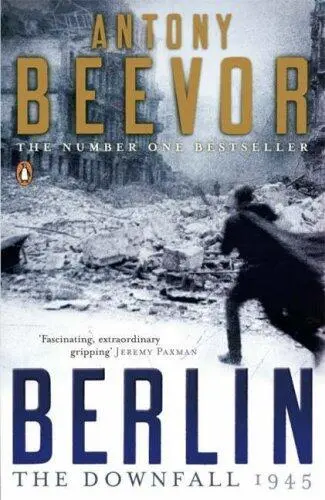
- Название:Berlin: The Downfall 1945
- Автор:
- Издательство:Penguin Books
- Жанр:
- Год:2007
- Город:New York
- ISBN:978-0-141-90302-6
- Рейтинг книги:3 / 5. Голосов: 1
-
Избранное:Добавить в избранное
- Отзывы:
-
Ваша оценка:
Berlin: The Downfall 1945: краткое содержание, описание и аннотация
Предлагаем к чтению аннотацию, описание, краткое содержание или предисловие (зависит от того, что написал сам автор книги «Berlin: The Downfall 1945»). Если вы не нашли необходимую информацию о книге — напишите в комментариях, мы постараемся отыскать её.
Antony Beevor reconstructs the experiences of those millions caught up in the nightmare of the Third Reich's final collapse, telling a terrible story of pride, stupidity, fanatacism, revenge and savagery, but also one of astonishing endurance, self-sacrifice and survival against all odds.
Berlin: The Downfall 1945 — читать онлайн бесплатно полную книгу (весь текст) целиком
Ниже представлен текст книги, разбитый по страницам. Система сохранения места последней прочитанной страницы, позволяет с удобством читать онлайн бесплатно книгу «Berlin: The Downfall 1945», без необходимости каждый раз заново искать на чём Вы остановились. Поставьте закладку, и сможете в любой момент перейти на страницу, на которой закончили чтение.
Интервал:
Закладка:
‘We’re not cold, Herr Oberleutnant,’ the man replied. ‘We’re afraid.’
Back in Berlin, safely behind the lines, Martin Bormann sent an eve of battle message to the Gauleiters. He ordered them to sort out the ‘rabbit-hearted’. In the centre of the city, trams were manhandled across the street, then filled with brick and rubble as instant barricades. The Volkssturm was called out. Some of them had to wear blue-grey French helmets and even uniforms. It was the last of the booty from the great German victories in 1940 and 1941.
Hitler was not alone in looking back to the Seven Years War. Pravda had already published an article trumpeting the Russian entry into Berlin on 9 October 1760 with five Cossack regiments in the vanguard. ‘The keys of the city were taken to St Petersburg for permanent keeping in the Kazansky Cathedral. We should remember this historic example and fulfil the order of the Motherland and Comrade Stalin.’ General Chuikov’s 8th Guards Army were given large key shapes cut out of cardboard to remind the troops of this moment as they prepared to go into the attack.
More modern symbols were also distributed in the form of red banners. These were issued to the attacking divisions. They were to be raised on significant buildings in Berlin and indicated on a large model of the city built by Front engineers. ‘Socialist competition’ was expected to push men forward to even greater sacrifice, and the greatest glory would go to those who stormed the Reichstag, the objective which Stalin had selected to represent the total conquest of the ‘lair of the fascist beast’. That evening, in what amounted to a mass secular baptism, over 2,000 Red Army soldiers of the 1st Belorussian Front were received into the Communist Party.
Even though Soviet commanders did not doubt that they would break through, they were extremely nervous that the American and British armies might make it to Berlin first. Such an eventuality was seen as worse than a humiliation. Berlin belonged to the Soviet Union by right of suffering as well as by right of conquest. Each army commander had been left in no doubt of the feelings of the Verkhovny, their commander-in-chief, waiting impatiently in the Kremlin. They did not, however, know quite how disturbed Stalin was. Inaccurate newspaper reports in the western press claimed that American point units had reached Berlin on the evening of 13 April, but these detachments had then been withdrawn after protests from Moscow.
Only Zhukov and Konev and a few of their closest colleagues knew that the strategy of the whole Berlin operation was designed to surround the city first in order to warn off the Americans and British. But even the two Front commanders were unaware of the importance Stalin and Beria evidently attached to seizing the institutes of nuclear research, particularly the Kaiser Wilhelm Institute for Physics in Dahlem.
On the eve of battle, Stalin in Moscow maintained his shield of lies. General Deane reported on another session in the Kremlin in an ‘Eyes only for Eisenhower’ signal. At the end of a long meeting about the ‘other matter’ (the future deployment of Soviet forces in the Far East against the Japanese), ‘Harriman mentioned that the Germans had announced that the Russians were planning an immediate renewal of their attack directed against Berlin. The Marshal [Stalin] stated that they were in fact going to begin an offensive; that he did not know how successful it would be, but the main blow would be in the direction of Dresden, as he had already told Eisenhower.’
Stalin and his entourage must have concealed their nervousness well. Neither Deane nor Harriman sensed that they were being lied to. The evening before, at a meeting with the Stavka, General Antonov seized upon a line in Eisenhower’s latest message about the avoidance of confusion between western forces and the Red Army. He immediately wanted to know ‘if this indicated any change in the zone of occupation previously agreed upon’. When he was assured that the reference was to tactical areas and that no change was implied in the zones of occupation, ‘Antonov requested that confirmation be obtained from Eisenhower on this point.’ The Soviet chief of staff then wanted to verify that ‘upon completion of tactical operations the Anglo-American forces would withdraw from the previously agreed Soviet zone of occupation’. This was reconfirmed to him in a signal from Eisenhower on 16 April.
For Red Army soldiers, their first priority was a shave to make themselves presentable conquerors. While there was still enough daylight, those not on duty scraped away with cutthroat razors while squinting into a broken fragment of mirror. Few could sleep. ‘Some of them shaded torches with their coats as they wrote letters home,’ wrote an officer in the 3rd Shock Army. Their letters tended to be brief and uninformative. ‘Greetings from the front,’ ran a typical one. ‘I am alive and healthy. We are not far from Berlin. Severe battles are going on, but soon the order will come, and we will advance to Berlin. We will have to storm it and I will see if I am still alive by then.’
Many wrote not to parents or to fiancées but to pen-pals. Thousands of lonely young women drafted to work in armaments factories out in the Urals or Siberia had been writing to soldiers at the front. Snapshots were exchanged at a certain stage in the relationship, but sex was not the driving force. For soldiers, a woman somewhere at home was the only thing left to remind them that a normal life could still exist. Sergeant Vlasienko in the 1st Ukrainian Front wrote a pen-pal song in epistolary form. It was set to the haunting melody of ‘ Zemlyanka, the great wartime song set in a frozen bunker ‘just four steps from death’.
The hurricane lamp is driving away darkness,
Making a way for my pen.
You and I are close through this letter.
We are like a brother and a sister.
I long for you from the front
And I will find you when these days of fighting are over
Deep in the homeland
If only I survive.
And if the worst happens
If the days of my life are counted
Remember me sometimes
Remember me with a kind word.
Well, goodbye for now.
It is time for me to go to attack the Germans
And I want to carry your name forward
If only in my battle-cry ‘ Ura!’
‘Wait for Me’, one of the most popular songs of the war, was based on the poem which made Konstantin Simonov famous in 1942. It evoked the Red Army’s quasi-religious superstition that if a girlfriend remained faithful, the soldier would stay alive. It was permitted by the authorities only because it strengthened military patriotism. Many soldiers kept ‘Wait for Me’ written on a piece of paper in their left breast pocket, and read it silently to themselves like a prayer in the moments before they went into the attack.
The song ‘Blue Shawl’, about a faithful girl’s farewell to her soldier lover, also produced such intense loyalty that many soldiers added it to the official battle-cry, making it ‘Za Rodinu, za Stalina, za Siny Platochek! ’ — ‘For the Motherland, for Stalin, for the Blue Shawl!’ A great number of Komsomol members still carried newspaper cuttings with a photograph of Zoya Kosmodemyanskaya, the young Komsomol partisan ‘tortured to death by Germans’. Many wrote ‘for Zoya’ on their tanks and aircraft.
Another poem of Simonov’s, on the other hand, was condemned as ‘indecent’, ‘vulgar’ and ‘bad for morale’. It was ironically entitled ‘Liricheskoe’, or ‘Lyrical’.
They remember names for an hour.
Memories here do not last for long.
Man says ‘War…’, and embraces a woman carelessly.
He is grateful to those who had so easily,
Without wanting to be called ‘darling’,
Replaced for him another one who is far away.
Here she was as compassionate as she could be to other women’s loved ones,
And warmed them in bad times with the generosity of her uncommitted body.
And for those waiting to go into the attack,
Those who may never live to see love,
They find it easier when they remember that yesterday
At least someone’s arms were around them.
Интервал:
Закладка:
Похожие книги на «Berlin: The Downfall 1945»
Представляем Вашему вниманию похожие книги на «Berlin: The Downfall 1945» списком для выбора. Мы отобрали схожую по названию и смыслу литературу в надежде предоставить читателям больше вариантов отыскать новые, интересные, ещё непрочитанные произведения.




Обсуждение, отзывы о книге «Berlin: The Downfall 1945» и просто собственные мнения читателей. Оставьте ваши комментарии, напишите, что Вы думаете о произведении, его смысле или главных героях. Укажите что конкретно понравилось, а что нет, и почему Вы так считаете.